
LC Ideas: Views & Insights
Making Complexity Investable
Bernadette Gostelow, VP of Asset Management, Lighthouse Canton

Asia’s fragmented credit markets reward managers that can translate bespoke risks into investable opportunities.
Markets that are difficult to standardise are difficult to commoditise. For managers with the infrastructure to originate and underwrite that complexity, what looks like a constraint can become a source of differentiation.
This is why the evolution of Asian private credit is unlikely to resemble a simple convergence towards the Western model. Compared with the sponsor-backed direct lending markets in US and Europe, a substantial share of Asian private credit deal flow is bilateral and sponsorless.
Asian private credit is like prime real estate: location is king. Fragmented legal regimes, cross-border enforcement hurdles and differing business practices mean that scale depends on the depth of a manager’s local networks, not merely the breadth of its regional footprint.
The numbers make the structural gap concrete:
Metric / Structural Driver | United States | Europe | Asia Pacific |
Private Equity to Private Credit AUM | 5.2x | 3.5x | 30.8x |
Sponsor-backed share of Private Credit deals | ~70% in 2023 | 89% UK; 85% rest of Europe in Q3 2022 | ~10% sponsor-backed / 90% non-sponsored |
Typical origination model | Predominantly sponsor-led; competitive or club-based processes | Predominantly sponsor-led direct lending | Predominantly non-sponsored; bilateral or small-club transactions |
Sources and Definitions: AUM ratios are based on Preqin data as of 31 March 2023 and include Australia within APAC. US and European sponsor shares are the figures cited by ADM Capital from US market data and Deloitte’s European Direct Lending Deal Tracker. The APAC figure is sourced to AIMA’s Private Credit in Asia 2.0.
The above comparison reflects the various stages and structures of three different markets. As of March 2023, private equity AUM was 30.8x private debt AUM in APAC while this figure equaled 5.2x and 3.5x in the US as well as Europe. Western direct lending turned out to be notably more sponsor-driven: around 70% of private credit deals made in the US in 2023 were sponsor-heavy while the number accounted for 89% in the UK and 85% in continental Europe in Q3 2022. In contrast, around 90% of private credit transactions in APAC were initiated without backing from private equity. As a result, Asian origination is more frequently bilateral or conducted through small clubs, with lenders structuring directly with companies, founders and other controlling shareholders rather than financing a conventional sponsor-led auction.
Scale may not come from ever-larger sponsor-backed or conglomerate transactions. It may instead come from managers aggregating a set of fragmented opportunities: matching the right risk to the right capital and using structures to bridge funding gaps that banks and conventional capital cannot fill.
But that does not mean the market cannot be made more efficient. Some elements, such as documentation standards and aspects of distribution, can be standardised even if the underlying credit cannot. The differentiator will be the ability to combine those repeatable processes with underwriting that remains flexible enough to accommodate local and transaction specific risks.
The challenge, then, is not simply to scale Asian private credit. It is to translate it.
In Asia, “scale” may depend less on finding a single natural holder for an entire transaction than on disaggregating the risks and matching each layer to the capital best suited to hold it.
A bank may be the cheapest natural holder of senior operating risk but unwilling to take subordinated risk.
An insurer may prefer long-duration, highly contracted cash flows.
A family office may be willing to own a bespoke tranche but lack the infrastructure to originate it directly.
The manager makes those pools interoperable. They underwrite the borrower holistically, separate the financing requirement into distinct risk layers, design a common security and covenant framework, and place each layer with its natural holder: the bank, the insurer or the family office. That takes local sourcing and underwriting depth. In doing so, the manager converts a financing requirement that no single institution may be willing to fund into a transaction that several investors can underwrite on different terms.
The prevalence and form of bank-fund partnerships vary considerably across Asia, with Australia among the region’s more developed non-bank lending markets. It could therefore become an area of growth as the market develops.
The Manager as an Intermediary and Translator
The manager’s role increasingly resembles that of a translator: converting a borrower’s financing requirement into different types of risk that different pools of capital can understand and underwrite.
The key is not simply access to a larger pool of capital. It is knowing which capital can absorb which risk, and structuring the transaction accordingly. This is particularly evident where borrowers may need financing below the minimum scale or outside the risk parameters that larger institutional pools of capital can accommodate.
Complexity is not an inefficiency or investment advantage per se. Where pricing and structural protections compensate for the additional diligence, monitoring and enforcement burden, they can also create barriers to entry and make specialist expertise commercially valuable.
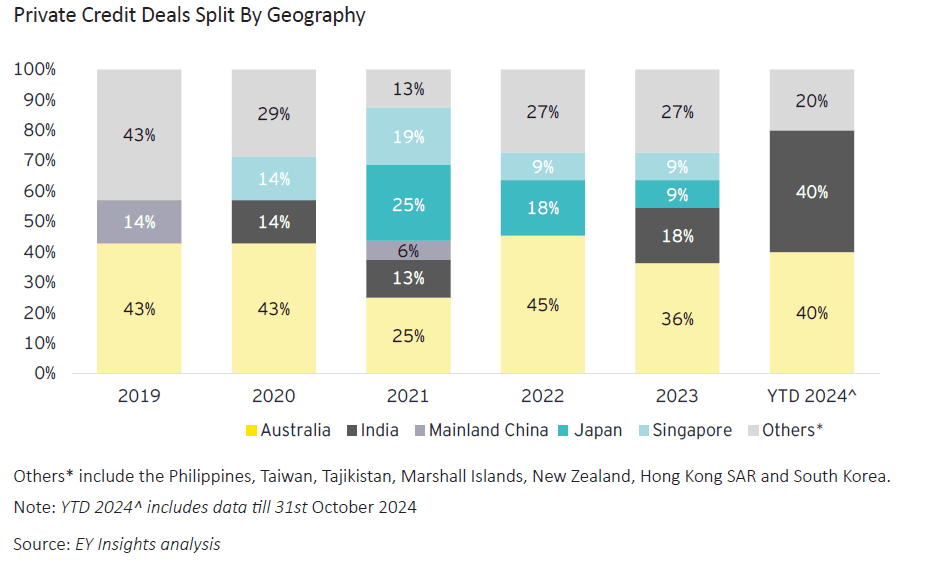
The geographic composition of reported Asia-Pacific private-credit activity can shift quickly. Japan’s share of deal count fell from 25% in 2021 to 9% in 2023, while India’s increased from 13% to 18% over the same period before reaching 40% in the first ten months of 2024. These movements reflect differences in macro conditions, banking capacity and borrower demand across the region, although disclosed deal counts can also be affected by reporting coverage and a relatively small number of transactions.
Why local underwriting is heterogenous in APAC
A succession financing for a Japanese SME may require close analysis of ownership transition, governance and collateral liquidity.
A Korean restructuring may instead turn on creditor coordination and the applicable restructuring process.
A Vietnamese structured facility may require an offshore-onshore security architecture, regulatory approvals and management of currency convertibility
An Indonesian growth financing may depend more heavily on sector-specific licences, cash-flow controls and enforceability.
These differences are not only jurisdictional. They also persist across sectors within the same market: underwriting an Indonesian real-estate transaction requires a different knowledge base from underwriting an Indonesian telecommunications company. The challenge for managers is to build sufficient local and sector depth without creating an uneconomic cost base.
The ability to navigate these differences can become a defensible capability.
The opportunity, therefore, is not to eliminate complexity but to make it manageable.
Asian private credit does not need to replicate the Western sponsor-backed model to become institutional. It needs an intermediation model capable of making fragmented risk palatable to different pools of capital.
The opportunity lies not in complexity itself, but in the ability to price, structure, and distribute sources of capital. This would be the key differentiator for managers, and bank-fund partnerships may be the most immediate opportunity.
Between the appetite and the deployment still falls the shadow. The next phase of Asian private credit will belong to the managers capable of crossing it.