
LC Ideas: Views & Insights
The Succession Questions a Will Cannot Answer

Table of Contents
Tan Kiam Toen and his wife had put their wish for family harmony in writing. Their children, their joint will said, “should respect each other and live in harmony”. The bulk of the couple’s estate would ultimately go to charity.
Yet the legacy of the businessman became the subject of litigation between his eldest daughter and her four siblings. Among the contested assets were shares in Afro-Asia Shipping. The siblings disagreed over whether assets registered in particular family members’ names belonged to them or formed part of their father’s estate.
In its 2017 judgement, Singapore’s Court of Appeal noted the shortage of clear, objective evidence, partly because of the informal way the family business had been run. It upheld the finding that the disputed Afro-Asia Shipping shares were beneficially owned by family members in specified proportions.
The case illustrates a question that comes before deciding who inherits: what does each person own?
For Southeast Asian families preparing to transfer wealth, that distinction is important.
A will sets out how a person’s estate should be distributed. It cannot, by itself, settle every question about earlier transfers, shared ownership or how a business will be governed after the founder is gone.
The timetable is tightening.
BCG’s 2026 Global Wealth Report notes that 40% to 50% of major enterprises across Singapore, Malaysia and Indonesia remain under founder leadership, with median leadership ages above 70.
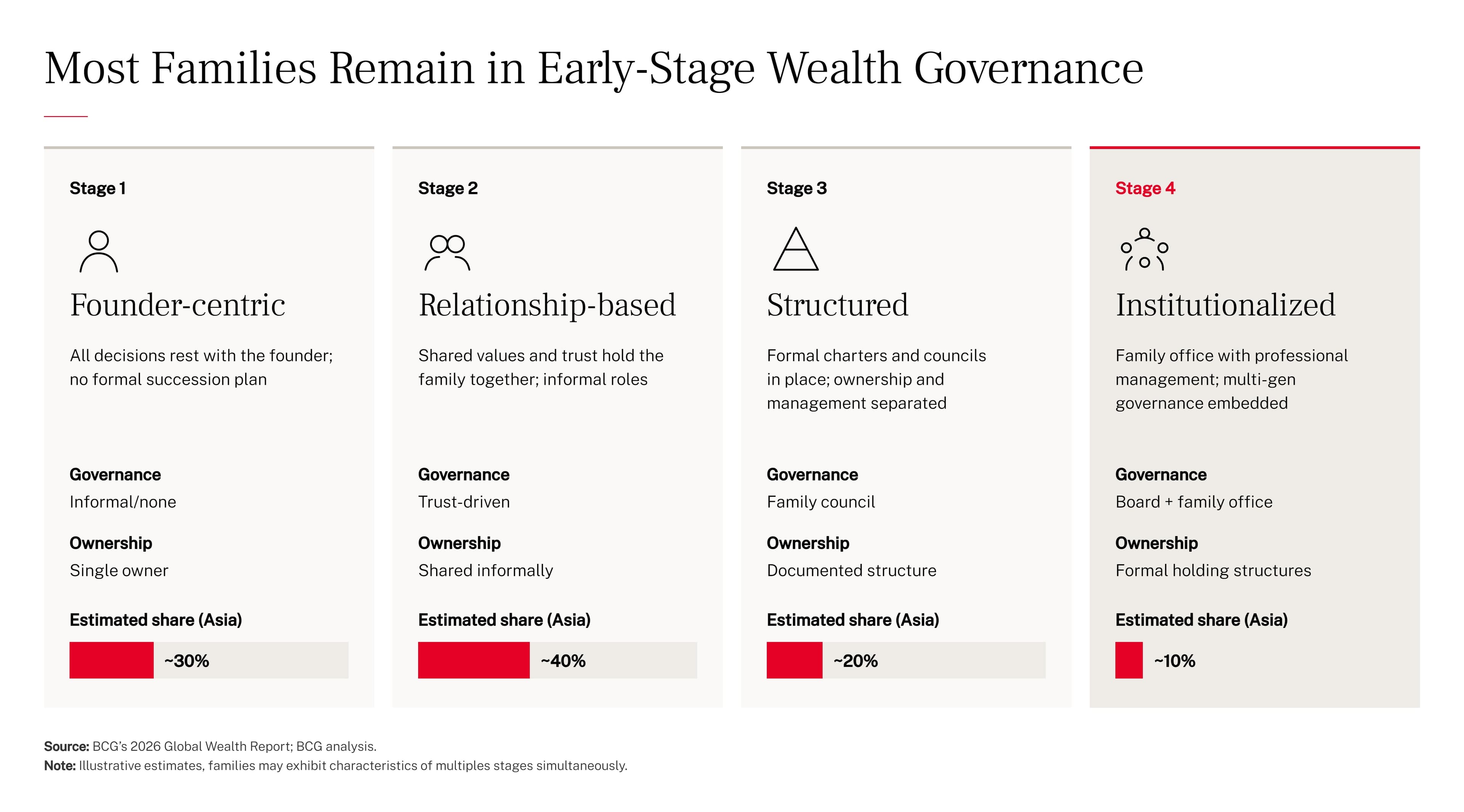
Meanwhile, Deloitte Private’s 2024 Asia Pacific survey found that 37% of respondent families had no succession plan. That finding covers 89 single family offices across the wider region, rather than Southeast Asian families as a whole.
Preparing for succession means making ownership, expectations and decision-making explicit while the people who shaped them can still explain what they intended.
For a founder who has spent decades building a business, preparing someone else to lead it involves questions about continuity, responsibility and the preservation of what has been built. A transition can recognise that contribution while giving successors time to develop their own judgement.
“For many entrepreneurs, the business is not merely an asset; it represents decades of hard work, personal sacrifice and identity. Letting go is therefore as much an emotional decision as it is a financial one,” said Angela Saik, Managing Director, Wealth Management, at Lighthouse Canton.
“Our role is to help founders understand that succession does not necessarily mean surrendering control overnight. It is about creating a gradual and thoughtful transition that allows the next generation to develop the confidence and capability to take over.”
What the family owns and what it assumes
In a founder-led business, an arrangement can work for years because everyone knows whom to ask. Shares may be held in one relative’s name, another may manage the business, and the founder may remain the person whose approval matters most.
“There can be a lot of assumptions about what the founder intends, what the children expect, and what everyone considers fair. These assumptions may coexist peacefully for years until circumstances force the family to confront them,” Saik said.
An early conversation gives the family time to compare those expectations with its existing ownership arrangements and resolve any differences while the founder can explain the original intent.
An ownership review should therefore go beyond a list of accounts and properties.
It should record the registered owner,
any trust or nominee arrangements,
the intended beneficiaries and the documents supporting those arrangements.
Earlier gifts, loans and share transfers deserve particular attention. Was a transfer intended to give someone wealth outright, or merely to let them hold or administer it?
This is sensitive work because an asset register can expose differences the family has avoided discussing.
Respect for parents can make these discussions particularly delicate. Family members need a way to ask questions without the conversation becoming a challenge to the founder’s judgement.
“In many Asian families, respect for the older generation is deeply ingrained. Children may hesitate to question their parents’ decisions, particularly when it comes to family wealth. But silence should never be mistaken for agreement,” Saik said.
Giving family members opportunities to express their expectations separately can help identify differences before discussing them together. Legal advisers can then clarify which expectations are supported by ownership records and which require new arrangements.
The first successor may be a spouse
Families often picture succession as a transfer from parents to children. But a surviving spouse may take responsibility first. This transfer within the same generation is sometimes called horizontal succession; a transfer to children or grandchildren is intergenerational succession.
The two need to be planned together. A spouse may need income and financial independence for many years, while children expect to receive or help manage some of the same assets.
A Singapore judgement involving the Wibawa family shows how these expectations can diverge. Purnakarya Wibawa, an Indonesian businessman, died in 2000. His widow argued that they had understood the surviving spouse would receive the money and investments from their business. His will, however, allocated half the residuary estate to her and the rest among their children. The court rejected the claimed understanding.
The dispute also involved assets placed into a Jersey trust. In the 2016 High Court decision, the son’s claim against his mother failed, with the court finding that he had concurred in and acquiesced to the arrangements.
The planning lesson is to reconcile the spouse’s expectations, the children’s entitlements and the proposed structures before implementation. Families should discuss who needs income immediately, who will oversee investments and what discretion anyone administering the assets will have. The spouse should be part of those conversations, with a clear understanding of both the family’s finances and their own position.
Equal inheritance - unequal responsibilities
Passing wealth to several heirs creates another decision for the family: how to recognise their different needs and contributions when deciding what each should receive.
“One of the most delicate conversations in succession planning is the difference between equality and fairness. Dividing assets equally may seem like the simplest solution, but it does not necessarily reflect the different roles, contributions and needs of family members,” Saik said.
An arrangement needs to account for how family members will use the wealth and the responsibilities they will carry. Those differences become clearer when ownership, management and income needs are considered separately.
Two siblings can inherit equal economic interests while having very different commitments to a company. One may have spent twenty years running it; the other may live overseas and depend on its dividends. The first may favour reinvestment, while the second needs distributions. Both positions can be reasonable.
This hypothetical example exposes decisions an equal division of shares does not resolve: who appoints management, who approves dividends, how the working sibling is paid and how either owner can exit.
Families should distinguish the right to benefit economically from the authority to make decisions and the responsibility to manage the business. A family charter can record employment criteria and shared expectations. A shareholders’ agreement can address voting, transfers and exit arrangements. A board oversees the company, while a family council provides a forum for matters affecting the family collectively.
These tools serve different purposes.
A charter does not automatically give an expectation legal force, and a trust or holding company requires legal and tax assessment against the family’s circumstances. The choice should follow agreement on what the family wants to achieve.
Preparation also means involving heirs before they assume formal responsibility.
Lighthouse Canton’s focus on building relationships with younger family members early can help bring their ambitions into the discussion before roles are settled.
A practical way for families to support that development is to give heirs supervised exposure to investment decisions or board discussions, with responsibilities that grow as their understanding develops.
Make the plan work on the first difficult day
Succession arrangements must also function when a family is grieving, a principal is incapacitated or markets are under pressure.
Start by testing a practical scenario: if the main decisionmaker could no longer act tomorrow, who could pay household expenses, oversee the company and authorise investment decisions? Who would know where the documents were held?
A large estate may offer little immediate flexibility if most of its value sits in property or business shares. Families should assess accessible liquidity against household needs, debt and investment commitments, and any planned payments to heirs who will not retain business interests. They should also review the authority needed to act during incapacity, separately from arrangements that take effect on death.
A multi-family office can help bring the portfolio, business interests and family priorities into one discussion, coordinating with legal, tax and governance specialists. The useful output is a set of decisions with named responsibilities: who maintains the ownership records, who prepares the spouse and successors, and who checks that documents and financial arrangements work together.
The next review should test what has changed since those decisions were made. A marriage, relocation, business sale or heir’s decision to pursue a different career can alter a plan that once made sense. Each change is an opportunity to resolve a difficult question while the family can still answer it together.
How can Lighthouse Canton help your family prepare?
We have avoided discussing succession. Where do we begin?
Lighthouse Canton can bring an independent perspective to the family discussion. Start by identifying the decisions that cannot be postponed: who wants to remain involved in the business, who needs income, and where family members have different expectations. A structure can then be assessed against those objectives.
Our decisions span the business and personal wealth. Who brings the advice together?
The Lighthouse Canton team can bring external specialists into discussions as they develop. This allows commercial and investment priorities to be considered alongside the legal, tax and governance questions that require specialist advice. The family needs clarity on how a decision in one area affects the others.
How do we involve the next generation before the handover?
Lighthouse Canton’s emphasis on building relationships with younger family members early provides a starting point for understanding their ambitions. It allows the discussion to include the people who will eventually own or oversee the assets, alongside the founder, rather than waiting until a handover
Disclaimer: Lighthouse Canton Pte Ltd. (“LCPL”) is incorporated in the Republic of Singapore (Registration No: 201422117K) and regulated by the Monetary Authority of Singapore (Capital Markets Services Licence No. CMS100443). Lighthouse Canton Capital (DIFC) Pte Ltd (“LCC”) is incorporated in Dubai International Financial Centre (Licence No. CL 2614) and regulated by Dubai Financial Services Authority (Category 3C Licence No. F004068). The financial products offered by LCPL and LCC are only available to Accredited Investors and Institutional Investors as defined by MAS and Professional Investors as defined by DFSA. The information in this electronic transmission does not constitute an offer, or intention by, or on behalf of LCPL and/or LCC, to subscribe, purchase or sell any financial products and/or services. LCPL and LCC accept no liability for any loss arising from the use of any information contained herein. The contents of this email are confidential and meant for the intended recipient only.


