
Investment Insights
Evidence, Not a Verdict: Understanding Recency Bias in Alternatives
Edmund Tan, Senior Vice President - Investments & Products

Executive Summary
A year ago, the Milwaukee Brewers were cast as the team that couldn’t win in October. This October, they became World Series champions. Their regular-season record, the best in baseball two years running, said the same thing throughout; only the narrative swung. That gap is recency bias: letting the latest, most vivid result outweigh the fuller record. The antidote is not to ignore recent results but to read them along more dimensions: against what a strategy is designed to do, over rolling periods rather than single snapshots, and alongside any change in the people and process behind them.
Recent results are evidence, not a verdict.
The Elephant in the Room
Every baseball season produces two kinds of story. One is told over 162 games, the other over a handful.
Entering the postseason, the Brewers had led the majors in wins for a second straight season, with a franchise-record 103. Yet much of the commentary around them leaned on a single memory: being swept by the Dodgers in last year’s National League Championship Series. A club with a mid-table payroll and few home runs was widely seen as the kind of team that struggles when it matters most. Eleven wins in thirteen postseason games later, the same commentary is rewriting the story in the opposite direction.
Investors will recognise the pattern. The trailing twelve-month return features prominently on most factsheets and in most market conversations. A strong year can make a strategy feel inevitable, and a softer one can make it feel broken. The instinct is understandable: the latest data point feels like the truest picture because it is the one we experienced most vividly. The allocator’s question is not whether to look at it, but how much weight it deserves.
Why Recency Bias Exists
Recency bias is less a flaw in judgement than a shortcut that usually works. In most of life, the newest information is the most relevant. Markets change too: rate cycles turn, opportunity sets widen and narrow, and a strategy’s most recent results can reflect something genuinely new.
The difficulty is that short periods blend two things: the quality of a process and the circumstances it happened to meet. Over twelve months, circumstance often dominates. The same disciplined manager can look exceptional in a year that suits the approach and ordinary in one that doesn’t, without anything about the process having changed. A longer record lets those circumstances average out. A single year rarely does.
How It Works in Practice
The most useful question to ask of any new information is whether it describes a result or a change. A result is the outcome of a period: vivid, recent, widely quoted. A change is a shift in what produces outcomes, such as new people, a different process, or a broader mandate. Results over short windows are mixed with circumstance. Changes to the inputs are meaningful as soon as they occur.
Allocators read manager updates with that distinction in mind. The headline is the starting point, and the question behind it does the work.
The headline | The allocator’s question |
|---|---|
A strong twelve months | Did the environment suit the approach, or has something in the process improved? |
A softer twelve months | Is this how the strategy is designed to behave in this environment? |
A style moving out of favour | Is the opportunity set changing, or just the cycle? |
A change in the team | How does this change the way the strategy behaves from here? |
Most of the time, the answer is that the strategy is behaving as designed, and that is useful information in itself. Changes to people and process, more than results, are what prompt a fresh look.
The Allocator’s Lens
Headline performance is usually quoted along one dimension: return over the latest period. Allocators read it along several.
Consistency. Every strategy has strong and weak months and quarters. Rolling three- and five-year windows show how reliably a process delivers what it is designed to, without the starting-point luck that any single calendar year carries.
Context. A result means more when read against the environment it met. A strategy trailing a market it isn’t built for is behaving as designed.
Change. Shifts in people, process, or strategy are real information whenever they arrive, whatever the latest return says.
A well-documented example shows all three, and one more: that even a single company can be measured in more than one way. In 1999, by Warren Buffett’s own account, Berkshire Hathaway had its weakest year relative to the S&P 500. Per-share book value rose 0.5% against 21.0% for the index. The share price fared worse, falling 19.9%, and by December commentators were asking whether his touch had faded. The two numbers told different stories: the price reflected how the market felt, while book value reflected what the business had added on its books. Neither is the whole picture, and Buffett himself treated book value as a better long-term gauge than a single-year yardstick. But the gap between them is the point. A headline tends to follow whichever number moves most.
Over the next three years, the index fell every year. Berkshire finished ahead of it on both measures each time, with the share price up 26.6% and 6.5% in the first two years and down 3.8% in the third, against index declines of 9.1%, 11.9% and 22.1%. Judged as a single year, 1999 looked like a verdict. Judged on a rolling basis, it was a chapter.
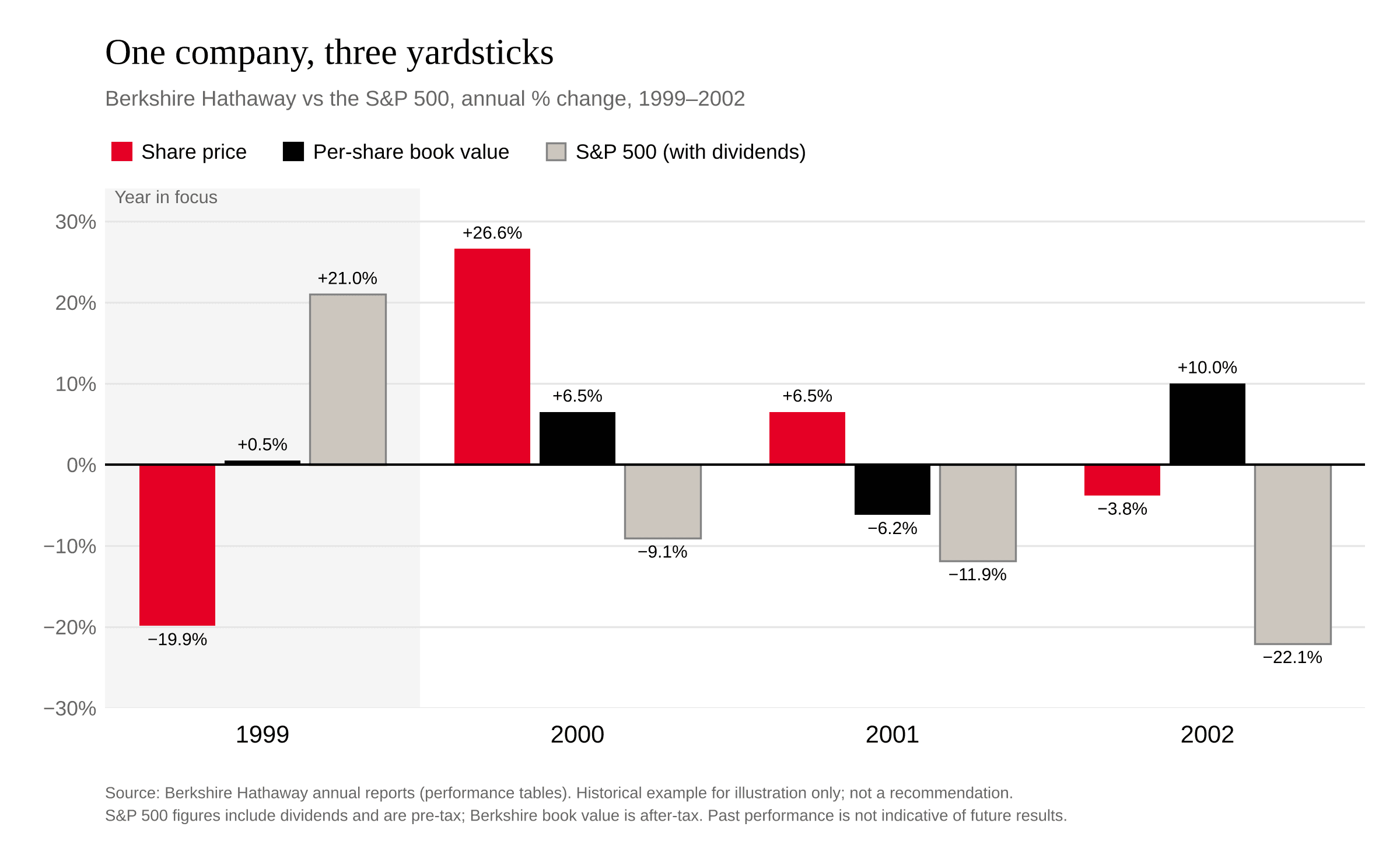
[Figure 1: Berkshire Hathaway, annual % change in per-share book value and share price vs. S&P 500 (with dividends), 1999–2002. Source: Berkshire Hathaway annual reports. Historical example for illustration only. S&P 500 figures are pre-tax; Berkshire book value is after-tax.]
Lighthouse Canton Perspective
At Lighthouse Canton, the shelf is assessed the way a season is: across many observations, not one. Our reviews look at performance over rolling periods and across different market environments, alongside the inputs that tend to persist: the people, the consistency of the investment process, the operational backbone, and the alignment of incentives between manager and investor. A strong or soft quarter is read against what each strategy is designed to do. A material change to those inputs prompts a fresh look, whichever direction returns have moved. The aim is a shelf judged over seasons, not series.
Disclaimer: Lighthouse Canton Pte Ltd. (“LCPL”) is incorporated in the Republic of Singapore (Registration No: 201422117K) and regulated by the Monetary Authority of Singapore (Capital Markets Services Licence No. CMS100443). Lighthouse Canton Capital (DIFC) Pte Ltd (“LCC”) is incorporated in Dubai International Financial Centre (Licence No. CL 2614) and regulated by Dubai Financial Services Authority (Category 3C Licence No. F004068). The financial products offered by LCPL and LCC are only available to Accredited Investors and Institutional Investors as defined by MAS and Professional Investors as defined by DFSA. The information in this electronic transmission does not constitute an offer, or intention by, or on behalf of LCPL and/or LCC, to subscribe, purchase or sell any financial products and/or services. LCPL and LCC accept no liability for any loss arising from the use of any information contained herein. The contents of this email are confidential and meant for the intended recipient only.


