
Investment Insights
Anthropic's S-1: Reading the Frontier-Lab Economics
Drishtant Chakraberty, CFA, Vice President, Equity Research

Table of Contents
Anthropic's public S-1, filed 26 October 2026, is the first real look under the hood of a frontier AI lab's unit economics and on our read, the numbers argue for a constructive view on the business, with a positive read-through for the AI hardware ecosystem more broadly.
Overview
Anthropic’s S-1 lays out four years of financial history that tell a clean story: revenue has gone from effectively nothing to $16.3bn in a single half-year, operating losses have narrowed even as that revenue has grown fourteen-fold year over year, and the business posted its first-ever half-year of positive operating cash flow in H1 2026. Those three facts, taken together, are the foundation for a constructive view on the underlying business, one we are comfortable setting out plainly here: Anthropic looks, on the numbers it has actually disclosed, like a company moving steadily toward the kind of operating leverage that eventually produces durable profitability and free cash flow, and the pace at which it is getting there is unusual even by the standards of the fastest-growing software businesses we have covered.
The sections that follow build out the case in more detail. We look at how much revenue the business now generates for every dollar it spends on compute, a metric we think is as important to the hardware ecosystem as it is to Anthropic itself; we explain why the reported gross margin materially understates the improvement in the underlying inferencing economics; we address the customer concentration concerns that circulated ahead of the filing and that the disclosed figures do not support; and we point to a near-term signal from outside the S-1, Anthropic’s recent reacceleration on OpenRouter, that corroborates the growth story the filing tells. We close with what we think this means for the broader AI hardware trade.
The Numbers at a Glance
Anthropic’s revenue is compounding far faster than its losses: $41m in 2023, $386m in 2024, $4.6bn in 2025, and $16.3bn in H1 2026 alone — a 14x year-on-year increase and already 3.6x all of FY2025. Operating loss, which had widened every year through 2025, reversed course in H1 2026: down to $693m from $2.1bn a year earlier, despite the revenue surge.
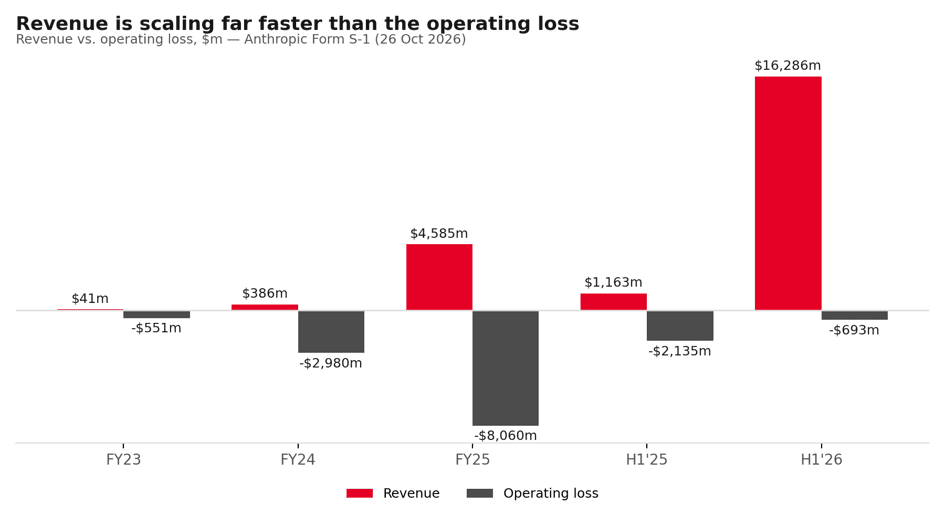
Source: Anthropic, PBC Form S-1, filed 26 Oct 2026.
The more important inflection sits below the operating line. Operating cash flow turned positive for the first time in H1 2026, at +$3.9bn, against -$1.5bn in H1 2025 — a swing of over $5bn in a single year. The reported GAAP net loss of $80.7bn for the half is real, but it is overwhelmingly a non-cash fair-value remeasurement of SAFEs and convertible notes (-$72.4bn) that moves mechanically with Anthropic’s own rising valuation, not a reflection of the operating business. Strip that out and the underlying trend is one of narrowing losses, positive operating cash flow, accelerating revenue, which is the more useful signal for where this business is headed.
Compute Efficiency Is Inflecting
The single most useful lens on frontier-lab economics is simple: how much revenue does the business generate for every dollar it spends on compute and infrastructure? On that measure, Anthropic’s trajectory is striking. Revenue per dollar of total compute and infrastructure spend has moved from roughly $0.09–$0.15 in 2023–2024 to $0.63 in FY2025 and $1.82 in H1 2026.
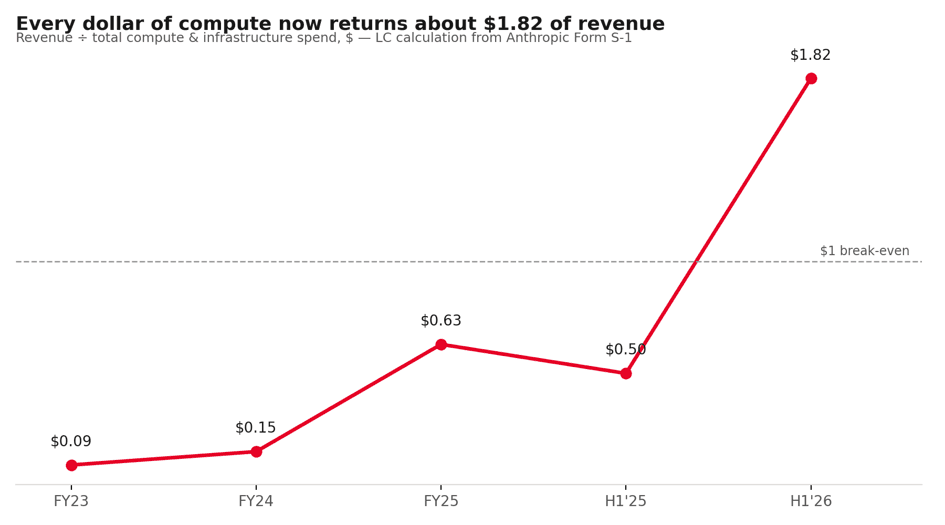
Source: LC calculation from Anthropic, PBC Form S-1, filed 26 Oct 2026.
We would not be surprised if this ratio continues to improve as the business scales, model efficiency gains compound, and a growing share of total compute spend shifts from training (a sunk, largely fixed cost per model generation) toward inference against an expanding revenue base. If that holds, it is a constructive signal not just for Anthropic but for the hardware ecosystem supplying it: a lab that generates more than a dollar of revenue for every dollar of compute has a structural incentive to keep buying compute as long as demand holds up, which is exactly the dynamic we are seeing play out in 2026’s wave of multi-year infrastructure commitments.
That dynamic shows up in Anthropic’s willingness to pay premium prices for incremental capacity. Anthropic’s compute agreement with SpaceX reportedly runs to roughly $15bn a year for about 400MW of capacity, equivalent to roughly $40bn per GW, well above the $20–$24bn per GW Anthropic is estimated to generate in revenue per GW of its installed base, and above the $15–$20bn per GW generally viewed as the threshold for a GPU owner to earn a solid return on current-generation hardware. Anthropic is evidently willing to pay a structural premium for marginal capacity because the underlying blended economics justify it, and compute owners from hyperscalers to neoclouds are capturing real pricing power as a result.
Gross Margins: The Reported Number Understates the Real Trend
Anthropic’s reported cost of revenue excludes the bulk of its model-training compute, which is booked instead to R&D. We think that treatment understates the real picture: training cost is fundamentally part of the cost of generating revenue from a given model generation, and in our view belongs in COGS.
Period | Revenue ($m) | Cost of revenue ($m) | Reported gross margin |
FY23 | 41 | 26 | 37% |
FY24 | 386 | 752 | (95)% |
FY25 | 4,585 | 2,773 | 40% |
H1 25 | 1,163 | 1,019 | 12% |
H1 26 | 16,286 | 2,380 | 85% |
Two things are true at once here. First, the reported gross margin swing from 12% to 85% across H1 2025 to H1 2026 is the clearest evidence in the filing of improving inferencing economics: the compute cost of actually serving Claude to customers is falling sharply relative to the revenue it generates. That is the number we would watch most closely, because it isolates the part of the cost base that scales with usage today.
Second, even if training cost were fully loaded into COGS, we would expect the combined margin to keep improving for a structural reason: training cost per model generation is a largely fixed, front-loaded cost, while the inferencing revenue that cost supports keeps compounding for as long as that model (and its successors built on the same research) stays in commercial use. As the business scales, a growing base of inferencing revenue should spread a training cost base that grows more slowly than revenue, the textbook definition of operating leverage. We think the past four years of disclosed figures already show this leverage building, and capturing it fully is, in our view, the key swing factor for Anthropic’s path to sustained profitability and free cash flow. The progressive reduction in the cost of generating a token via newer, more efficient hardware and continued software gains in inferencing efficiency and throughput is the mechanism we expect to keep driving it.
Customer Concentration: The Fear That Didn’t Show Up
Going into the filing, one of the more common worries about Anthropic’s business was customer concentration — that a small number of large accounts (or a handful of distillation-driven resellers) might account for an outsized share of revenue, leaving the business exposed if any one relationship soured. The S-1 does not support that worry.
No single customer represented more than 10% of revenue for the nine months ended September 30, 2026. Roughly 79% of Q3 2026 revenue came from outside Anthropic’s top five customers, up from about 64% as recently as Q1 2026 — concentration has been falling, not rising, as the business has scaled. The customer base is also broad and growing fast: more than 11,900 customers generated $100,000 or more of trailing-twelve-month revenue as of September 30, 2026, up from roughly 20 at the end of 2023, and more than 1,900 customers now generate $1 million or more. Over 50% of the Fortune 500 and over 30% of the Global 2000 are already customers at the $100,000-plus tier, yet Anthropic’s revenue from its Fortune 500 customers represents, on average, less than 0.1% of those customers’ total expenses, which we read as a long runway for deepening penetration within accounts the business has already won, rather than a dependence on a handful of them.
The OpenRouter Signal: A Post-Plateau Reacceleration
Outside the S-1 itself, the most interesting near-term datapoint on Anthropic’s competitive position comes from OpenRouter, the third-party model-routing gateway. Anthropic’s share of combined Anthropic/OpenAI spend on OpenRouter had been eroding through the summer, slipping from a stable 75–80% through most of 2024–2025 into the high 50s by mid-August 2026, and OpenAI briefly overtook Anthropic in weekly dollar spend on the platform for the first time in two and a half years, in the week of 7–13 September — the “plateau” period.
That has reversed sharply since. Following the 22 September 2026 launch of Claude Opus 5.5 (and Sonnet 5.5 and Haiku 5.5 shortly after), OpenRouter’s own data shows the seven-day average token volume for Anthropic models up roughly 3.6x, from about 0.6 trillion tokens a day through the summer plateau to about 2.2 trillion a day by 24 October 2026. Opus 5.5 alone now ranks seventh among all models on the platform by token volume despite premium pricing, well ahead of most other closed-weight frontier models. We treat this as directionally real rather than purely a function of cheap trial volume: Opus 5.5 shipped with tightened anti-distillation safeguards that Anthropic says cut unauthorized extraction of reasoning tokens by 90–99%, the kind of change that should suppress token volume from bulk distillation accounts rather than inflate it. A reacceleration that coincides with a model launch and tighter anti-distillation controls, not looser ones, is a cleaner read on genuine demand. One gateway’s tokens are not Anthropic’s revenue, but as a leading indicator of enterprise mindshare moving back toward Claude after a difficult August, it corroborates the S-1’s own growth numbers.
Implications: A Positive Read-Through for the Hardware Trade
Taken together, we think the S-1 supports a constructive view of Anthropic’s underlying business: revenue compounding at a rate few software businesses have ever matched, an operating loss that is narrowing rather than widening even through that growth, a first half-year of positive operating cash flow, improving compute efficiency, a gross margin trend that understates the real inferencing economics, and customer concentration that looks better, not worse, than feared. None of this guarantees the business reaches sustained GAAP profitability on any particular timeline — the compute commitment load disclosed elsewhere in the filing is real and substantial but the trend lines in the numbers Anthropic has actually posted point the right way, and we would not be surprised if several of them (compute efficiency chief among them) continue to improve from here.
The read-through to the broader AI hardware ecosystem follows directly from the compute-efficiency argument above. If a leading frontier lab is now generating well over a dollar of revenue for every dollar of compute it buys, and if that ratio is improving as the business scales, the economic case for buying and switching on more compute capacity strengthens for as long as AI demand stays robust, which is exactly the environment we are currently in. That is consistent with what we are seeing play out in the market: frontier labs committing to multi-year, multi-billion-dollar compute deals, and paying premium rates for incremental capacity in a supply-constrained environment, because the underlying unit economics justify it even at a premium. We would watch Anthropic’s own disclosures and Q3/Q4 2026 updates from the other frontier labs for confirmation that this efficiency trend continues, which we think is the single most important swing factor for the hardware trade from here.
Disclaimer: Lighthouse Canton Pte Ltd. (“LCPL”) is incorporated in the Republic of Singapore (Registration No: 201422117K) and regulated by the Monetary Authority of Singapore (Capital Markets Services Licence No. CMS100443). Lighthouse Canton Capital (DIFC) Pte Ltd (“LCC”) is incorporated in Dubai International Financial Centre (Licence No. CL 2614) and regulated by Dubai Financial Services Authority (Category 3C Licence No. F004068). The financial products offered by LCPL and LCC are only available to Accredited Investors and Institutional Investors as defined by MAS and Professional Investors as defined by DFSA. The information in this electronic transmission does not constitute an offer, or intention by, or on behalf of LCPL and/or LCC, to subscribe, purchase or sell any financial products and/or services. LCPL and LCC accept no liability for any loss arising from the use of any information contained herein. The contents of this email are confidential and meant for the intended recipient only.