
Investment Insights
The Return of the Foreign Investor | The Beam: Weekly Market Narrative
Abhay Laijawala, Chief Investment Officer, India

Table of Contents
- A rare convergence of valuation support, earnings growth and oil price decline
- Indian Equities cannot stabilize if foreigners keep selling
- 2025 and YTD 2026 were Annus Horriblis for India in global portfolios. The Long Winter Thaws
- A Rare Alignment of the Stars
- Why This Rally Has Legs
- The Resilient Engine Beneath the Market
- Valuations: Large caps have the best valuation support currently
- The Lesson of History, and Its Caveats
A rare convergence of valuation support, earnings growth and oil price decline
Indian Equities cannot stabilize if foreigners keep selling
When India opened its markets to foreign institutions in 1992, it began a partnership that has shaped the market's liquidity, its valuations and its integration with global capital ever since. More than three decades on, FIIs today account for almost 15% of total market capitalization. That share is concentrated on the large, liquid franchises that anchor the benchmark indices, which makes foreign investors the marginal price-setters at least for the large cap universe. Domestic investors, through systematic investment plans and insurance and pension flows, have absorbed much of the selling and prevented a disorderly decline. Even so, a shareholder group of this size cannot sell for long without leaving its mark. Indian markets cannot fully stabilize until foreign selling abates.
2025 and YTD 2026 were Annus Horriblis for India in global portfolios. The Long Winter Thaws
Between September 2024 and almost until the final days of October 2026, foreign institutional investors were relentless sellers, withdrawing almost US$60bn in net terms. As we saw, the damage to relative performance was historic. Over that period India underperformed the MSCI Emerging Markets Index by a cumulative 65% plus, the worst stretch of underperformance on record. It was undeniably the worst underperformance in the history of Indian markets, since India opened to foreign institutional investors - worse than the capital flight of 2008, worse than the taper tantrum of 2013 when India was branded one of the "Fragile Five" and worse than what we saw between 1994 and 1996. Such significant underperformance had led many market commentators to say that that India risked becoming irrelevant in global portfolios, if the underperformance continued at similar levels. Thankfully, November has brought a change of tone. FII flows this month have been decisively strong, and the sellers of two years have begun to turn into buyers. Sir John Templeton has said " bull markets are “born on pessimism, grow on skepticism, mature on optimism and die on euphoria.” India has just endured two years of the first part. The question now is whether investors will move on to the second, and the early evidence from November suggests they are.
A Rare Alignment of the Stars
Markets seldom hand investors a clean set of tailwinds! Today, three forces are converging at once. First, valuation: the Nifty 50 trades at a PEG ratio of roughly 1x, the lowest in many years. Second, earnings: the quarter just reported was the best reporting season in almost four years, evidence that corporate India has kept delivering through the drought of foreign capital, demonstrating a rare resilience. Third, oil: a sharp decline in crude prices eases the pressure on India's import bill, inflation and current account. Any one of these would be welcome. Together they form the kind of confluence that has historically marked the opening phase of India's major rallies, such as 2003 and 2009.
Why This Rally Has Legs
Skeptics will say that a few weeks of inflows do not make a trend, and the history of false dawns justifies caution. But the evidence this time is broader than flows alone. The rupee has appreciated meaningfully from its intraday low of INR 96.96, removing the currency drag that eroded dollar returns for foreign holders. Visibility on oil continues to look benign, which supports both the rupee and the inflation outlook. As a result, India is outperforming MSCI EM again in dollar terms for the first time after a two-year gap and a record period of underperformance.
The Resilient Engine Beneath the Market
Our confidence in the market having bottomed and conviction that the worst of the underperformance is now behind us comes from high frequency data and robust nominal GDP growth. Gross GST collections rose nearly 23% year on year to ₹2.31 lakh crore in October, with domestic revenue up 15.8% and import-linked revenue up 42.2%. Bank credit growth stands at 18.2% year on year as of 15 October, ahead of deposit growth of 16.7%. Automobile retail registrations rose 25% month on month in October to 3.17 million units; Diesel consumption, a dependable proxy for real economic activity, rose 11.7% year on year to 8.5 million tonnes in October and is up 5.9% over April to October. These are not the numbers of an economy in distress. On 30 November the 2QFY27 GDP figures will be released, and we expect them to be strong. Taken together, the high-frequency indicators suggest real GDP growth could again exceed the RBI's own projection of 7.2% for the quarter. If so, India would exit the first half of the fiscal year with real momentum, setting up a strong 2HFY27. History has often rewarded investors who recognized that growth data tends to lead the narrative on India, not follow it.
Valuations: Large caps have the best valuation support currently
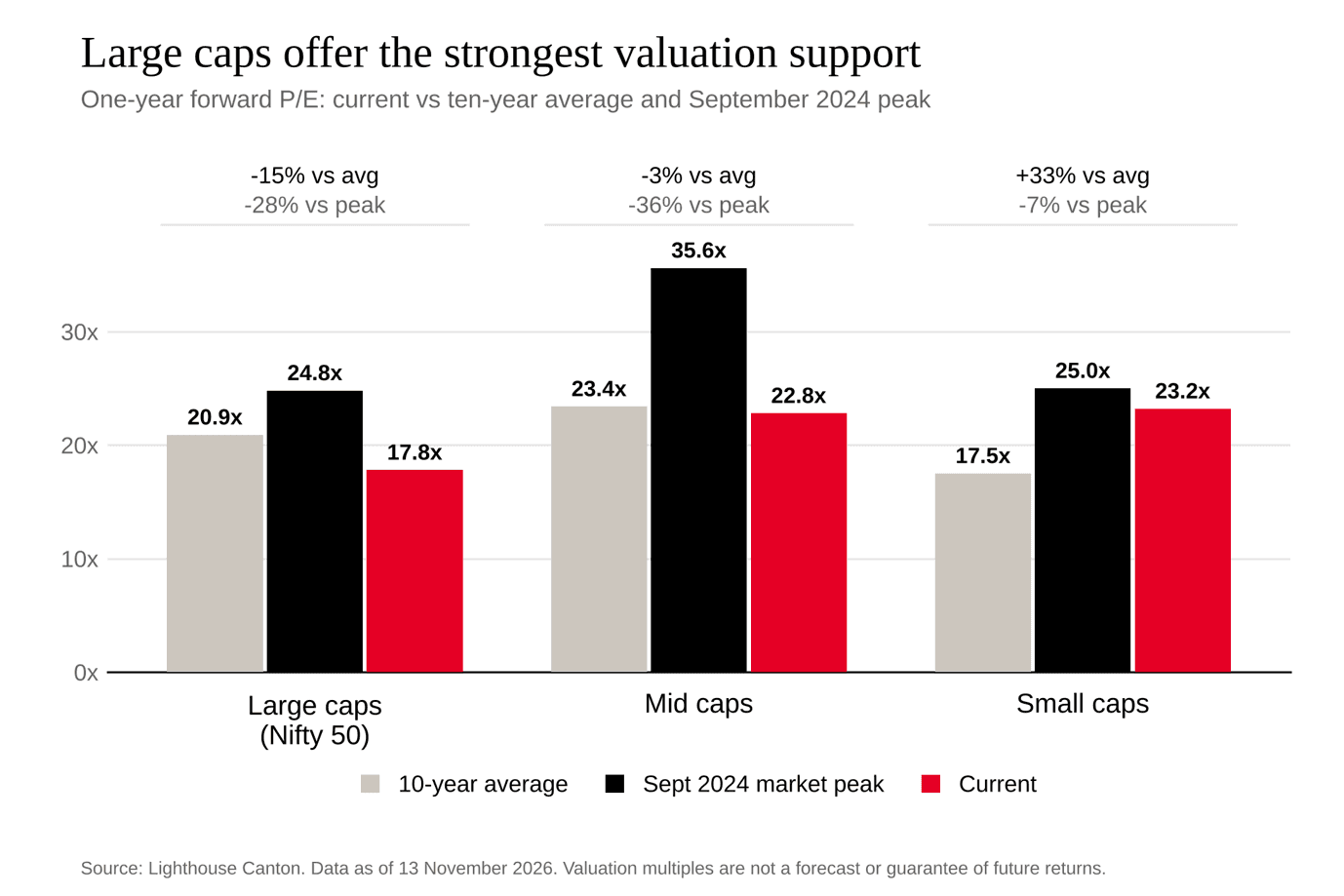
The Nifty 50 trades at 17.8x one-year forward earnings, against a ten-year average of 20.9x, a meaningful discount. In September 2024, when the foreigners started to sell India citing high valuations, the Nifty was trading at 24.8x one year forward earnings. Mid caps trade at 22.8x one year forward earnings against an average of 23.4x, essentially in line with history. Small caps, at 23.2x against a ten-year average of 17.5x, trade at a considerable premium, though earnings growth in small caps has been very impressive. The message is plain: the strongest valuation support currently lies in the widely perceived ‘boring’ large caps. While we like the earnings momentum seen in small caps, enthusiasm here deserves more discipline.
The Lesson of History, and Its Caveats
India's equity story has always been punctuated by exits and returns. Foreign capital left in 2008, again in 2013, and again in 2024, and each time the investors who held their nerve were rewarded when the cycle turned. Templeton warned that the four most dangerous words in investing are "this time it's different". Our view is the opposite of complacency: the structural drivers of India's growth, including demographics, formalisation, infrastructure and a deepening domestic savings base, have not changed. What changed was the price investors were prepared to pay, and that price has reset.
Yet the return of foreign capital should not be taken for granted. Global capital is scarce, and emerging markets, India included, are competing for every dollar of it. At the same time, India is witnessing three capital-intensive supercycles simultaneously, and the scale of investment they require makes foreign capital all the more valuable. Policy therefore matters. Long-term capital gains tax on foreign investors, has been the subject of considerable deliberation, and even SEBI has reportedly recommended its removal in its pre-budget proposals to the government. We believe the government should not defer this decision for too long. Any decision rests with the government and is expected anytime between now and the Union Budget in February 2027. A prolonged delay or a disappointment could put the foreign momentum at risk, India's attractiveness notwithstanding. Markets also remain exposed to a reversal in oil, a firmer dollar and a shift in global risk appetite. With foreign flows returning, the rupee firming, oil benign, earnings delivering and large-cap valuations below their decade average, we believe the foundations for a durable recovery are being laid, provided policy keeps pace.
Disclaimer: Lighthouse Canton Pte Ltd. (“LCPL”) is incorporated in the Republic of Singapore (Registration No: 201422117K) and regulated by the Monetary Authority of Singapore (Capital Markets Services Licence No. CMS100443). Lighthouse Canton Capital (DIFC) Pte Ltd (“LCC”) is incorporated in Dubai International Financial Centre (Licence No. CL 2614) and regulated by Dubai Financial Services Authority (Category 3C Licence No. F004068). The financial products offered by LCPL and LCC are only available to Accredited Investors and Institutional Investors as defined by MAS and Professional Investors as defined by DFSA. The information in this electronic transmission does not constitute an offer, or intention by, or on behalf of LCPL and/or LCC, to subscribe, purchase or sell any financial products and/or services. LCPL and LCC accept no liability for any loss arising from the use of any information contained herein. The contents of this email are confidential and meant for the intended recipient only.