
Investment Insights
A Decade in a Year
Sunil Garg, CMT, Chief Investment Officer

Samvat 2082 felt like a decade compressed into twelve months: a record high, a war, an oil shock, a currency crisis, a rate-cut cycle that became a hiking cycle, an AI boom that markets are now treating like a bust, and a US election that may have reset all of it.
Samvat 2082 tested conviction. India does not need a new story; it needs investors to notice that the story has become cheaper, earnings are recovering and the crowd has left. The long night was real; so is the light.
Shubh Deepavali, Shubh Labh and a prosperous Samvat 2083 to you and your families.
The look back: a decade in a year
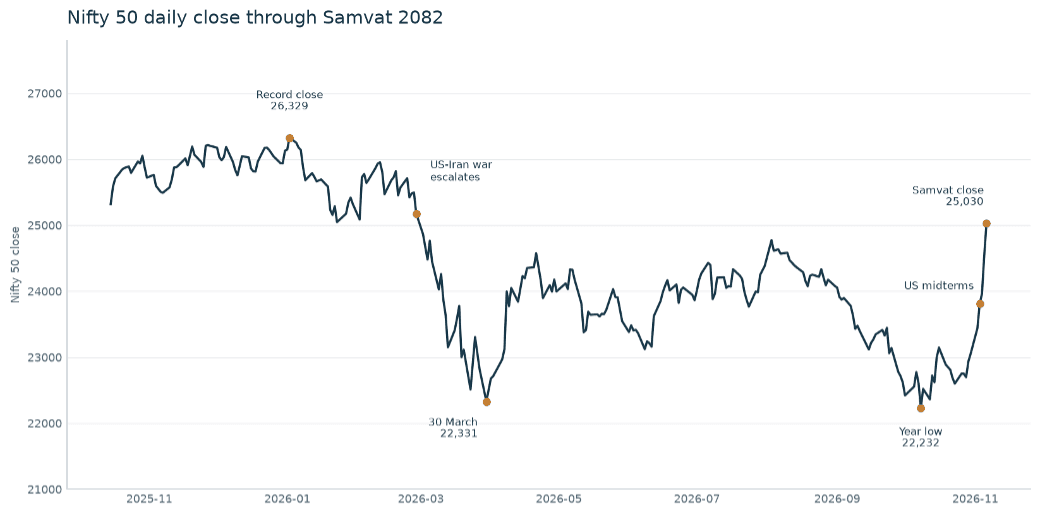
Hope Meets Hormuz: The year opened in hope. The Nifty closed at a record 26,329 on 2 January and touched 26,373 intraday on 5 January. Hope morphed into despair as the Middle East conflict escalated on 28 February, choking traffic through Hormuz. Brent settled at $114 on 4 May. Front-month futures had already closed near $118 on 31 March, and they closed near $118 again on 30 October. The Nifty fell to 22,331 on 30 March. The rupee hit a record low of 96.96 per dollar on 20 May.
Policy whipsawed. After 125bp of cuts in 2025, the RBI hiked 25bp to 5.50% on 7 October and moved to "calibrated tightening". The next day the Nifty closed at 22,232, its low for the year and 15.6% below the 2ndJanuary close. Global capital crowded into AI hardware: the SOX roughly doubled from March to June, then fell 31.8% from 6 October to 5 November. The Nasdaq ended 5 November 11.9% below its high, in correction.
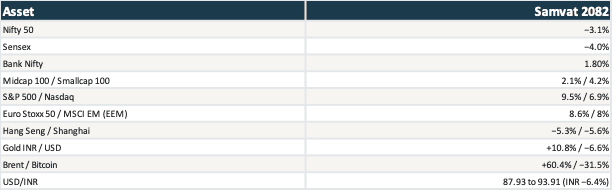
The scorecard is humbling. Over the Samvat (20 Oct 2025 to 6 Nov 2026) the Nifty fell 3.1% and the Sensex 4.0%, the weakest Samvat since 2011. The S&P 500 gained 9.5%, Euro Stoxx 8.6%, MSCI EM (via EEM) 8.0% and the Nikkei 16.8%, while the Hang Seng lost 5.3%, Shanghai 5.6% and Bitcoin 31.5%. In dollars India did worse, because the rupee lost 6.4%.
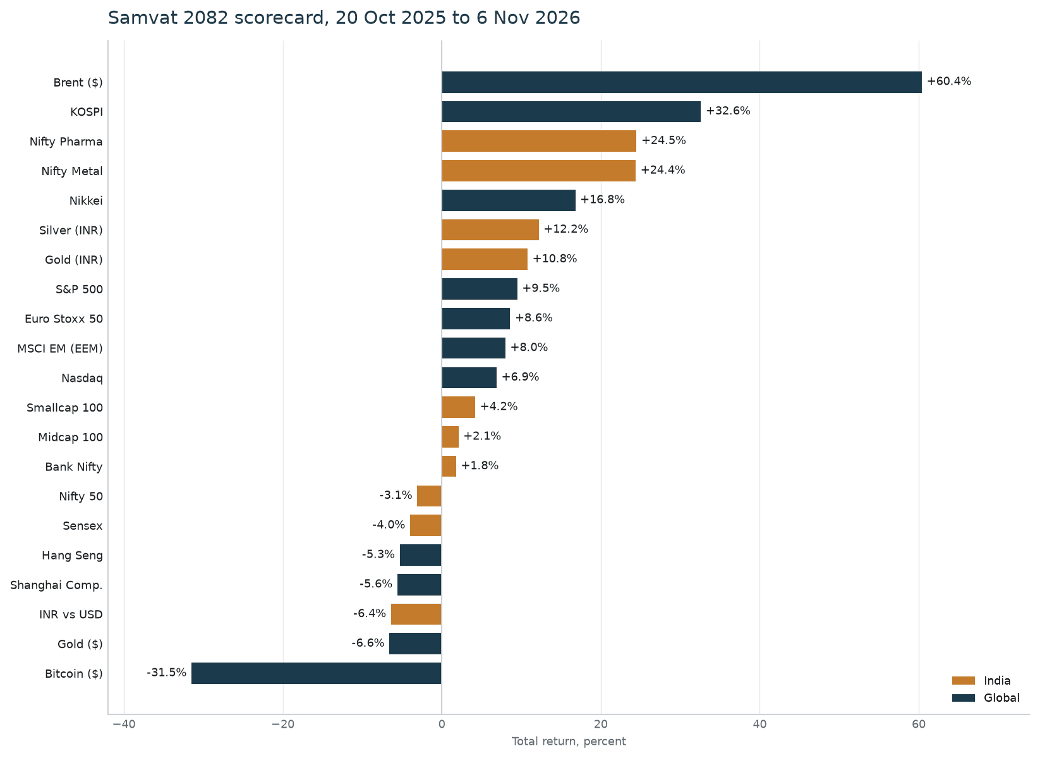
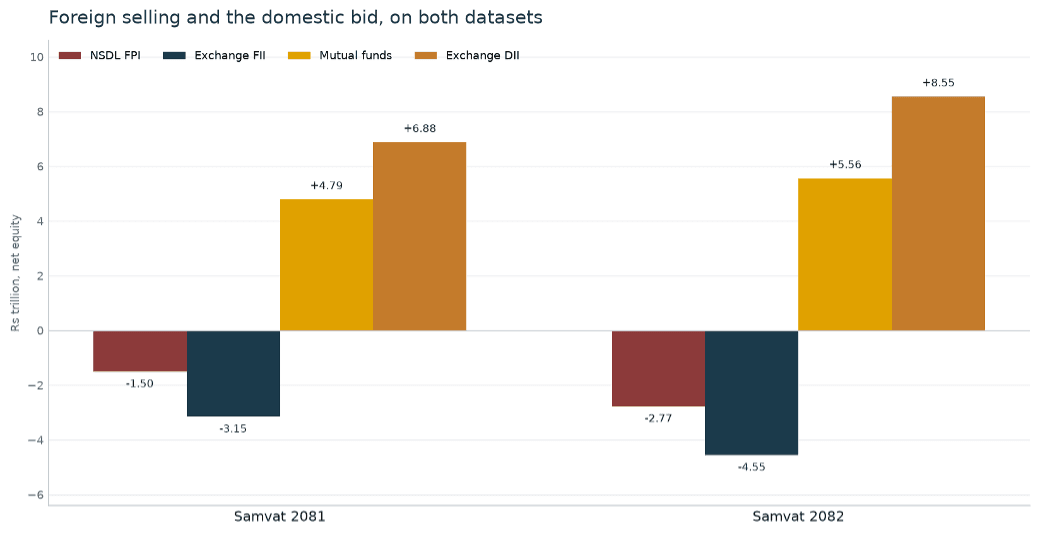
Beneath the headline, the market was healthier. Bank Nifty rose 1.8%, midcaps 2.1% and smallcaps 4.2%. Pharma gained 24.5% and Metals 24.4%. Foreign selling was a record on both series: Rs 2.77 trillion in NSDL’s FPI data, about $31 billion, and Rs 4.55 trillion on the exchanges’ FII tape. Domestic institutions bought a record Rs 8.55 trillion on that exchange count, Rs 5.56 trillion of it through mutual funds. SIPs reached a record Rs 32,490 crore in September, against a monthly average of about Rs 29,100 crore in FY26. Gold fell 6.6% in dollars and still rose in rupees - about 10.8% on Business Standard’s domestic quote, and about 8.5% on MCX. The rupee explains little of that gap. In May the import duty was raised from 6% to 15%. The Indian household absorbed the largest foreign exit on record; that is the story of Samvat 2082.
Why have we turned positive
As we argued in “India's Unloved Upside”, the most interesting thing about India today is that nobody wants it. That pessimism is the opportunity, and the year's data now supports it.
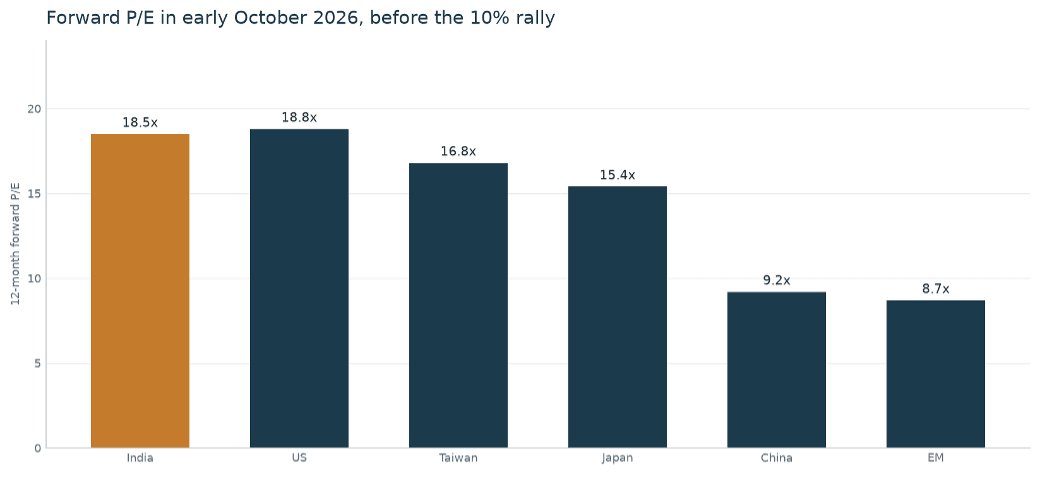
The derating is largely done, though the last seven sessions have given a little of it back. Kotak puts the Nifty at 18.7 times FY27 earnings and 16.5 times FY28. MSCI India was at 18.5 times in early October, its lowest since May 2020 and below its ten-year average. The rally since has lifted that multiple. India still trades at about twice emerging markets. EM, near 9 times, is low because forward earnings estimates have been revised up by about 70%, concentrated in North Asian technology.
Earnings are turning. Nifty EPS compounded at only about 7% over FY25-26. For FY27, revenue growth of 12-13% and EPS growth of 16-17% are expected, and the June and September quarters reflect this optimism. The June quarter grew about 18%. In the September quarter, the 35 Nifty companies that had reported by 31 October grew earnings 22%.
The positioning is washed out. FIIs have pulled out a net $53-59bn over FY25-27. In the final week of the Samvat they bought Rs 45,960 crore, including Rs 14,975 crore on 5 November, the biggest day since Feb 2021.
India is the AI hedge. With markets questioning AI monetisation, India offers a large, liquid market driven by consumption, financialisation, infrastructure and manufacturing rather than the hardware cycle.
Policy is opening the door. Foreign investors have been exempt from tax on G-sec interest and gains since April 2026, the finance ministry is weighing a lower long-term capital-gains tax, and SEBI has recommended removing it for foreign investors. Nothing has been decided. Record FCNR(B) deposits, about $133 billion, have rebuilt the RBI’s dollar buffer. The dollars are swapped, so they are not an equal bid in the spot rupee. The India-US trade deal is agreed in outline and still unsigned, with the legal text being fine-tuned. Brent fell just under 20% over the three sessions to 4 November (the move began the day before the midterms, and by 6 November crude was back near $98).
Technically, the Nifty bounced off its 22,000 support and has broken out, with a 10.3% run in seven sessions, the strongest pre-Muhurat surge in at least 20 years. Most sectors are early in breakouts. Rotation favours banks and financials, with emerging optimism in a beaten-down FMCG sector. Kotak sees 28,000-30,000 on the Nifty by end-2027, and Morgan Stanley’s May base case is a Sensex of 89,000 by June 2027, about 10% above Friday’s close of 81,028. It assumed oil would fall from the levels of that month.
What could go wrong
Oil remains the swing factor for inflation, the deficit and the rupee, and Brent is still near $100. The RBI is hiking, not cutting, with CPI seen at 6.0% in Q3 FY27. AI is a structural threat to IT services, one of India's largest organized employers. The trade deal is unsigned. And a 10% rally in seven sessions invites a pause.
The watch-points for Samvat 2083: crude below $90, the rupee holding under 94, FPI buying beyond short covering, a signed trade deal, and earnings upgrades rather than downgrades.
Samvat 2082 tested conviction. India does not need a new story; it needs investors to notice that the story has become cheaper, earnings are recovering and the crowd has left. The long night was real; so is the light.
Shubh Labh, and Saal Mubarak.
Disclaimer: Lighthouse Canton Pte Ltd. (“LCPL”) is incorporated in the Republic of Singapore (Registration No: 201422117K) and regulated by the Monetary Authority of Singapore (Capital Markets Services Licence No. CMS100443). Lighthouse Canton Capital (DIFC) Pte Ltd (“LCC”) is incorporated in Dubai International Financial Centre (Licence No. CL 2614) and regulated by Dubai Financial Services Authority (Category 3C Licence No. F004068). The financial products offered by LCPL and LCC are only available to Accredited Investors and Institutional Investors as defined by MAS and Professional Investors as defined by DFSA. The information in this electronic transmission does not constitute an offer, or intention by, or on behalf of LCPL and/or LCC, to subscribe, purchase or sell any financial products and/or services. LCPL and LCC accept no liability for any loss arising from the use of any information contained herein. The contents of this email are confidential and meant for the intended recipient only.


