The real opportunity in Asia’s wealth transition
Asia’s private wealth story is often framed as cautious or under-allocated. But that view misses what is actually unfolding beneath the surface: a structural transition in how wealth is governed, not how it is invested.
According to Vijay Bhatia, Managing Director, Wealth Management at Lighthouse Canton, the most important change in Asia today is not asset preference, but rather families actively restructuring how they oversee and protect their capital.
“The space we operate in is a big opportunity in its own right,” Bhatia said. “The appetite among families for independent, institutional-grade advisory structures has exploded in the last two to three years. Before that, it existed, but it was very small.”
FROM PRIVATE BANKING TO FAMILY OFFICE THINKING
For decades, private banking dominated wealth management across Asia. That legacy still shapes behaviour, but it is now being challenged as families begin to understand the structural advantages of a family office framework.
“Once someone has experienced the family office model, they typically don’t go back to dealing with banks directly,” Bhatia said. “They see the difference.”
Overall, Bhatia shared that what is driving this shift is not performance chasing, but alignment. Importantly, this family office framework is not replacing private banking, but rather supplementing the existing system by acting as an objective advocate for the client.
What is driving this shift is not performance chasing, but alignment.
“Performance-oriented mandates resonate far more than fixed-fee models,” he said. “Clients want to know their advisor is aligned with outcomes, not just activity.”
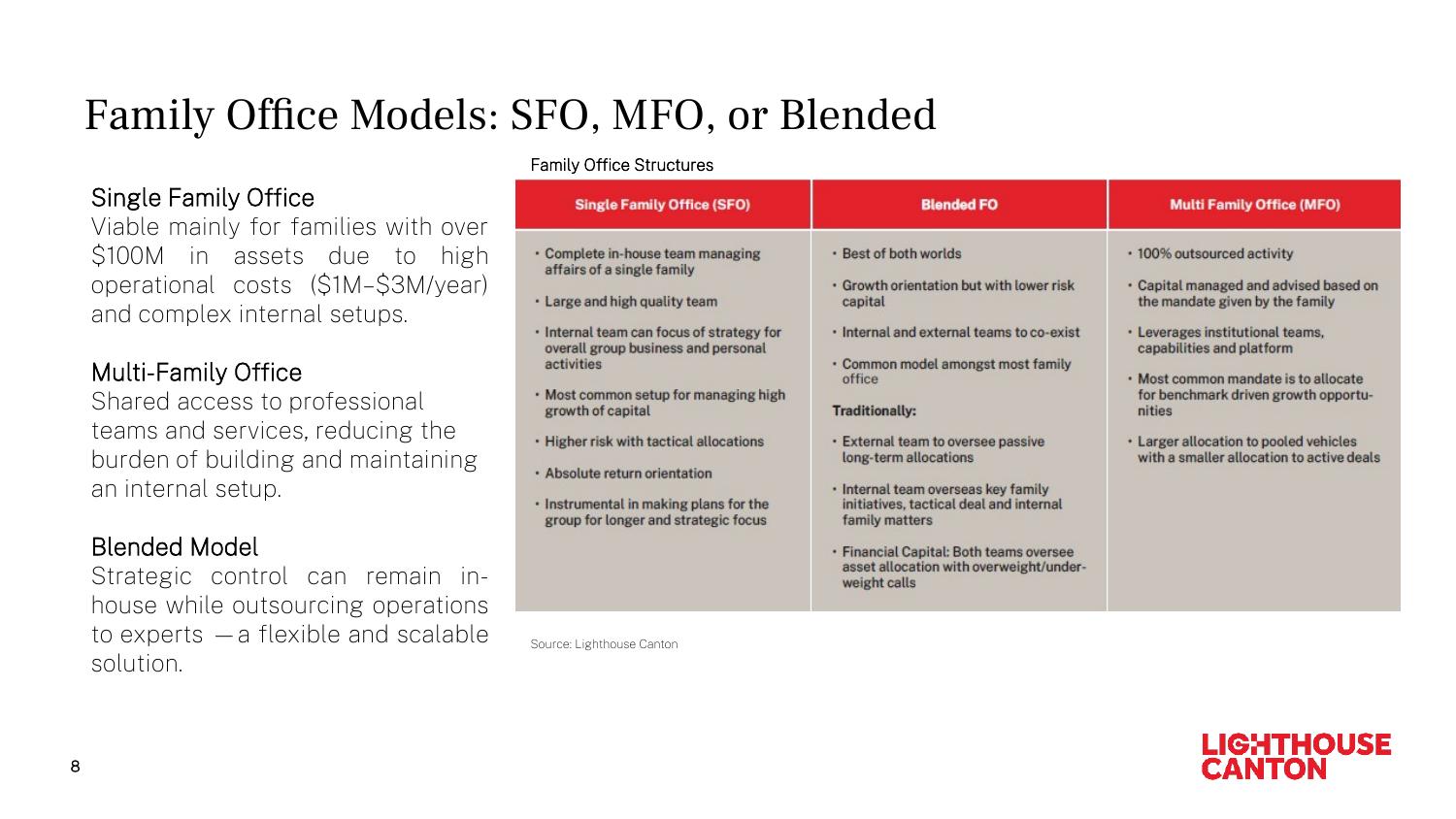
This is where Lighthouse Canton believes it holds a structural edge, by aligning incentives in a way that mirrors how families think about capital. Families typically arrive at one of three structural models, depending on the complexity of their needs and their desire for control.
THE ASIAN DILEMMA
In Southeast Asia especially, the pace of change is shaped by deeply rooted family structures.
“You typically have three generations involved,” Bhatia explained. “The grandfather started the business and still controls the capital. The sons are in their 50s or 60s. The grandsons, who are in their 30s and 40s, are often running the business, but they don’t control the money.”
This generational dynamic creates a natural lag between recognition and action.
“The younger generation immediately sees value in professional wealth management,” Bhatia said. “They see the world through a different lens. They understand why you separate business from capital management.”
But familiarity and comfort matter.
“When someone has spent 20 or 30 years in private banking, explaining a new model isn’t easy,” he said. “Change takes time.”
WHY THIS IS NOT A MISSED OPPORTUNITY
From the outside, this can appear as investor inertia. In reality, it is sequencing.
“Only when control transitions will you see meaningful change,” Bhatia noted. “And that transition is already underway.”
More than 1.2 million wealthy people around the world will transfer $31 trillion by 2033, according to Altrata’s family wealth transfer report. Gen X is first in line to inherit from their wealthy parents over the next decade, the report says, while Gen Z and millennials are more likely to receive lesser sums from their grandparents.

In contrast to Europe, where family office structures are long-established, Asia’s evolution is still early but accelerating.
The pace of this shift, Bhatia noted, is driven by systemic maturity. “It’s about readiness,” he explained, pointing out that true adoption relies on the growing availability of specialised expertise, evolving regulatory frameworks, and the underlying infrastructure needed to fully support family offices.
For Lighthouse Canton, that means engaging families before the inflection point.
“Our strategy in Asia is not about forcing change,” he said. “It’s about being in the right place, with the right fit, when the change happens.”
A DIFFERENT VALUE PROPOSITION
Families moving into a family office structure quickly realise that the model only works if the provider has institutional depth, not just advisory coverage. Unlike traditional EAM models, Lighthouse Canton’s structure allows it to operate as a full financial institution, a distinction that matters in family office transitions.
“As confidence builds, the relationship deepens.”
This approach reflects how Asian families prefer to evolve partnerships, incrementally, through trust rather than disruption.
“Today, it’s about presence,” he said. “Tomorrow, it’s about participation.”
Asia’s wealth transition will not be defined by sudden reallocations or headline shifts. It will be shaped by governance, generational change and the gradual institutionalisation of family capital.
“The opportunity is inevitable,” Bhatia said.
For platforms that understand this cadence, and are prepared to invest time before capital, the payoff is structural, not cyclical.





.png)