
Investment Insights
Equity Insight: Tech Titans at a Crossroads - The Growing Divide Between Meta and Microsoft
Drishtant Chakraberty Senior Associate, Investment Consulting, Lighthouse Canton
Investing in AI is one thing but actually driving meaningful returns out of this investment is a completely different challenge.
Last night's earnings report from Microsoft and Meta are a testament to the above, with Microsoft struggling to justify its large AI related spending bill on one hand and Meta clearly showcasing its ability to leverage AI & ML to drive revenues and earnings higher on the other hand.
With Wall Street having made a decisive shift from looking at how much spending the mega-cap tech companies are doing on AI to trying to get a sense of what kind of ROI will be generated from these massive investments, the stock price reaction of the two companies says it all (MSFT: -4% & META: +2%). Even though Microsoft's earnings call started off with CEO Satya Nadella emphasizing on how they are trying to unlock the full ROI of AI, the Street seems to have developed the ability to look through their marketing prowess and focus on what is actually being delivered.
Key takeaways from Microsoft's earnings :-
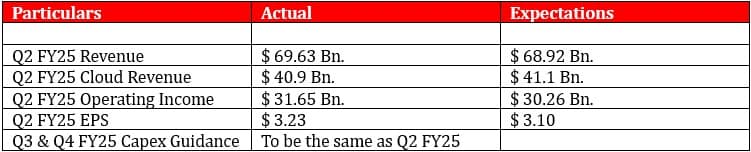
Azure growth failed to meet lofty expectations primarily due to execution challenges on the non-AI side of the business : We see Microsoft's attempt to split Azure's growth between AI and non-AI related workloads to be more of a marketing ploy to highlight the benefits of their AI spending than anything else as inherently Azure continues to be a cloud infrastructure business in our opinion, where a broad based transition from general purpose computing to advanced computing was bound to happen. What clearly comes to light from last night's earnings print is that while the wallet size / spend being allocated by large scale enterprises is definitely growing, it is not growing simultaneously across both AI and non-AI related workloads as enterprises begin prioritizing the development of AI related workloads at the expense of general computing requirements.
The incorporation of AI applications into the overall tech stack are not yielding much as of now : The promise of being able to incorporate AI applications into the overall software suite and drive additional spend by upselling customers seems to be falling short, as many AI applications struggle to deliver tangible value, enough to justify the additional 30$ per seat monthly subscription cost to customers. We expect additional pressure in this segment, especially as competitors start offering similar services at a cheaper cost (Salesforce's Agentforce), potentially benefitting from lower development costs by using open source models / innovative training techniques as showcased by DeepSeek this week. The above calls into question, not just the large capex spend the company is engaging in but also its significant investment into OpenAI.
Capex spend for FY25 Q3 and Q4 to be at the same level as Q2 FY25 and the growth in capex is expected to slow going into FY26: There clearly seems to be a more measured approach being taken by the management on capital allocation and capex, as highlighted by the company's decision to take more of a backseat in terms of funding OpenAI's future training capex needs and slightly muted capex guidance for both H2 FY25 and FY26 by CFO Amy Hood. We believe that the above is definitely warranted given the kind of developments we are beginning to see, especially from many Chinese competitors such as DeepSeek and Alibaba, who seem to be able to do a lot more with a lot less in terms of capex spend and availability to top end AI related hardware. The above clearly introduces some risks for AI related hardware suppliers, who have had a stellar run over the past 18 months, primarily on the back of strong forward looking projections being priced in by the Street, which might begin to be questioned and potentially be revised lower.
Key takeaways from Meta's earnings :-
Incorporation of AI & ML to increase targeted ad-deliveries seems to be paying off: Roughly two-thirds of the growth in Meta's family of apps segment was driven by increased average price per ad this quarter (+14% YoY), which to us signifies the company's ability to generate an incrementally higher ROI for its customers, which is why they continue to be willing to spend top dollar for advertising on Meta's family of apps. The company's investments into AI & ML seems to be the driving factor here, with management touting its ability to improve ad-targeting on a sequential basis. Further, there were mentions of the company introducing some new features on their apps, such as custom feeds (based on one's preference) which could drive incremental topline growth.
Reality labs continues to be a massive drag: The pace of losses accelerated once again in the reality labs segment, with the company losing nearly $5 Bn. this quarter, dragging down what was otherwise a phenomenal quarter for the family of apps segment, which generated a 60% operating profit margin. The consolidated company level margins came in at 48%, which is the highest since Q4 2017.
Management at Meta is uncertain about what the recent developments surrounding DeepSeek mean for the company's AI related infrastructure spend: The company maintained its 2025 capex guidance of $60-65 Bn. while being unsure about what the recent developments surrounding the use of distilled / small language models will be in terms of the requirement for compute going forward. On one hand it seems to be clear that compute demand for pre-training purposes is going to go down, but the demand for inferencing will increase as the industry seems to have identified incremental benefits of using higher compute for inferencing purposes. Further, the deployment of AI at scale will not be possible without incremental investments being made into datacenter build outs.
Overall, we are of the sense that the Street is getting increasingly angsty to see tangible returns being driven out of the large AI spends currently being conducted by the hyperscalers.
Recent developments surrounding DeepSeek appear to have had a profound impact on the industry, instigating a re-look at previously made projections surrounding planned capital investments and this is bound to introduce some uncertainty / subdued clarity when it comes to the ability of the AI related hardware companies to meet already elevated earnings expectations.
While the hardware companies outperformed over the past 18 months, a rotation may be on the cards if the software companies tasked with providing AI applications to end consumers, can follow the footsteps of companies such as DeepSeek and efficiently develop offerings that fit into multiple use cases.
All investments carry risk, for more important information please read this disclaimer.