
Investment Insights
Equity Insight: The Structural Shift Toward Larger Tyres: EV Engineering, Rim-Size Mix, and Investment Opportunities
Drishtant Chakraberty, CFA Assistant Vice President -Equity Research
Executive Summary
A quiet but highly consequential trend is reshaping the global tyre industry: the steady migration toward larger rim sizes (18–22 inches) across passenger vehicles. What began as a by-product of SUV penetration has now been reinforced and accelerated by the rise of electric vehicles (EVs).
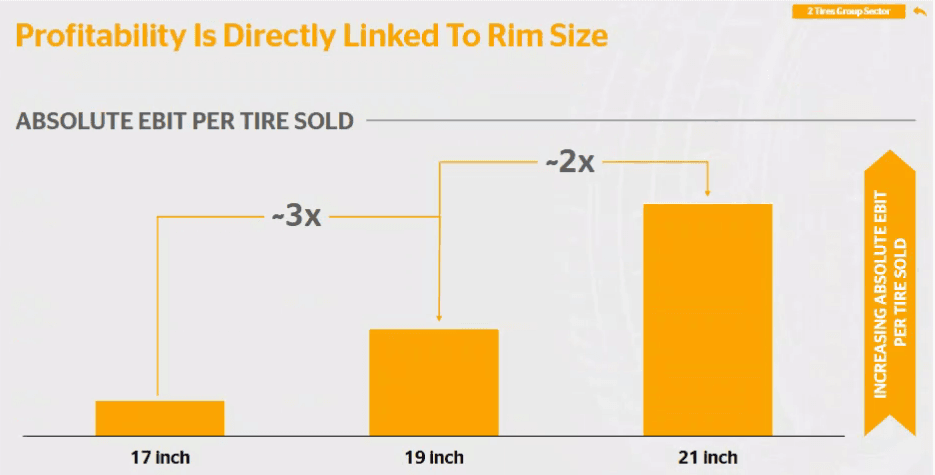
This migration is structurally margin-accretive for tyre manufacturers. Larger-diameter tyres command higher prices, involve more complex engineering, and exhibit lower price elasticity, allowing manufacturers to expand gross margins even in periods of weaker volumes.
The EV transition brings additional complexity: heavier vehicles, higher instantaneous torque, stricter rolling-resistance requirements, noise constraints, and packaging geometry that often necessitates bigger rims and bespoke EV tyre designs. As automakers increasingly produce EVs with18–21" wheels, the mix shift is feeding directly into tyre companies’ P&Ls through higher ASPs, richer replacement cycles, and product differentiation. Further, our discussions with industry experts corroborate these findings.
This publication analyses the engineering forces behind this trend, outlines why the economics skew positively toward tyre companies, and highlights global and Chinese players best positioned to benefit.
1. Engineering Drivers Behind the Move to Larger Rim Sizes
Understanding the tyre mix shift requires understanding the engineering realities of modern EVs and SUVs. The EV drivetrain and chassis architecture fundamentally alter tyre requirements.
1.1 The Battery Pack and Vehicle Packaging
Most EVs today use a skateboard-style battery pack integrated into the floor. This creates three structural effects:
Higher ride height because of the vertical thickness of the battery pack.
Different suspension geometry, requiring larger wheel arches.
Preference for large-diameter wheels to maintain handling performance and design profile.
Put simply: to accommodate battery-pack architecture while maintaining vehicle dynamics, many EVs default to 18–21" rims.
1.2 Higher Vehicle Mass → Higher Load Index Tyres
EVs are typically 20–30% heavier than equivalent ICE models because the battery pack can weigh 300–700 kg.
Heavier vehicles require tyres with:
Higher load index
Stronger carcass and bead materials
Reinforced sidewalls
Larger rim diameters to distribute forces more effectively
This pushes manufacturers to develop EV-specific tyres with higher structural rigidity, often paired with larger diameter wheels and lower-profile sidewalls.
1.3 EV Torque Characteristics: Instantaneous, High Output
Electric motors deliver maximum torque from zero RPM, creating:
Higher shear stress on tyre tread blocks
Faster wear potential
The need for tread compounds that balance grip, rolling resistance, and longevity
Preference for wider, larger-diameter tyre formats
This torque behaviour favours ultra-high performance (UHP) or high-rim-diameter designs, even for mass-market EVs.
1.4 Rolling Resistance and Range Sensitivity
EV range is highly sensitive to tyre rolling resistance. Reducing rolling drag by even 10% can add:
~3–4% more driving range on a typical EV To achieve low rolling resistance, manufacturers use:
Larger-diameter tyres with narrower sidewalls
Stiffer internal structures
Advanced silica and polymer compounds
Aerodynamically optimised design (large wheels improve airflow when paired with low-profile tyres)
The net result is a propensity for larger rim sizes paired with low rolling resistance technology.
1.5 Noise Constraints: The EV Quietness Penalty
EVs lack engine noise, making road roar and tyre noise extremely noticeable. To reduce cabin noise, EV tyres increasingly use:
Acoustic foam inserts
Pattern optimisation
Tread-block sequencing
Sidewall harmonics dampening
These technologies scale naturally with premium, large-rim tyres, improving ASPs further.
2.Why Larger Rim Sizes Drive Better Economics for Tyre Companies
The tyre industry benefits from this mix shift in three powerful ways: pricing, mix, and technical complexity.
2.1 Larger Rims Command Higher ASPs
A typical 19–21" tyre can be priced 1.6–2.0xhigher than a 15–16" tyre.
Even controlling for raw materials, larger tyres incorporate:
More rubber and steel
Higher load and speed ratings
More complex construction
EV-tuned compounds and noise-reducing elements
This translates directly to higher gross margins.
2.2 EV Tyres Create a Premium Tier
EV-specific tyres tend to be priced at a premium to standard tyres, because they must balance four competing factors:
Load capacity
Wear resistance
Rolling resistance
Noise reduction
This allows manufacturers to build a “High Value” segment—similar to Pirelli’s strategy—that consistently prints mid-teens margins.
2.3 Replacement Market Economics Improve
Most EVs ship with large wheels from the factory. When replacement time comes, consumers generally stick to:
The same rim size
The same load index
The same EV-specific requirements
Often the same brand or OE-approved pattern
This locks in higher-value replacement cycles, which are the profit engine of the tyre industry.
2.4 EV Tyres Wear Faster → Higher Volume Turnover
Due to higher torque and mass, EV tyres often wear 10–20% faster than ICE tyres.
This increases:
Replacement frequency
Total lifetime tyre spend per vehicle
Volume predictability for large-rim segments
3. Investment Implications: Who Benefits?
Tyre manufacturers with strong positions in 18–22" sizes, UHP products, and EV-specific lines will disproportionately win.
Below are the most attractive players globally and in China.
4.Global Winners
4.1 Pirelli (PIRC IM)
Purest global play on ≥18" and EV-specialised tyres
“High Value” tyres (≥18") make up the majority of revenue.
Strong EV positioning with hundreds of EV OE homologations.
Mid-teens EBIT margins, helped by premium mix.
Most directly levered to the same mix dynamics as luxury EVs and premium SUVs.
4.2 Michelin (ML FP)
Balanced compounder with strong mix tailwinds
High-rim and UHP tyres drive a meaningful share of profit.
Consistently maintains strong margins via price/mix discipline.
Very diversified (aviation, mining, specialty), offering downside protection.
4.3 Bridgestone (5108 JP)
Large-rim segment explicitly identified as structural growth driver
Strong position in North America—the world’s largest SUV-heavy market.
Clear portfolio shift toward premium, high-rim-diameter tyres.
4.4 Continental (CON GY – Tyre Division)
OEM-heavy, high-tech tyre business benefiting from EV fitments
Significant presence in premium German OEMs (BMW, Mercedes, Audi).
High-value replacement market opportunity.
Potential strategic unlocking of tyre division value over time.
4.5 Hankook – EV-specialist products climbing the value ladder
Why it’s interesting:
Aggressively pushing the iON EV tyre line (summer, all-season, winter) with technology explicitly aimed at:
High load support
Managing EV torque
Low rolling resistance and low noise.
High exposure to
Produces the ERANGE EV line with advanced compound technology.
Strong penetration into 18–22" rim sizes.
Moving aggressively into mid-to-premium positioning.
mid-to-large rim sizes
on premium Asian and European EVs, especially as Korean OEMs (Hyundai/Kia/Genesis) and some European brands scale EV offerings.
EV angle:More of a rising challenger – not as premium as Michelin/Pirelli yet, but the strategy is to ride the EV/large-rim trend to migrate the brand up the value curve.
5. Chinese Winners
China is crucial because its EV export wave is disproportionately driving global demand for 18–21" tyres.5.1 Sailun Group (601058 CH)Fastest-growing Chinese play on EV-specific tyres
5.2 Zhongce Rubber (603049 CH)China’s largest tyre manufacturer with a rising EV-UHP portfolio
Launching EV-ready UHP tyres under Westlake and Goodride.
Strong export positioning as Chinese EVs penetrate global markets.
Conclusion
The transition toward bigger tyres and larger rim sizes is one of the most powerful and underappreciated structural shifts in the global automotive supply chain.
This trend is being driven not by consumer fashion but by engineering necessity:
Battery-pack architecture
Higher vehicle mass
Instantaneous EV torque
Rolling resistance and range optimisation
Noise and comfort constraints These dynamics make larger-diameter, high-performance, EV-optimised tyres a multi-year profit tailwind for the industry.
The winners will be tyre manufacturers with:
The winners will be tyre manufacturers with:
High exposure to ≥18" rim sizes,
Strong EV-specific technical capabilities,
Premium brand positioning, and
Robust global replacement channels.
In an industry with structurally low volume growth, this mix-driven transformation is one of the clearest long-term margin expansion opportunities, which in turn should lead to strong double digit earnings growth.