


Investing in India just became attractive for wealthy overseas Indians with the Reserve Bank of India (RBI) opening a special foreign exchange mobilisation window in June to attract dollar deposits. And the response so far has been overwhelming.
The central bank has prematurely changed the application window to close on 31 August 2026, a month before the September-end deadline announced at the time of launch.
The latest official data released indicates that banks have mobilised nearly $52.3 billion, significantly surpassing the roughly $25 billion raised under a similar programme in 2013.
FCNR(B) Deposit Mobilisation: Then and Now
Source: RBI
"The product has seen tremendous traction among the global Indian ultra-high-net-worth (UHNW) community," said Sumegh Bhatia, Managing Director, Chief Executive Officer – India, Lighthouse Canton.
He said demand has been strongest among overseas Indians in the Middle East and Hong Kong but has been relatively muted in Singapore, the United States, and Canada, where local tax rules reduce the appeal of the tax-efficient product.
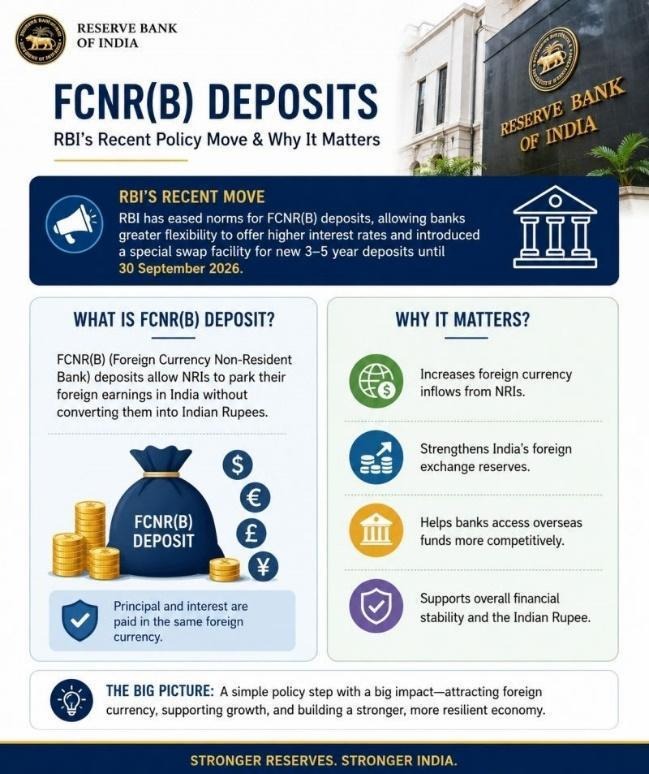
The special FCNR(B) deposits have maturities of three or five years but are not subject to a full-term lock-in. Depositors can withdraw funds before maturity, subject to the bank's applicable premature-withdrawal terms and penalties. However, no interest is payable if the deposit is withdrawn before completing one year.
Leverage Opportunities at GIFT City
A key differentiator that has contributed to the high FCNR deposit mobilisation compared to the previous exercise in 2013 is the leverage opportunities provided by banking units located at India's international financial centre, GIFT City.
Several Indian and foreign banks are allowing NRIs to borrow multiple times the value of their deposits, with the likes of HSBC offering up to 19 times. Under this, a customer investing $100,000 in FCNR (B) deposits offered by any bank in India can borrow up to $1.9 million against a five-year FCNR-B account. This is expected to generate an annual return of about 14.25 percent while paying loan interest of 5.05 percent to 5.15 percent.
Bhatia pointed out that the majority of the leverage happening at GIFT City is through Indian banks. The leveraged FCNR(B) structure also creates benefits for Indian banks, which provide the financing while attracting foreign-currency deposits into the banking system.
"They're providing leverage, earning the spread, bringing deposits into India, and using those deposits to support credit growth and the broader economy," he said.
FCNR(B) deposits address low-cost, high-velocity liquidity needs by letting Indian banks tap overseas Non-Resident Indian (NRI) capital without bearing currency hedging costs, directly easing a tight credit-deposit (CD) ratio.
Competitive deposit rate strategies
With competition only intensifying, banks are differentiating themselves less on FCNR (B) deposit rates than on leverage, credit quality, and execution. While smaller Indian banks have been luring depositors through higher deposit rates of up to 7.5 percent, most large multinational lenders typically offer lower rates but substantially higher leverage and stronger credit profiles.
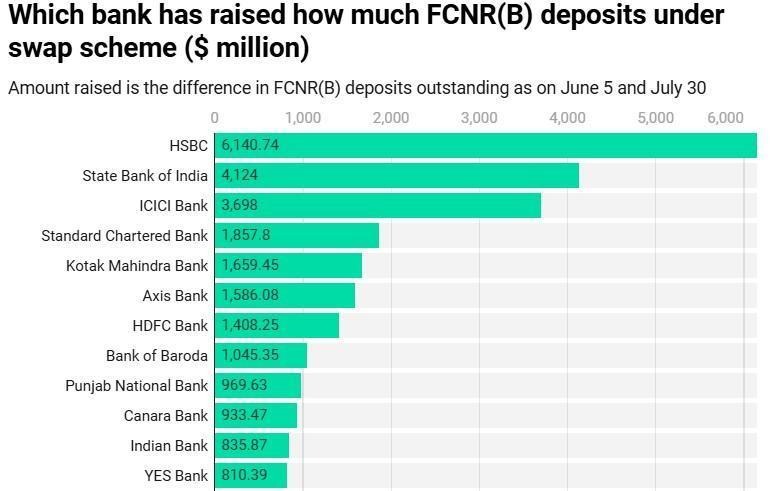
Source: Indian Express/Lok Sabha question
"Rates are not everything for sophisticated investors. Some of our clients are comfortable accepting a lower return from a large international bank because of its creditworthiness," explained Bhatia.
The general trend noted is that while local banks have captured much of the demand because of their extensive NRI networks, global banks have generally been quicker to process applications and execute transactions.
NRI Investment: Funding strategies & risk considerations
Clients are funding deposits through a range of sources. Bhatia said some are deploying surplus investable proceeds, including from private equity exits, while others are booking profits from equity assets, they consider overvalued and reallocating the proceeds.
Meanwhile, more conservative investors are shifting low-yielding cash and global fixed-income holdings into FCNR(B) deposits, he added.
"The risk is generally greater for smaller investors and those using lower-rated banks than for UHNWIs with more diversified portfolios," he elaborated.
Bhatia also warned against excessive use of leverage, particularly where borrowed funds represent a large proportion of an investor's net worth. In addition, he said investors should consider tail risks, including the unlikely event of a bank failure, the possibility of capital controls delaying the repatriation of funds at maturity, and changes in residency status of the investor that could remove the tax advantages associated with the deposits.
As a result, clients are scrutinising loan documentation more closely, paying particular attention to provisions covering nominee arrangements, joint account holders and early exit options. However, the immediate priority for clients and advisors is securing an allocation and getting accounts open.
Beyond the deposits: Lighthouse Canton's role
"FCNR(B) is bringing offshore capital back into the India ecosystem, but for Global Indians, the opportunity is much broader than the deposit itself. The real value we bring to them is in helping them connect their India wealth with their global portfolio and make that capital work across markets and portfolio ambitions," he added.
As more Global Indians build financial lives that span multiple jurisdictions, products such as FCNR(B) could increasingly become entry points into a more integrated approach to wealth management, connecting banking, investment and succession decisions rather than treating them as separate pools of capital.
Also Read:

Broader economic impact
The FCNR (B) deposits have been launched as part of the government's stability measures. These deposits strengthen India's credit landscape by injecting stable foreign liquidity into domestic banks, bolstering macro-financial stability, and lowering the cost of funds without adding domestic currency volatility.
"By shielding banks from exchange rate risks — especially during special RBI swap windows — these foreign inflows expand the aggregate lending capacity of Indian financial institutions," concluded Bhatia.
Frequently Asked Questions on FCNR-B
Q1: What is an FCNR-B account and how does it differ from NRI fixed deposits?
A: An FCNR-B (Foreign Currency Non-Resident Bank) account is a deposit account held in foreign currency by Non-Resident Indians. Unlike NRI fixed deposits, FCNR-B accounts are maintained in foreign currency (typically USD), shielding investors from rupee depreciation risk. FCNR-B accounts offer attractive FCNR deposit rates and allow leverage at GIFT City, making them ideal for NRIs seeking dollar-denominated returns.
Q2: Who is eligible to invest in FCNR(B) deposits, and can accounts be held jointly?
A: FCNR(B) deposits are available to individual NRIs and Persons of Indian Origin (PIOs), including OCI cardholders who are resident outside India; an Indian passport is not required for an eligible OCI cardholder. Trusts and other non-individual entities are not eligible. Joint deposits can be held either with another eligible non-resident on an "Either or Survivor" basis, or with a close resident Indian relative on a "Former or Survivor" basis. In the latter case, the deposit must remain solely owned by the non-resident.
Q3: What tax advantages do FCNR deposits offer compared to NRI investment in India?
A: FCNR-B deposits offer tax neutrality on foreign exchange gains, as interest and currency gains are not taxed if repatriated. However, tax residency status is critical — changes to NRI classification can eliminate these advantages. Consult a tax advisor before opening FCNR-B or NRI fixed deposit accounts to confirm eligibility.
Q4: What is GIFT City in India and why is it important for FCNR (B) investments?
A: GIFT City (Gujarat International Finance Tec-City) is India's premier financial centre offering offshore banking units with special privileges. It enables NRIs to access leverage against their FCNR-B deposits, with some banks offering up to 19x leverage. This makes GIFT City investment a critical component of maximising returns on NRI investment India.
Q5: How do I invest in GIFT City as an NRI?
A: To invest in GIFT City, NRIs typically: (1) open an FCNR-B account with a bank operating in GIFT City, (2) deposit foreign currency funds, and (3) leverage those deposits through GIFT City banking units. Most major Indian and multinational banks facilitate this process. The process is streamlined, but requires documentation including proof of NRI status and source of funds.


.png)

.png)
.jpg)