Bessent says he's the dealer. The tape hasn't signed off.
SHORT VERSION
• Treasury tripled its long-bond buyback to $6bn on 9 September, funding it almost entirely at the short end. 84% of 2025 issuance ran under twelve months. Call it yield curve control without the name - it rhymes with four decades of BOJ.
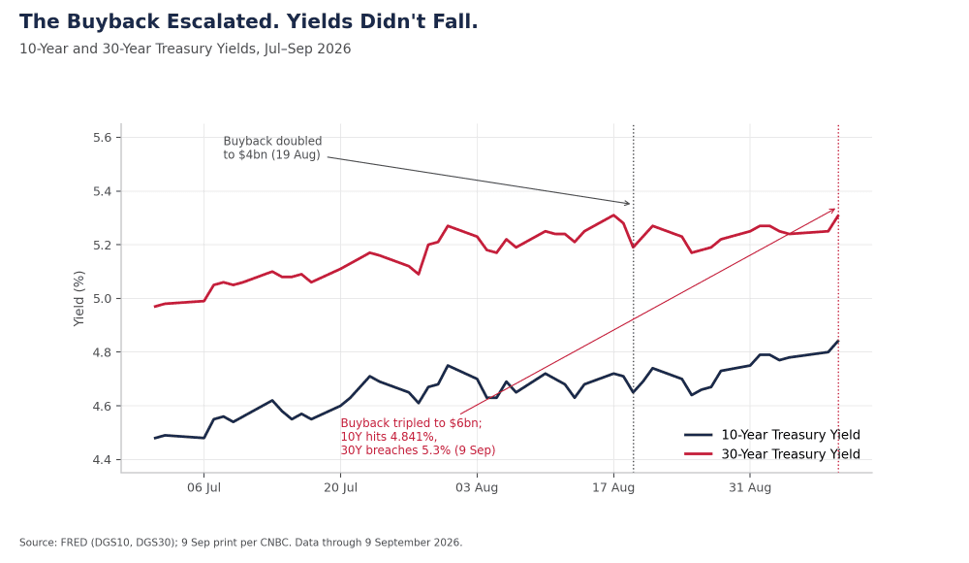
• The tape hasn’t signed off. Yields hit 4.85% the same week the buyback tripled, a level last seen before November 2023.
• Warsh talked himself into a corner at Jackson Hole. PPI prints before market today, CPI is tomorrow, FOMC is the 16th. A hold now reads as capitulation, not independence.
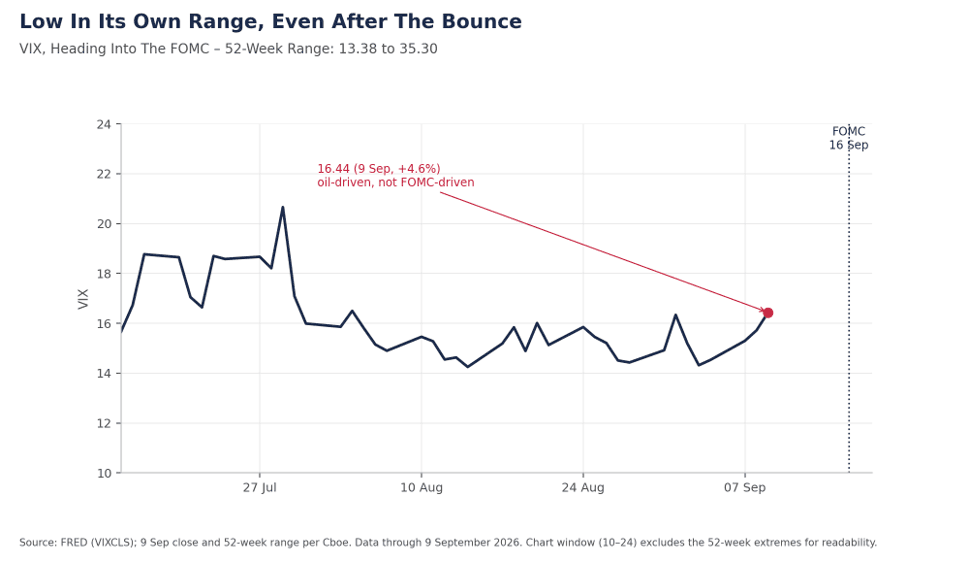
• Fed funds futures put the hike at 60%. VIX at 16.5 says equities are bracing for oil, not for the Fed - the FOMC tail still isn’t in the price.
Own that gap through the strangle we sized yesterday. We are not picking hike or hold (still lean towards a hold) - we’re picking the reaction over either outcome priced alone.
The House That Bessent Built
Treasury doubled its buyback size on 19 August, then tripled it to $6bn for the 10 September operation, concentrated in the 10-20 and 20-30 year durations that have seen a buyers’ strike since late June. CNBC has reported, citing two senior Treasury officials, that the department may also tap its General Account - close to $1 trillion sitting at the Fed - to fund the purchases without issuing a dollar of new debt.
“I am the house now,” Bessent said in Texas this week, daring traders to bet against him. He was talking about the yen intervention specifically. The market read it as a statement about Treasury generally.
The number that actually matters: in 2025, 84% of gross issuance ran under twelve months. That’s not liquidity management. That’s funding a $2 trillion deficit on a rolling short-term facility while using the proceeds to buy back the long end. A bit like funding your mortgage through credit card debt, resetting ever so often.
The BOJ Playbook, Minus The Printing Press
The BOJ ran a version of this for the better part of four decades - defend a yield level, absorb what the market wants to sell, fund it however the balance sheet allows. The difference is not small. A central bank prints the money it uses to defend a level. Treasury has to borrow every dollar of the buyback in bills, which is why Wellington’s Brij Khurana characterized this as “twisting the curve” rather than a true monetary easing policy.
Druckenmiller, who mentored Bessent early in his career, made the sharper point in a recent op-ed: once markets believe an official is defending a price, every rise in yield becomes a test of resolve, and the defence has to keep growing to survive the test.
That is the dichotomy. The story is prudent liquidity management. The price says something else.
The 30-year breached 5.3% even as the buyback tripled. You don’t fight the Fed. Increasingly, you can fight the Treasury, and right now the house is losing the hand it dealt itself.
Warsh’s Squeeze
Can Warsh actually hike without looking like he’s picking a fight with his own Treasury Secretary?
His 28 August Jackson Hole line - underlying inflation must move to target “clearly and at sufficient speed, otherwise we have work to do” - took hike odds from 35% to 57% (now 60%) in a single session. PPI prints before market today. CPI is tomorrow. Three FOMC members already dissented in July in favour of a hike.
Trump, Vance, Bessent and a senior economic adviser have all leaned on Warsh publicly this past week to hold, or cut. A hike now reads as institutional independence. A hold now reads as capitulation to a pressure campaign running alongside a Treasury Secretary who’s just called himself the house. Warsh doesn’t get to thread that quietly.
Softer data actually helps his case, not hurts it. August payrolls came in much stronger, all eyes are now on inflation metrics.

The Asymmetry
So which is it, hike or hold? Wrong question.
A 60% probability priced into fed funds futures is a rates-market call on the odds of a hike. It says nothing about whether equities are positioned for the consequence of one.
Not for this risk, anyway. VIX closed at 16.5 on 9 September, up 4.6% on the day - a real move, but the driver was oil breaking above $100 on Middle East tensions and yields climbing, not FOMC positioning. Skew was still flat as of the 8th, one-month call/put implieds near New Year’s lows, with deep OTM put demand the only real hedge left standing. 16.5 remains well below its own longer-run average and nowhere near the 35.30 high printed in March. That’s a market waking up to an oil shock. It isn’t pricing a Fed decision.
The rates market has priced the odds of a hike. The equity market hasn’t priced the FOMC tail at all. If Warsh hikes, equities have further to move than a “60%-priced” framing suggests, because the hedging that would show digestion of that specific risk hasn’t shown up yet. This rhymes with 1994, or Q4 2018, more than a well-telegraphed move.
The downside scenario - hike delivered, market genuinely wrong-footed - carries more convexity than the upside scenario of a hold everyone already half-expects.
Positioning: Own The Move, Not The Direction
This is the setup the strangle we sized yesterday is built to own, long the move, indifferent to direction.
• Long Strangle: 18 Sep 26 Expiry, 740-780 (on SPY) costs just 0.3%. Size to the FOMC date, not the CPI print.
• Duration: don’t read the buyback-supported long end as a floor. It’s administratively supported, not fundamentally supported. Prefer the belly of the curve to 20-30yr, where Treasury’s own bid can disappear on a given announcement day.
• Equities: own the strangle as the primary tail hedge into the 16th rather than stacking directional puts. The “September Effect” chatter - a possible 5% S&P correction on a hike - argues for convexity, not outright short beta.
What Would Change The Call
Confirmation Signals
• PPI today or CPI tomorrow prints hot, core above 0.3% m/m. Keeps the hike case alive and the skew intact.
• Yields stay elevated or grind higher even as the buyback operations continue. The market genuinely taking on the house, not just testing it once.
• Rate vol (MOVE) and equity vol stay low into the 16th. The complacency that makes the strangle cheap relative to the actual tail risk.
Denial Signals
• A soft core CPI print, around 0.2%, hands Waller’s camp the committee. Goldman’s base case, and the one that keeps this a hold.
• Long yields visibly compress on continued buyback flow. An actual YCC win, which would validate Bessent’s framing rather than the market’s skepticism of it.
• 10-year breaks back under 4.60% into the meeting. The house, in that case, is in fact the house.
Bottom Line
We are not picking a side in the house’s bet, and we are not fighting the Fed’s either. We’re positioned for a probability the market has priced without pricing its consequence - own that gap through the strangle, keep duration selective and away from the buyback-distorted long end, and let PPI, CPI and the FOMC settle whose story was right, Bessent’s or the tape’s.


.png)
.jpg)