India’s family office landscape is undergoing a quiet but decisive shift.
As generational transitions accelerate and fortunes continue to deepen, India is witnessing a fundamental reconfiguration of how wealthy families organise, manage, and preserve their capital. What was once an informal, relationship-driven system is steadily giving way to formalised, professionally governed family office structures. This evolution was the focus of a recent LC IDEAs: Views & Insights conversation with Sumegh Bhatia, MD & Chief Executive Officer, Lighthouse Canton India.
“Every serious business family in India is now thinking about institutionalising its wealth,” said Bhatia. “The family office has become the natural next step in that journey.”
His observation reflects a shift in mindset: families are no longer viewing wealth as something to be managed ad hoc, but as a complex enterprise requiring rigour, governance, and long-term planning. The move toward institutionalisation is therefore not merely administrative — it is strategic, signalling a desire for continuity, risk oversight, and multi-generational resilience.
Bhatia emphasised that the driving force behind this transition is changing demographics.
“It’s the newer generation that’s leading these conversations. These are young, foreign educated, globally connected individuals who understand asset classes, global markets, and want structure around their family wealth.”
In other words, the next generation is introducing a more global, disciplined lens to wealth stewardship.
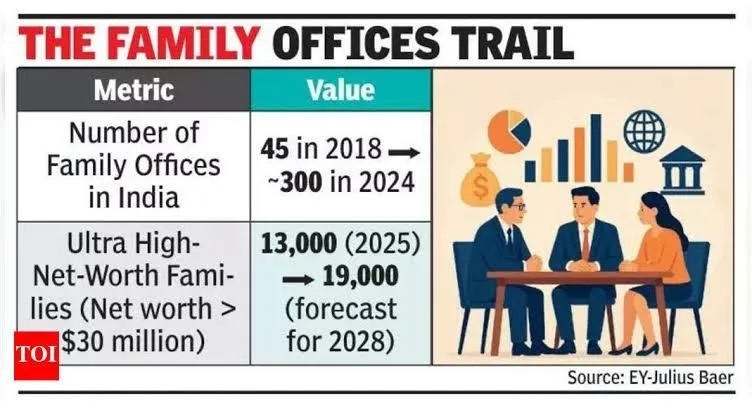
According to Knight Frank’s Wealth Report 2024, India’s population of ultra-high-net-worth individuals — those with more than USD 30 million — is expected to increase by 50.1% by 2028, one of the fastest growth rates globally. As wealth creation accelerates, family offices are emerging as essential platforms for capital preservation, intergenerational governance, and purpose-driven investing.
From Informal Holdings to Institutionalised Wealth
Historically, Indian family wealth was managed under personal or trust-based structures, often intertwined with operating businesses. That model is now giving way to institutionalisation. “Most promoter families have their holdings in individual names,” Bhatia explained . “There is no incentive for anyone to create a family office structure because India doesn’t offer a tax advantage, unlike some other countries globally.”
Instead, efficiency and governance have taken precedence. “Family offices can take many forms — a limited liability partnership, a private company, a trust, or even an AIF,” Bhatia explained. “Each structure carries its own tax treatment, and families choose what aligns with their objectives.”
Alternative Investment Funds (AIFs) have become the preferred vehicle for professional wealth deployment.
“Many families already run their own AIFs quietly,” Bhatia said. “They see them as investment vehicles, but in reality, these funds often form the backbone of the family’s investment architecture pooled by multiple family members.”
He emphasised that the core advantage lies in flexibility and autonomy. “There’s no regulatory overhang,” he noted. “If you have a couple of hundred million dollars and a family office, no one questions how you want to invest your money. It’s the most efficient way to manage wealth in India.”
This approach also allows families to separate business ownership from personal wealth. “People are starting to differentiate between the money they make in the company and their personal balance sheet,” Bhatia added. “That’s a fundamental shift.”
Governance, Purpose, and Professionalisation
As family offices mature, their focus is expanding beyond investment management to governance and professional oversight. Many families that once relied on company CFOs or long-time accountants for personal finances are now engaging independent advisors.
“The biggest shift is that families no longer rely on their company CFOs for personal wealth decisions,” Bhatia said. “They now engage professional advisors or multi-family office firms that bring independence and expertise and also regulated by SEBI as advisors or fund managers”
This professionalisation is driving the growth of multi-family offices that combine investment advisory with governance, succession planning, philanthropy, and lifestyle management. “You’re not only talking about investments,” he said. “It can be buying a yacht, global real estate exposure, aircraft financing or any other form of promoter financing, philanthropy, investing in experiences or legacy planning. Firms like ours bring that entire global ecosystem to the table.”
India is now estimated to have more than 330 family offices, up from fewer than 50 in 2018. The rise reflects a wider professionalisation of private wealth, with dedicated teams managing portfolios, compliance, and intergenerational engagement.
“Conversations about money are far more transparent today,” Bhatia noted.
“Our role is often to bridge perspectives — for some, wealth is about growth; for others, it’s about legacy and purpose.”
That purpose is increasingly formalised through an Investment Policy Statement (IPS), a governance document outlining long-term goals, capital allocation, and impact priorities. “IPS is not just about portfolio allocation,” Bhatia explained. “It’s about defining purpose — what does the family want to be known for.”
Cross-Border Ambitions and Purpose-Led Wealth
As Indian family offices grow in sophistication, many are benchmarking themselves against global hubs such as Singapore and Dubai, exploring offshore structures while maintaining domestic investment focus. “They are learning from these jurisdictions even as they build capabilities at home,” Bhatia said.
Purpose-led investing has become another defining theme, combining financial objectives with societal outcomes. Philanthropy, once conducted informally, is now being professionalised.
“We often find that younger members of the family, including daughters and daughters-in-law, are increasingly influencing these decisions,” Bhatia shared. “They want capital to be aligned with values — whether it’s education, healthcare, or sustainability.”
The democratisation of wealth management is also expanding the family office model beyond the ultra-rich. “This was earlier limited to the super-wealthy,” Bhatia said. “Now even families with USD 10–30 million (about 100–250 crore rupees), are having these conversations.”
Multi-family offices, he added, provide an integrated bridge for such households. “Families want specialists who can talk about investments, philanthropy, legacy, and even lifestyle,” Bhatia said. “You can have an in-house person, but that individual can’t know everything. Firms bring in the ecosystem and the right partners.”
As India’s wealth landscape matures, family offices are emerging not merely as custodians of capital but as architects of continuity and intent. “What we’re seeing is not just the creation of structures,” Bhatia concluded. “It’s a change in mindset. Families are no longer talking about how to make money — they’re talking about what to do with it.”





.png)