Across Asia, women are stepping decisively into the center of capital as leaders reshaping how wealth is governed, invested, transitioned, and grown.
From boardrooms in Singapore and Hong Kong to family enterprises in India and the Middle East, women are influencing decisions that determine not just portfolio returns but also legacy, governance, and generational continuity.
At Lighthouse Canton, the “Beyond InHERitance” series was created to recognise how women are influencing capital and doing so with clarity, discipline, and intent.
What began as a podcast miniseries is now expanding into a written platform, designed to deepen and document the voices of women across four defining pillars of the wealth ecosystem: Investing, Family Offices Stewardship, Succession, and Entrepreneurship.
REDEFINING THE CONVERSATION AROUND CAPITAL
The world of investing is undergoing structural change. An estimated USD 84 trillion is expected to transfer globally by 2045, with women poised to control a significant portion of that wealth.
Separate estimates from Boston Consulting Group project that women could control nearly USD 97 trillion in global financial assets by 2030, making them one of the fastest-growing and most influential investor segments worldwide.
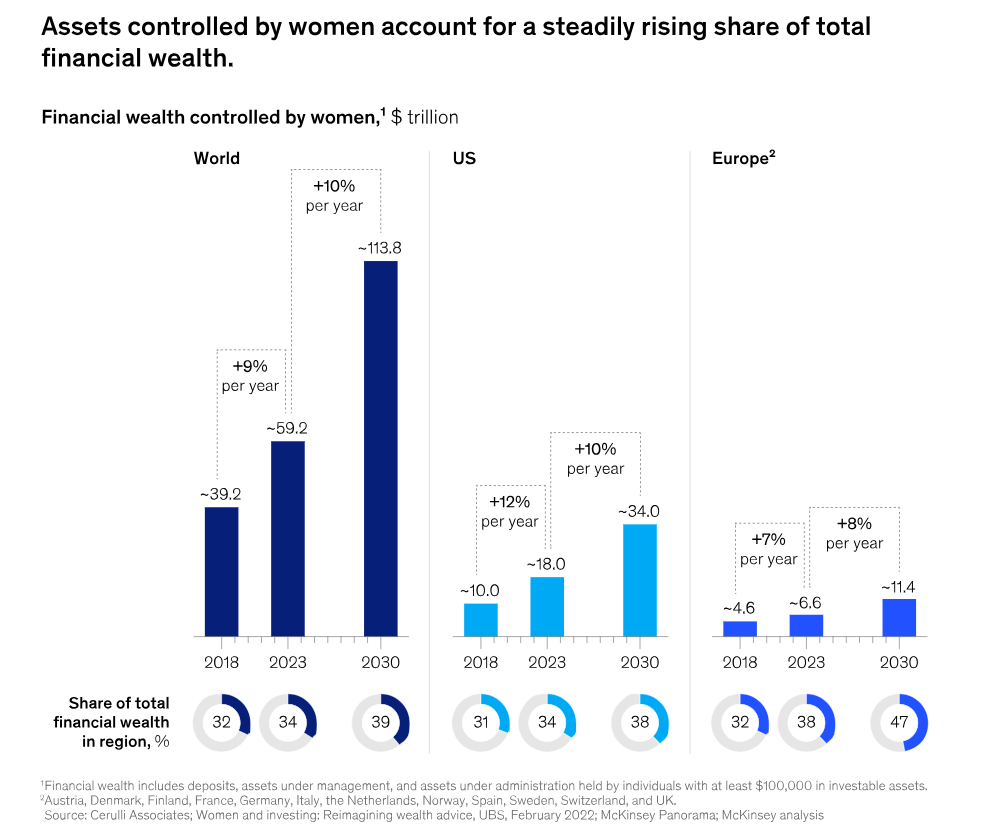
In Asia alone, the number of female high-net-worth individuals has risen steadily over the past decade, reflecting both wealth creation and generational transition.
But ownership is only part of the story. Influence is the larger shift.
Across the region, women such as Ho Ching, who led Temasek through transformative global investments, and Tan Su Shan, who built DBS's wealth management business into one of Asia's largest before becoming Group CEO, have demonstrated that capital leadership is as much about long-term conviction as it is about scale.
Women stepping into investment leadership are not simply replicating existing models. They are reframing them.
“When women step into investment leadership, the first thing that changes isn’t the asset mix, it’s the quality of the questions being asked,” said Charlene Lin, Managing Director, Strategic Growth (North Asia and Southeast Asia), at Lighthouse Canton.
“The conversation moves from ‘What’s the upside?’ to ‘What sustains this over a full cycle? Where is the alignment? And that shift changes outcomes.”
In asset and wealth management, this translates into a demand for transparency over unnecessary complexity. Product-first pitches give way to conversations about structure, governance, liquidity and long-term resilience. Due diligence becomes strategic. Questions of time horizon and alignment carry weight they rarely did before. It is a more exacting approach to investing, and a more enduring one.
INTEGRATING LEGACY WITH STRATEGY
If investing is about allocation, family offices are about stewardship.
Across Asia, family offices are professionalising at pace. India's family office sector has grown dramatically from 45 entities in 2018 to 300 in 2024, managing $30.00 billion in assets. Within these structures, women are increasingly stepping into formal leadership roles, chairing committees, shaping risk mandates, codifying governance.
In many Asian families, wealth is not abstract. It carries the weight of identity, reputation and the generations that came before. It is an inherited identity and inherited responsibility.
“In family offices, women often ask the question others are reluctant to confront: ‘If this goes wrong, who ultimately lives with the consequences?’" said Ratna Sharma, Executive Director, Private Client Business at Lighthouse Canton.
“That question forces discipline. It forces governance. It forces clarity.”
Women frequently act as integrators, balancing legacy real estate with new private market allocations, aligning entrepreneurial ambition with risk management, and ensuring liquidity buffers are intentional rather than incidental.
The focus shifts from momentum to foundation, governance before growth, continuity before scale. Capital becomes structured, purposeful, built to carry forward.
FROM ASSET TRANSFER TO LEADERSHIP TRANSITION
The “Great Wealth Transfer” is not a distant projection. It is unfolding in real time across Asia and the Middle East. Yet succession remains one of the most sensitive and under-structured areas of wealth management.
Many families have accumulated significant wealth, but rarely the clarity around what it is meant to do or become. Women stepping into succession conversations are changing that by moving the focus from inheritance to intentional transition.
“Succession is not just about transferring assets; it’s about transferring responsibility and decision-making authority with clarity,” Payal Devgan, Managing Director, Private Client Business, shared. “Without governance and communication, wealth can fragment faster than it compounds.”
Women leaders are increasingly driving structured dialogue around roles, voting rights, risk appetite and shared objectives. They are advocating for documented frameworks, defined accountability and professional advisory engagement.
Importantly, they are treating succession as a process rather than an event, one that integrates education, preparation and alignment across generations.
This disciplined approach strengthens both financial durability and family cohesion.
CAPITAL WITH PURPOSE
The final pillar of the Beyond InHERitance series examines the intersection of entrepreneurship and stewardship.
Across Southeast Asia and India, private capital is fuelling innovation ecosystems. In the Middle East, it is linked to diversification and national transformation agendas. Women are increasingly present on both sides of this equation, as founders building enterprises and as allocators directing capital with purpose and intent.
Figures such as Kiran Mazumdar-Shaw (founder, Biocon) and Raja Al Gurg (Managing Director, Easa Saleh Al Gurg Group) demonstrate this in practice — one building a biopharmaceutical enterprise that reshaped India's innovation landscape, the other stewarding a family conglomerate central to the UAE's economic growth, both directing capital toward impact that extends well beyond returns.
Women investors are increasingly building and scaling businesses and directing capital toward enterprises that combine governance strength with scalable innovation.
“Many women view investing and philanthropy as part of the same continuum,” Stella Lau. Managing Director, Wealth Management Greater China, observed. “It is not about choosing between returns and responsibility; it is about building durable outcomes, whether through markets, enterprises, or direct social impact.”
This does not imply diluted performance expectations. On the contrary, it reflects a holistic framework where sustainability, governance, and innovation are treated as drivers of long-term value creation.
Entrepreneurship and investing are viewed as interconnected. Capital becomes a catalyst, not only for growth but also for structural resilience and measurable impact.
EXPANDING THE PLATFORM
The expansion of Lighthouse Canton's Beyond InHERitance miniseries into written form marks the next phase of this conversation, amplifying the leadership already underway. It allows us to move beyond episodic dialogue and build a sustained platform highlighting how women across Asia are shaping wealth at every level, from portfolio construction and family governance to succession strategy and enterprise-building.
If you are navigating wealth, governance, entrepreneurship, or investment decisions within a family office, an institution, or your own enterprise, we invite you to join the conversation.
Because the capital women carry is not just financial.
It is strategic. It is generational. And it is redefining the future of wealth across Asia.





.png)