Capital is flowing into Asian private credit, but fragmented markets and sponsorless borrowers make deployment slower, costlier and harder to scale.

By Bernadette Gostelow, VP of Asset Management, Lighthouse Canton
“Between the idea
And the Reality
Between the motion
And the act.
Falls the Shadow.”
— T.S. Eliot, The Hollow Men
Asian private credit sits somewhere in the shadows. The capital is there. The need for capital is there. Yet the market that marries the two remains strikingly small.
At first glance, the diagnosis seems simple:
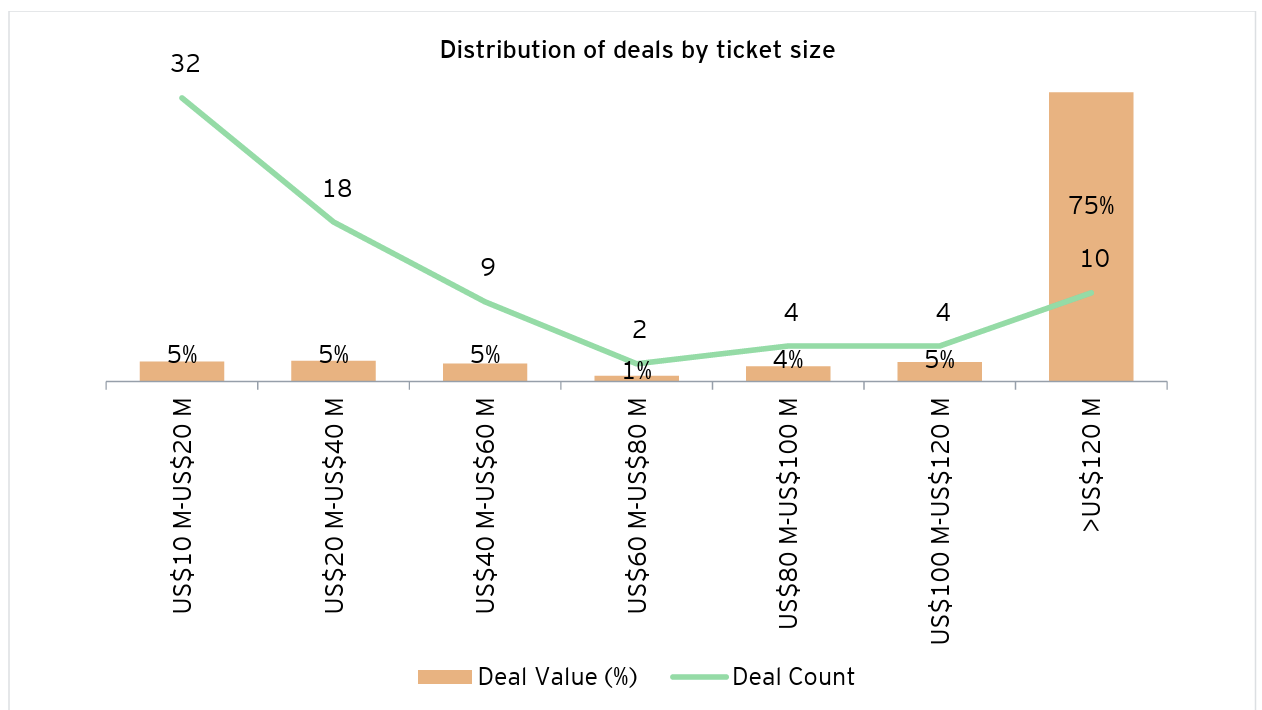
Asian private credit remains underpenetrated, accounting for only 1.4% of the region’s credit market. The market is also dominated by smaller transactions: 79% of APAC private credit deals with disclosed values in 2024 were below US$100 million.
India illustrates this pattern. According to EY India’s Strategy and Transactions report, transactions exceeding US$100 million represented just 18% of deal count in the first half of 2025, compared with 13% in 2024.
Source: EY India’s Strategy and Transactions Report
But the headline statistics obscure two important realities.
First, Asian private credit is unusually barbelled.
While conglomerate financings garner disproportionate attention, what constitutes “middle market” transactions in the West makes up much of Asian deal flow. These transactions are also frequently unreported.
India offers another useful example. Octus tracked US$4.63 billion across 144 private credit deals in H1 2026, averaging about US$32 million per transaction. Refinancing accounted for 50.7% of issuance. Octus’ H2 pipeline included Shapoorji Pallonji’s US$2.85 billion dual-currency financing, which could lift activity.
One prospective transaction was equivalent to more than 60% of the entire preceding half-year’s recorded Indian market volume. Headline deployment figures can therefore be materially influenced by sporadic conglomerate refinancings, obscuring the depth of the underlying mid-market.
Second, capital is arriving.
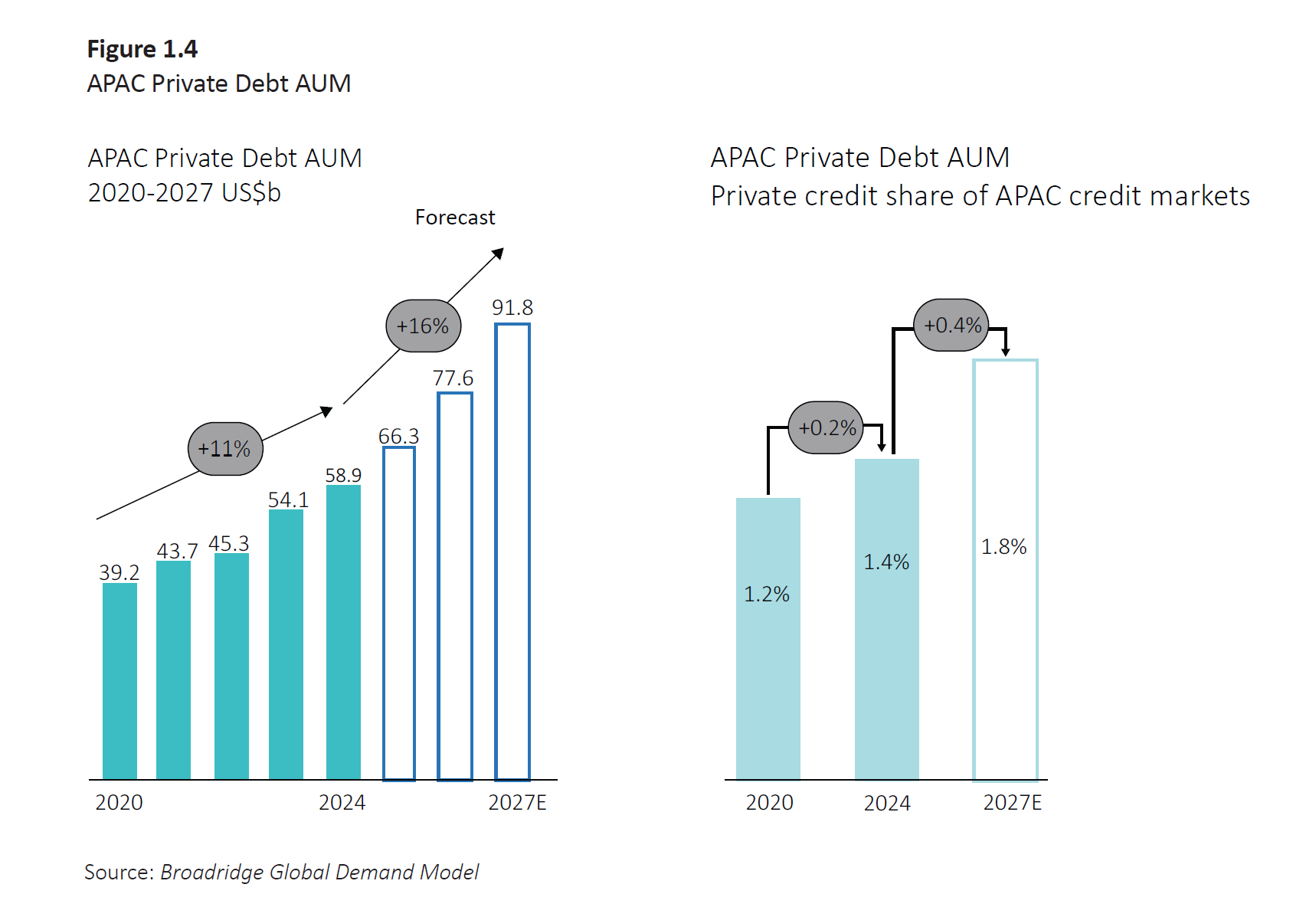
Asian private credit AUM stood at approximately US$59 billion in 2024 and is projected to reach roughly US$92 billion by 2027.
Asian family offices are also increasingly diversifying from public securities into alternatives, with Preqin estimating a 378% surge in family offices investing in alternatives since 2019, outpacing the global growth rate of 255%.
The more important question is this: if capital is flowing into private credit so rapidly, why is deployment difficult to scale?
The constraint is not capital or opportunity, but conversion. Many opportunities reach private credit desks in forms that require considerable time and expertise to assess, structure and turn into financeable transactions.
Unlike the US and Europe, where institutional private credit markets largely developed alongside deep pools of pension and insurance capital, Asian managers often operate with a more fragmented funding base. Wealth capital plays an unusually important and rapidly expanding role, projected to represent 28% of Asian private credit AUM by 2027, up from 23% in 2020.
That matters because the liability side of a private credit vehicle shapes the assets it can hold. Duration, liquidity expectations, ticket size, and concentration limits all affect what a manager can prudently originate.
The challenge becomes clearer when considering how transactions reach lenders.
An Alternative Credit Council survey of 28 private credit managers active in Asia found that 90% of transactions involved borrowers without private equity backing, compared with 31% globally. Direct borrower relationships, industry networks, and consultants collectively accounted for 73% of Asian origination. This reflects both the prevalence of sponsorless lending and the importance of relationship-driven origination in Asia.
This makes Asian private credit more relationship-driven than established US and European markets. It also means that many borrowers arrive without the institutional infrastructure typically associated with private equity ownership.
A sponsor does not necessarily make a borrower safer, but it can make the business more legible to lenders. Sponsor-backed transactions often come with organised data rooms, external due diligence, structured management access and established governance processes. Lenders can also evaluate the sponsor’s track record and financial capacity, although the sponsor is not necessarily obliged to provide further equity if the borrower encounters stress.
In sponsorless transactions, more of the analytical work falls to the lender.
Management accounts may need to be reconciled with audited figures. EBITDA adjustments, cash conversion and related-party transactions may require closer scrutiny. Reporting, governance and monitoring requirements may also need to be established through the loan documentation.
The constraint on deployment, therefore, is not simply risk appetite. It is underwriting capacity.
Asian private credit is not a single asset class in any meaningful underwriting sense.
A succession-driven Japanese SME loan, a Korean restructuring, a Vietnamese offshore-onshore structured facility, and an Indonesian growth financing may all sit beneath the same regional label while presenting radically different legal regimes, collateral packages, currency risks, and regulatory environments. A global manager can reap economies of scale from repeat sponsor-backed processes. It is considerably harder to industrialise bilateral Indonesian growth credit and Vietnamese structured lending in a meaningful way.
This makes smaller, bespoke loans expensive to process. Each transaction carries fixed costs for sourcing, due diligence, documentation and monitoring. Capital can therefore grow faster than the infrastructure needed to deploy it prudently.
The machinery does not scale linearly.
An LP can increase its allocation relatively quickly. A GP must build local sourcing networks, sector expertise, documentation standards and monitoring capabilities. That takes more time and resources.
In a region characterised by smaller transactions and heterogeneous markets, the marginal dollar of assets under management does not translate mechanically into a marginal dollar of lending.
The challenge facing Asian private credit is therefore not simply a shortage of capital or borrowers, but the institutional distance between the two. Managers able to combine local sourcing with rigorous underwriting can translate complex borrower needs into transactions suited to the requirements of capital providers.
That institutional distance may be precisely where the next opportunity lies.
Frequently asked questions:
Q1: How big is Asia's private credit market, and how fast is it growing?
A: Asian private credit AUM stood at roughly US$59 billion in 2024 and is projected to reach about US$92 billion by 2027. Even so, private credit represents only around 1.4% of the region's overall credit market, indicating substantial room for further market development.
Q2: What is a sponsorless private credit transaction?
A: A sponsorless transaction is a loan to a borrower without private equity ownership. It may lack the organised data rooms, external due diligence and governance structures that sponsor-backed deals have, so the lender has to do more of that analytical work itself, reconciling accounts, adjusting EBITDA, and structuring covenants and reporting requirements.
Q3: What is the difference between sponsor-backed, sponsorless and conglomerate private credit?
A sponsor-backed transaction involves a company owned or controlled by a private equity firm. The sponsor often brings established reporting, governance, due diligence and management-access processes, making the borrower’s risks easier for lenders to assess.
A sponsorless transaction involves a borrower without a private equity owner. These are common in Asia and may include family-owned businesses, founder-led companies and SMEs. Lenders often have to do more of the institutional work themselves, from reconciling financial information to establishing reporting requirements, governance protections and monitoring processes.
A conglomerate transaction involves a large, diversified corporate group. These deals are often much larger and attract disproportionate attention because they can materially affect headline market volumes. However, “conglomerate” describes the type of borrower, while “sponsor-backed” and “sponsorless” describe its ownership structure. A conglomerate financing could therefore also be sponsorless.





.png)