


The World Is Repricing Duration — Indiawill not be totally immune
Global bond yields are telling us something and we must listen! The era of costless fiscal expansion is over, and duration, particularly sovereign duration, is being re-priced globally. The US 10-year within sniffing distance of the psychological 5% threshold and the 30-year at levels last seen in 2007 are not just a US phenomenon. We are seeing every sovereign from Germany to France and Italy to UK, reprice. While the jury is not yet in, defining a conclusive reset, when the world's risk-free rate resets higher, it resets the discount rate on every cash flow generating asset, across markets. While EM’s and India look relatively better placed on their fiscal and debt to GDP positions, strong fundamentals don't buy immunity when the global cost of capital itself is being reset.
Thankfully we are not in 2013
Let us now shift the focus to India in the context of this global macro turbulence. The last time India had faced a similar situation was in 2013! Today, India is not the India of 2013, when taper tantrum fears had impacted Indian external accounts worryingly. The FCNR window that just closed after pulling in over $125 billion gives India a deliberate, pre-positioned buffer against exactly this kind of external shock. GDP growth too is resilient. Combine that with a $700 billion reserve buffer, India has the balance sheet to absorb a global yield shock. Consequently, the impact from global bond market repricing for India looks more like an air pocket than a dangerous stall.
Off Autopilot: Two Moves for the Turbulence Ahead
While India cannot claim total immunity to a global bond market repricing, a fortified balance of payments and the FCNR buffer, alongside resilient domestic growth, mean the impact on Indian equities is likely to look more like an air pocket than a worrying stall. However, the auto pilot will have to be disengaged, and the captain’s eye must be firmly on every compass and navigation tool, until we have exited the air pocket. With the air-pocket as the diagnosis, we believe the portfolio response must be two-fold; Rotate up the quality curve and into sectors and businesses whose earnings are insulated from this specific shock until the global repricing finds a floor. Use the correction to buy quality and own parts of the market relatively insulated from the discount rate move. We see two sectors that investors could look at in the current environment.
Time to buy Indian Banks – Quality on sale
India's own rate cycle looks like it may be turning: the RBI's August MPC minutes carried a muted hawkish tone, with one Deputy Governor pushing for higher rates and the Governor flagging policy "recalibration." A rising domestic rate environment is structurally good for bank margins: loan yields reprice up faster than deposit costs, particularly for banks with a large low-cost current-and-savings-account base. Banks are entering this tightening phase with a massive liquidity cushion, heavily reinforced by recent FCNR flows. Momentum in credit growth appears highly resilient due to, secular demand across retail loans, mortgages, and now, corporate credit. Indian banks (Nifty Bank Index) trade below their five-year average multiples with clean asset quality, which is quality on sale. Balance sheets are the strongest in a decade: capital ratios high, provisioning comfortable.
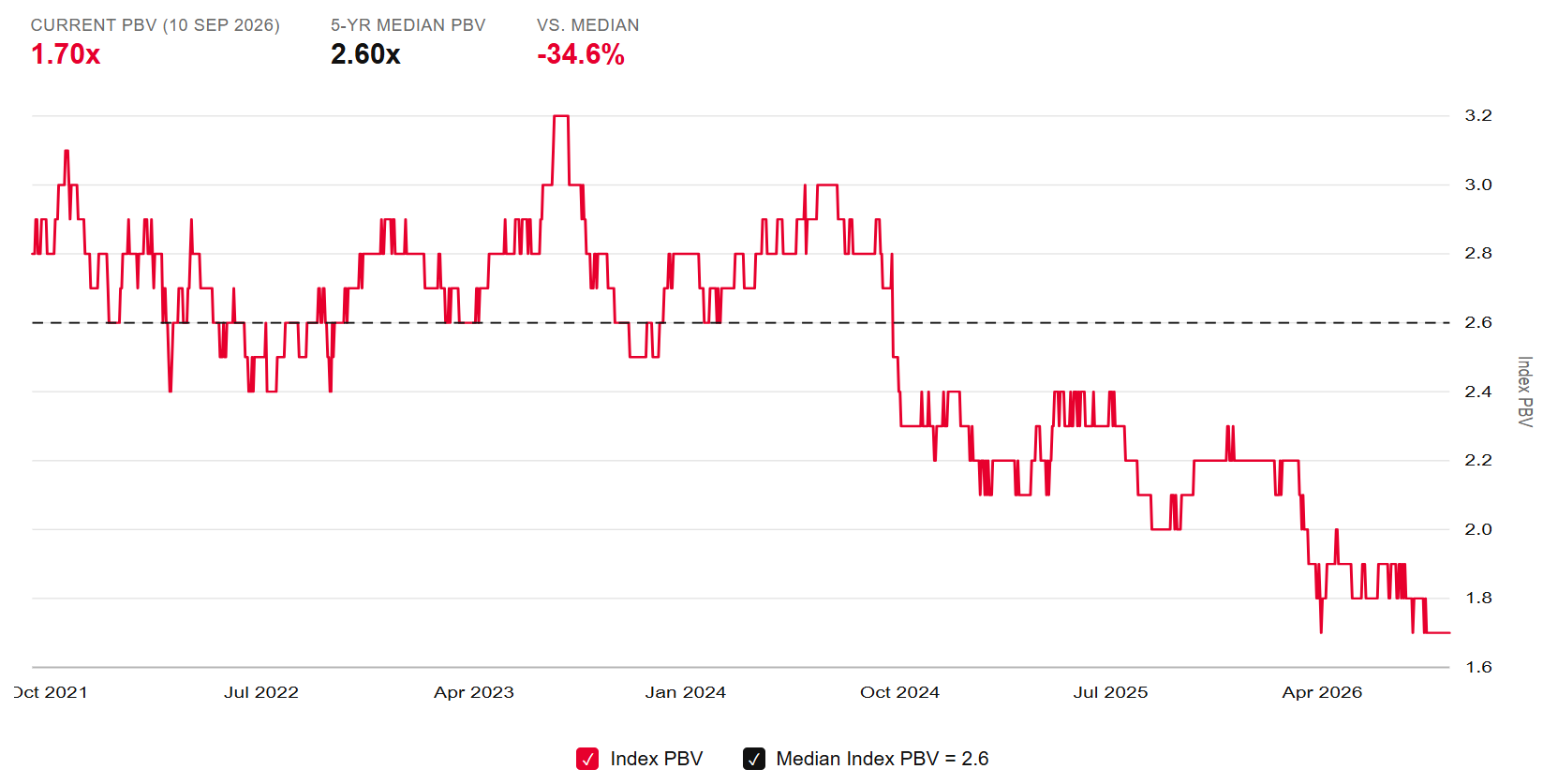
Nifty Banks valuation versus five-year median valuation
Source: Screener
Indian Pharmaceuticals and organized hospitals – A prescription for resilience
India's domestic pharmaceutical market is growing at a double-digit pace driven by structural shifts toward chronic care and resilient pricing power. The Indian Pharmaceutical market grew by 10.7% yoy in August 2026 as per the latest pharma tech report. Chronic and lifestyle-driven therapies — cardiac, anti-diabetic, oncology — are the fastest-growing segments as India's disease burden shifts toward the conditions of an aging, urbanizing, more affluent population, and the emerging anti-obesity category, now drawing Novo Nordisk and Eli Lilly into partnerships with leading Indian companies, is arguably the first genuinely premium-priced growth vertical India's domestic market has seen in a generation. Pharmarack officially lifted its 2026 full-year growth projection to 11.3%, stating that 2026 is on pace to be the best-performing year for Indian pharma in half a decade. Some of the beneficiaries of this trend include Sun Pharma, Torrent Pharma, Abbott, IPCA and CIPLA.
Organized healthcare through listed hospital stocks is a good place to add in the current market air pocket. India is witnessing a massive trend toward organized healthcare where large listed hospital chains are taking market share from a myriad of small clinics and unorganized standalone hospitals. Regulatory tightening, insurance penetration and the need for high investments in state-of-the-art medical equipment is driving massive growth in organized healthcare. Leading hospital chains are compounding revenue at 12-20% annually with healthy occupancy running 70-75% and premium operators above 80%, while average revenue per occupied bed keeps expanding as hospitals shift the mix toward oncology, robotic surgery and other high-value specialties.


.png)


.png)
