


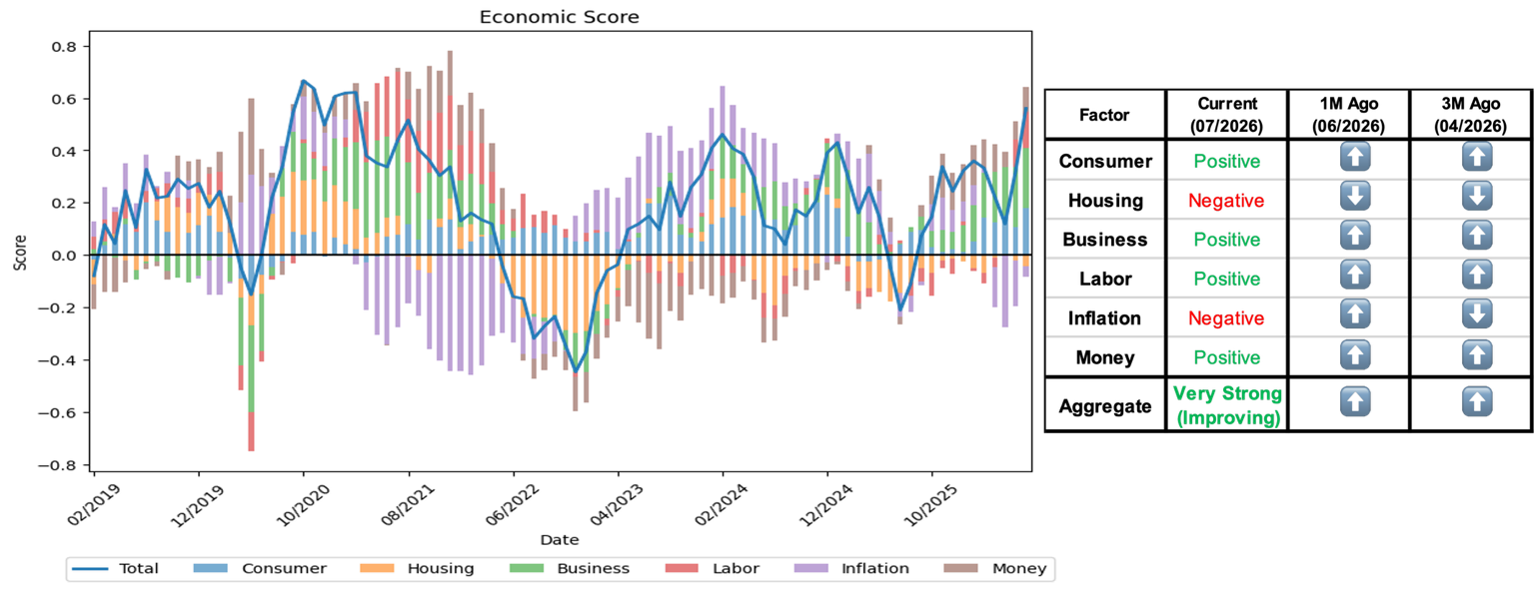
Inflation surprised to the downside, PMIs are accelerating, and earnings breadth (hyper-scaler capex) is intact, and rising. On our proprietary economic nowcaster (scored 1–5), the head now reads 5.
Down from highs, semiconductor stocks in a downtrend, exceptional volatility in semiconductors, memory – The tape is pricing a tail risk the head hasn’t yet been asked to price.
Nearly three months ago, in the first Head over Heart (Headover Heart, 07 May 26) the setup was clean - price action (“heart”)screamed conviction, fundamentals (“head”) screamed caution – we went with the“heart” – and it worked. The S&P and Nasdaq did not just hold their highs, they extended them through May and early June. Roxette had it rightthirty-eight years early - sometimes you really do have to listen to your heart.
Today the dichotomy has flipped, and it is the more uncomfortable version of the two. The head has firmed. The heart has not. Inflation cooled sharper than expected. Business activity is accelerating. Earnings are, for the most part, still beating. And yet the tape has spent the back half of July giving ground. While headline volatility is only marginally higher, underthe hood, especially for semiconductors and particularly for memory, it’s off the charts. If Part 1 was about trusting a rally the data hadn't caught up to, Part 2 is about a market refusing to trust data it has already been given.
The difference this time, the reason for the heart's hesitation -oil back at $100 and a market that is unwilling to accept negative free cashflows. Is it just about oil?
Ultimately, fundamentals and price action need to align – eitherthrough the inflation monster raising its head (and all the attendant growthrisks) OR price action alignment through a reversal of the recent swoon.
The bias remains with the heart. Wetrusted it in May and were paid for it; the instinct now is to trust it again -not by default, but because the head has actually done the work this time toearn that continuity. Stay invested where the head's case is strongest -cooling inflation, accelerating activity, and earnings breadth that holds onceyou look past the hyper-scaler capex.
But there is a second, more tactical answer sitting inside the same question, and it may be the more useful one right now. The heart isn't only flinching, it is overpaying for insurance. The elevated volatility, especiallyin memory names is suggesting 50%+ moves until the end of the year - that gap, between fear priced and fear justified, is not just something to sit through. It is something to sell. The elevated premium is itself the opportunity. This is the heart at its most useful - not a signal to follow blindly, but amispricing to harvest. Stay with the heart's bias to remain invested, andget paid by the very fear that's making it wobble.
DRAM ETF – Expected Move +/- 45% (18 Dec 26)
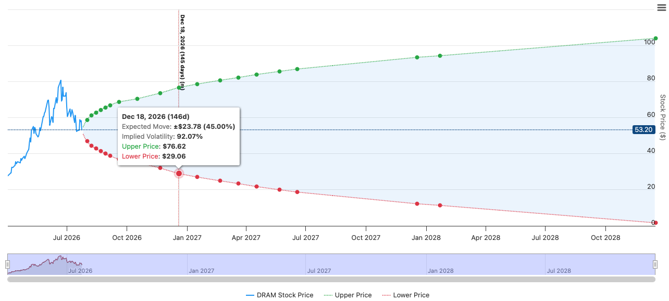
The confirm / deny framework - and the opportunity hiding in the fear
The head has earned a hearing. Whether the heart follows depends on a short list of things resolving in its favour.
CONFIRMATION SIGNALS - heart (price action) re-aligns with head (fundamentals)
- Diplomatic track produces a durable de-escalation, and Brent settles back into the $70–80 range.
- July CPI (due 12 August) confirms the disinflation trend held despite the energy spike, i.e., the June print wasn't a fluke about to be reversed.
- Fed, at this week's meeting, leans on the growth/inflation mix rather than the oil headline - no hawkish surprise.
- Q2 guidance from the remaining hyper-scalers (Microsoft, Meta, Apple next week) stabilises capex language rather than escalating it further.
- Volatility subsides – the semiconductor memory names that broke down in July stop making new lows.
DENIAL SIGNALS - heart (price action) is right to worry
- Strait of Hormuz incident count rises again; Brent re-tests or exceeds the mid-July $100+ high.
- Israel is drawn in from the sidelines, converting a supply-shock scare into a broader regional escalation.
- July CPI reverses higher on the energy pass-through, forcing the Fed's hand toward hawkish.
- Capex guidance from the remaining Mag-7 reporters this month follows Alphabet's lead rather than offsetting it.
- Credit spreads, still quiet, start to widen - the signal that macro stress is reaching balance sheets, not just multiples.
What the head is saying
The head did the one thing it failed to do in May, it showed up with better numbers. June CPI fell 0.4% month-on-month, the sharpest decline since April 2020, pulling the annual rate down to 3.5% from 4.2%. Core came in at 2.6%, cooler than every estimate on the street. Layer on a flash PMI print at an eight-month high, and the "the macro foundation is not broad enough" critique from Part 1 looks, for a moment, like it is being answered.
This is not nothing. It is the first time in this cycle that inflation, growth, and earnings have pointed the same direction simultaneously rather than trading off against each other.
But - and this is the part the head needs to sit with - that CPI print measures June. The ceasefire that cooled energy prices through most of last month is precisely what broke in the first week of July. The head's best data point predates the very event the heart is currently pricing. A good report card from a class that already ended is not a guarantee for the exam that's running now.
Lighthouse Canton Proprietary Economic Nowcaster
Why the heart is fluttering
Call it Hormuz, not Iran. The distinction matters. This is no longer a story about a war with a start and an end date - it is a story about a shipping lane. Iran tested the June MoU by firing on commercial vessels in early July; the U.S. responded with renewed strikes; by the third week of the month, drone activity was reported near U.S. positions in northern Iraq, and Brent had round-tripped from below $70 to above $100 and back toward $99 inside a matter of weeks. How this plays out is less determined by logic and more by megalomania – but what is guaranteed is volatility.
Markets can underwrite a war with a horizon. They struggle to underwrite a chokepoint with a temper. That is the asymmetry the heart is pricing - not the war itself, but the option value of it getting materially worse, even before the next CPI print lands.
Layer onto that a second, unrelated source of heartburn - a Q2 earnings season that has reopened the AI-capex debate we flagged in Part 1. Alphabet's capex guide for the year effectively doubled, and the stock fell hard after-hours; Microsoft, Meta, Amazon, and Oracle all traded down in sympathy. Tesla's miss, on an otherwise decent quarter for EVs broadly, added to the sense that the market's five to ten leadership names - the same ones that did 90-100% of the move in Part 1, are now the source of the wobble, not the cushion against it.
Breadth on the surface is stable – BUT, all but one of the 30 stocks in the SOX Index, are trading below short-term moving averages. At the broader Nasdaq 100 level, the downtrend (at least the short-term one) is visible in 70% of stocks. The heart isn't panicking indiscriminately. It is unwinding exactly where the concentration always was.
Nasdaq 100 & Brent

The earnings verdict, redux
We said in May: "AI monetisation is real and accelerating at Alphabet and Microsoft. At Meta and Amazon, the spend is scaling faster than the returns - and the market noticed." Two and a half months later, the market noticed again, this time about Alphabet too.
The proof, still standing:
- Cloud growth at the hyper-scalers remains strong; the underlying demand signal hasn't broken.
- July flash PMI improvement suggests the real economy hasn't cracked under the tariff and rate backdrop.
- Earnings beats are still outnumbering misses this season - this is a leadership problem, not a market-wide one.
The concern, sharper than in May:
- Combined hyper-scaler 2026 capex guidance has moved decisively past the $700bn marker flagged in Part 1 - Alphabet's revision alone was the single largest catalyst for Thursday's drop.
- Free-cash-flow compression at the biggest spenders is no longer a Meta/Amazon story. It is becoming a sector story.
- The market's patience for "trust the payback timeline" - finite in May, is visibly shorter now.
Hyper-scaler Capex
.png)


.png)

.png)
%20(14).png)
.png)