One of Chesty Puller’s famous quotes was “Pain is weakness leaving the body”. Look at the hard-asset and defence complex over the past four months and you see the same picture.
Defence tech is down roughly 20% from its highs. Uranium and nuclear names have shed a third of their value since January. Platinum and palladium gave back most of the summer rally in six weeks. Metals and mining cooled off after doubling the S&P 500 year to date. On the surface, that looks like capitulation.
It isn't. It's a regroup, not a retreat.
The Call
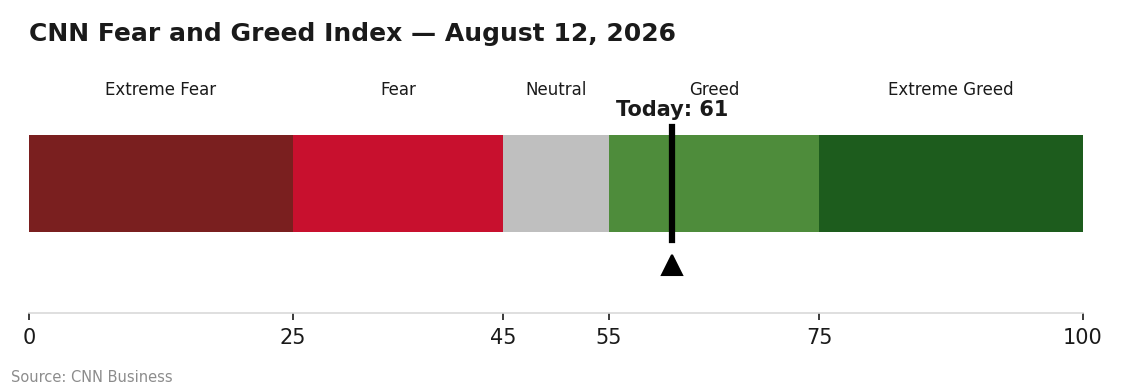
This is not an everything is cheap call. The broad market's Fear and Greed reading of 61 tells you sentiment has moved on to celebrating AI infrastructure and left the hard power and hard asset trades behind. That gap is the opportunity, and it argues for being selective rather than buying the basket blind.
- Own the theme through XME and the sector ETF complex over single names carrying contract specific risk, with KTOS as the one name we would own outright given the guide raise.
- Platinum over palladium. within platinum group metals. The structural deficit case is real for one metal and questionable for the other.
- Add on confirmation, not anticipation, in uranium and nuclear. We want URA back above its 20 and 50 week averages before adding exposure, and NLR's move this week is the leading indicator to watch.
- Metals and mining (XME) as the least controversial way to play the theme. It never broke trend, so it never needs to be repaired.
The Mood vs. The Math
The broad market is priced for good news. The CNN Fear and Greed Index sits at 61, in Greed territory, with the Dow at fresh record highs. The AAII sentiment survey shows bullish readings at 37%, still below the long run average of 37.5%, with bearish sentiment at 38%, actually the higher of the two. That is a market climbing a wall of worry even as it prints new highs.
None of that calm has reached the sectors that were the story of 2025. When the broad tape is priced for good news and a specific basket tied to the most durable, government funded, multi decade themes in the market gets left behind, the question is not whether something broke. It is who sold, and why.
The Mood
Bernstein pinned the defence drawdown on capital rotation, not fundamental deterioration. Higher discount rates compress the long duration contract cash flows defence investors had been underwriting at premium multiples, and renewed optimism around an Iran deal eroded the geopolitical risk premium that had been one of the sector's few remaining supports.
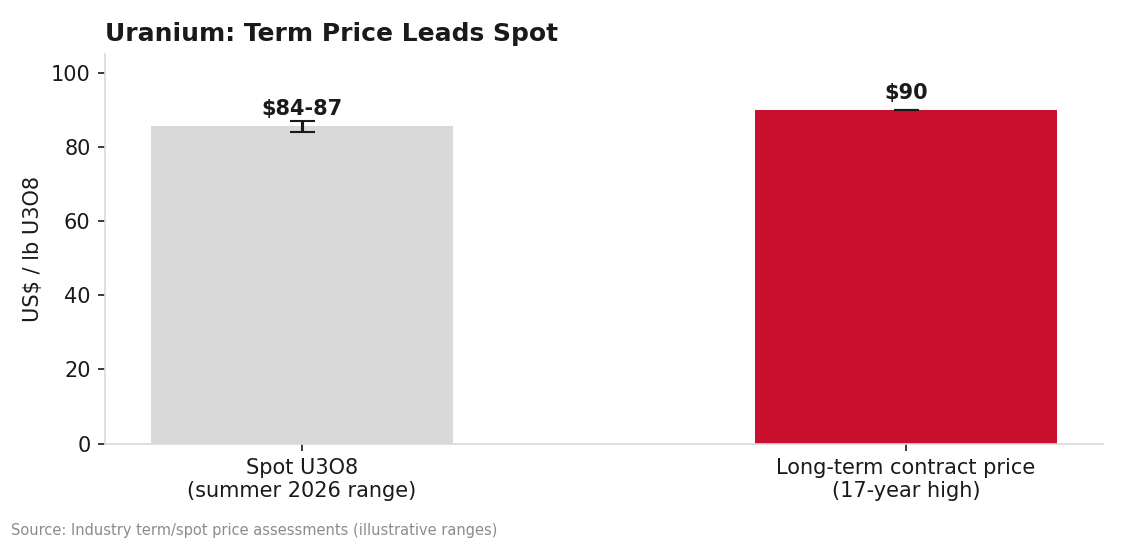
Uranium and nuclear sold off as investors moved from celebrating the scale of AI infrastructure spending to interrogating it. That is a sentiment shift, not a breakdown in the nuclear thesis. Spot uranium consolidated in the $84 to $87 range through the summer even as long term contract prices pushed to $90 per pound, the highest level since 2008.
Palladium and platinum cooled after a parabolic run, and copper equities have been trading around the prospect of a Section 232 tariff decision due in 2026 for phase in from 2027. That is a timing story, not a demand story.
The Math
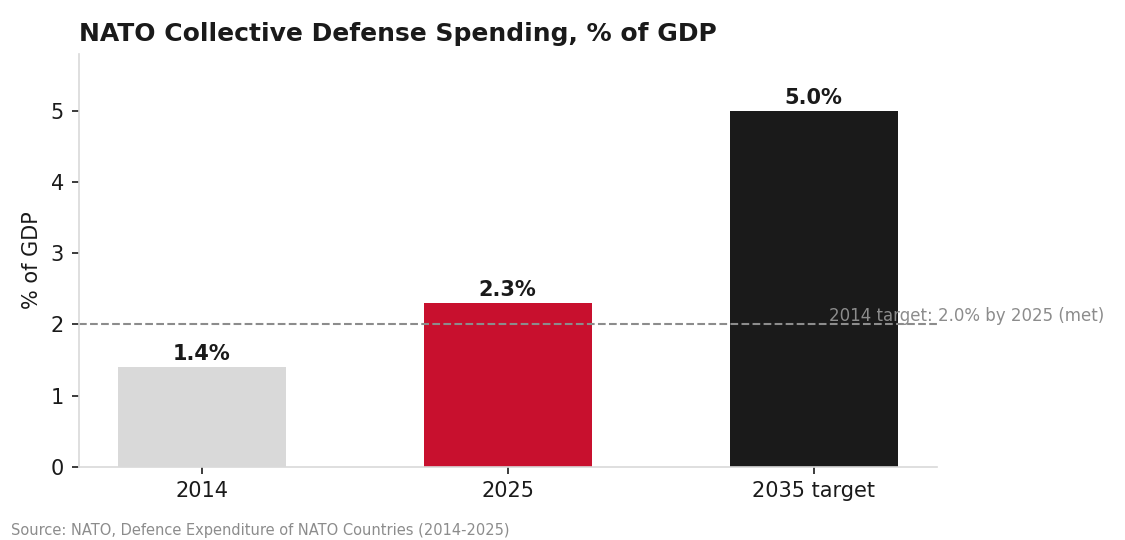
NATO's 5% of GDP commitment by 2035, split between 3.5% core defence and 1.5% broader security investment, is now policy rather than aspiration. European Allies and Canada already posted a 20% increase in defence spending in 2025 versus 2024.
Ukraine has taught every general staff in the world that three quarters of battlefield casualties now come from drones, that a few hundred dollar quadcopter can kill a multi-million-dollar tank, and that legacy platforms need replacing at a pace defence budgets have not yet priced. The most recent US defence authorization earmarked $1.7 billion for small drones, up from $398 million in 2022.
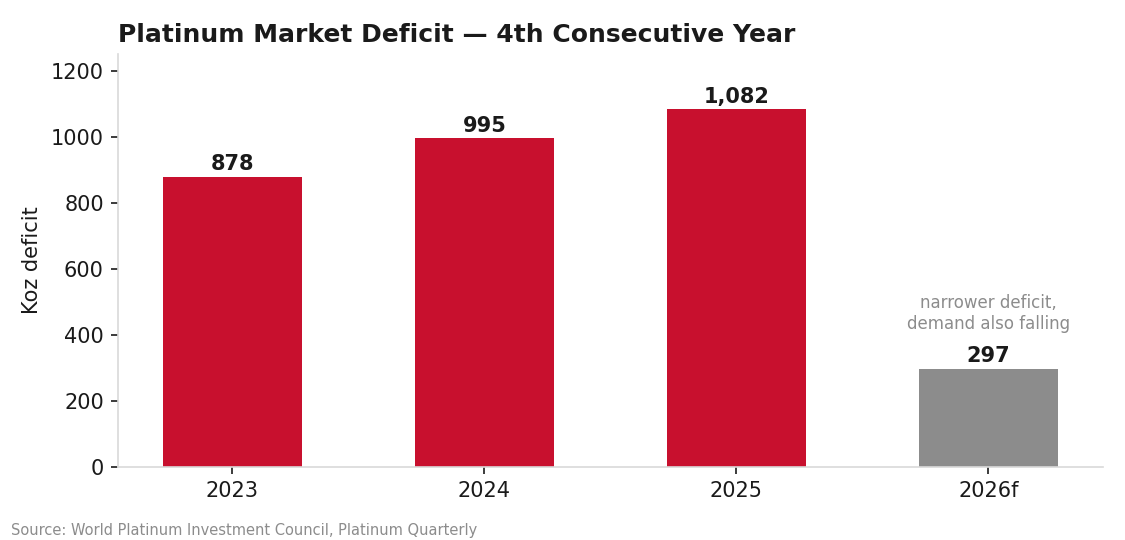
On the nuclear side, AI data center demand could add over 1,000 terawatt hours of draw (by 2030), and Big Tech is now signing direct power purchase agreements with reactor operators, Microsoft and Constellation at Three Mile Island being the clearest example. On platinum group metals, the World Platinum Investment Council forecasts a 297,000 ounce deficit in 2026, the fourth consecutive annual shortfall, with above ground stock down to under three months of global demand even as total demand falls.
Implication: None of the structural drivers changed in the last four months. Only the price did. That gap between the mood and the math is the trade.
Reading the Charts
All eight names below closed last week up between 1% and 15%. All eight show weekly MACD histograms flipping from red to green for the first time in months. Six of the eight show RSI crossing back above the 40 to 50 zone from oversold. That is not a coincidence. That is a basket being bought at the same time by the same kind of capital. The dispersion in strength across the group tells you where to lean first.
Defence: Beat and Raise, Sold Anyway
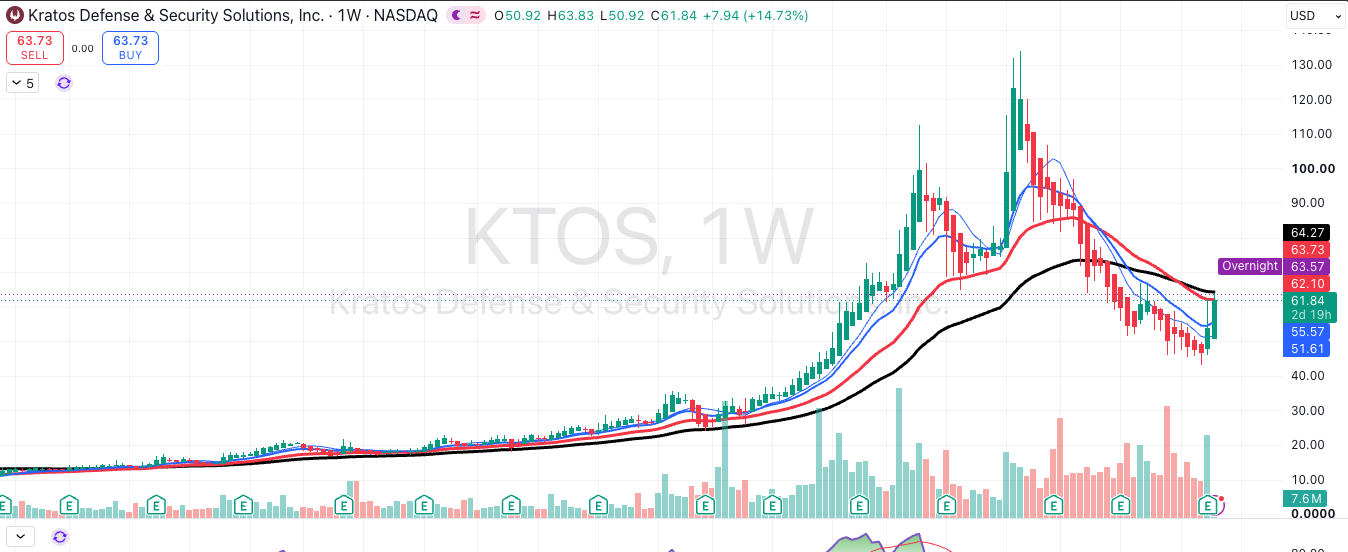
Kratos (KTOS) beat on both lines in its latest quarter and raised full year guidance to $1.75 to $1.81 billion in revenue, with backlog above $2 billion, 72% funded. The stock is still down sharply from its November highs, and this week's 14.7% rally is testing the 200-week average from below for the first time since spring, with RSI curling back through 50 and the MACD histogram flipping positive.
Outlook (KTOS): A reclaim of the 62 to 64 zone confirms the bounce has legs. Failure there keeps this a range trade back toward 50 to 55.
Kratos Defence & Security Solutions (KTOS), weekly
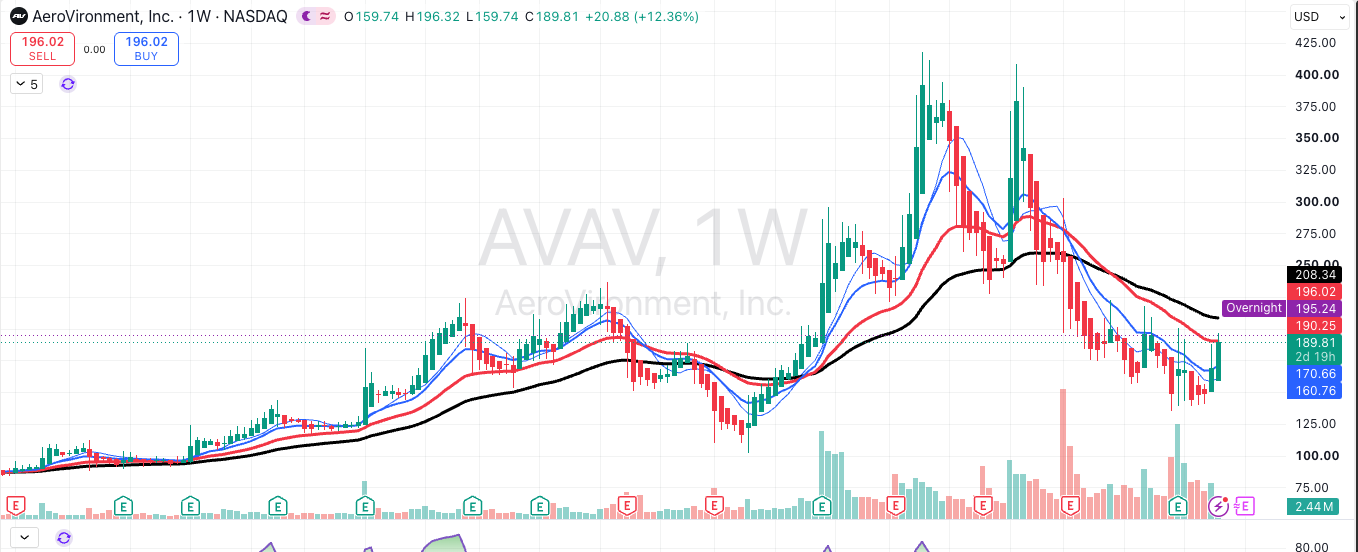
AeroVironment (AVAV) is a different case and deserves more caution. It lost a contract that cut $1.7 billion from its long-term outlook, a real backlog impairment rather than pure multiple compression, even against a still solid $1.2 billion funded backlog and a 1.4x book to bill ratio. It rallied 12.4% this week and RSI is crossing 50, but we would want the fundamental story to stabilize before chasing the bounce.
Outlook (AVAV): Watch the next print for guidance before adding. The technical bounce is real. So is the backlog cut.
AeroVironment (AVAV), weekly
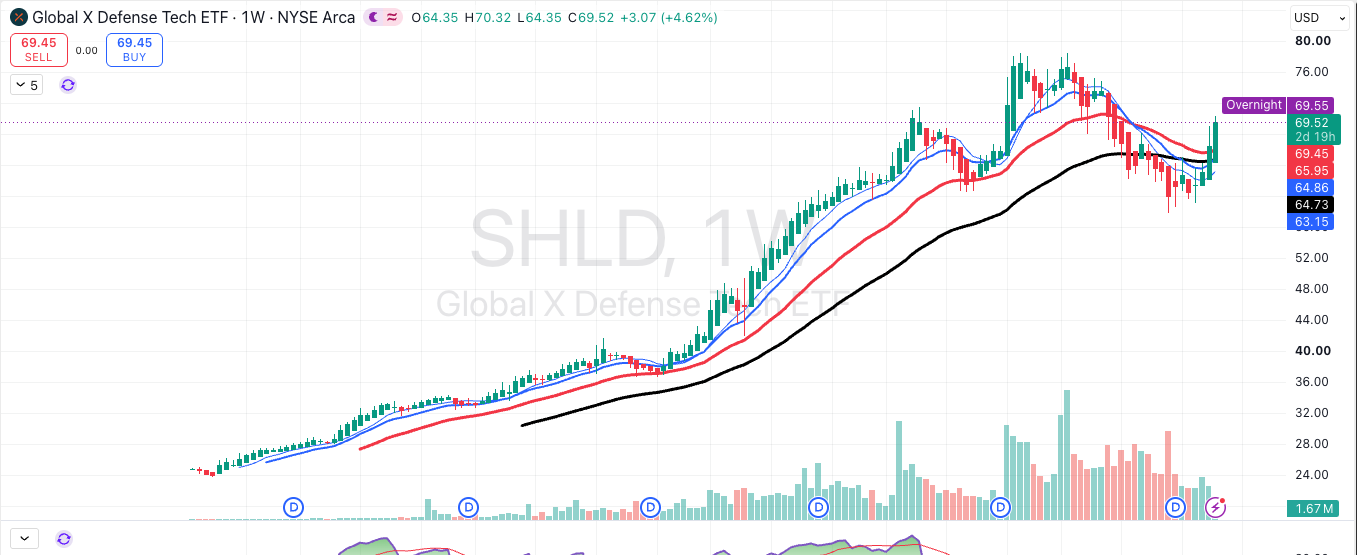
The Global X Defence Tech ETF (SHLD), the cleanest proxy for the sector, rallied 4.6% this week and is testing its 200-week average from below after round tripping from the mid 70s.
Implication (SHLD): The ETF is a cleaner way to own the NATO 5% theme than chasing single names carrying contract specific risk.
Global X Defence Tech ETF (SHLD), weekly
Nuclear and Uranium: Term Price Leads, Equities Lag
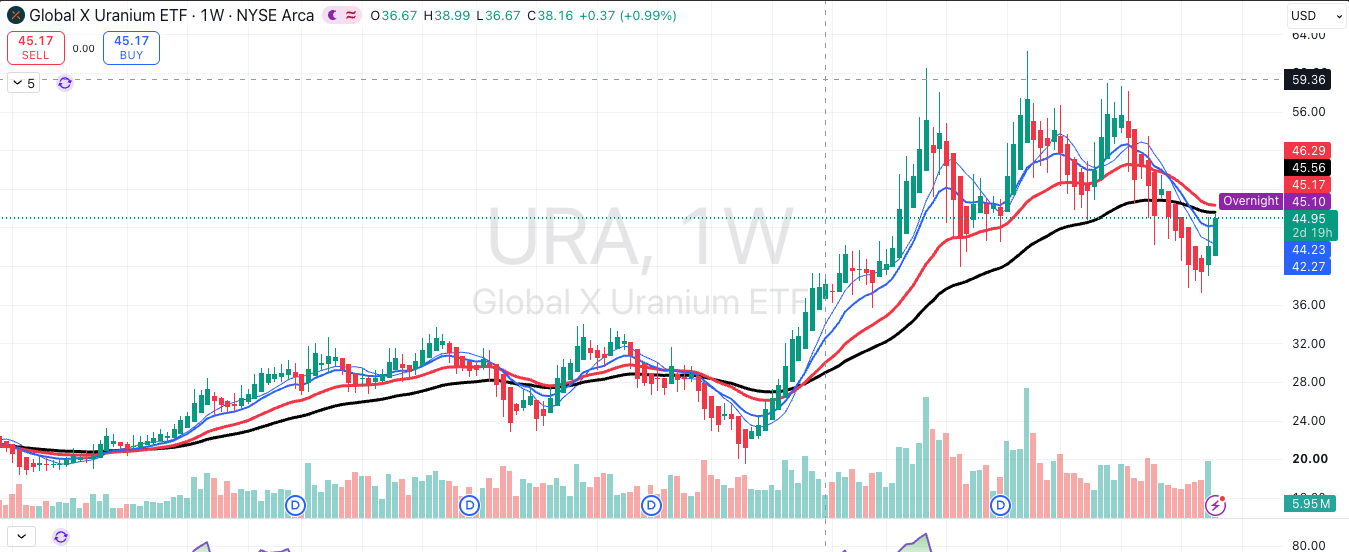
The Global X Uranium ETF (URA) is the laggard of the group, up only 1.0% this week with RSI stuck at 47 and price still below its 20, 50 and 200 week averages. The VanEck Uranium and Nuclear ETF (NLR) put in a stronger week, up 5.0%, with RSI at 44 but a clear turn in the MACD histogram.
Global X Uranium ETF (URA), weekly
VanEck Uranium and Nuclear ETF (NLR), weekly
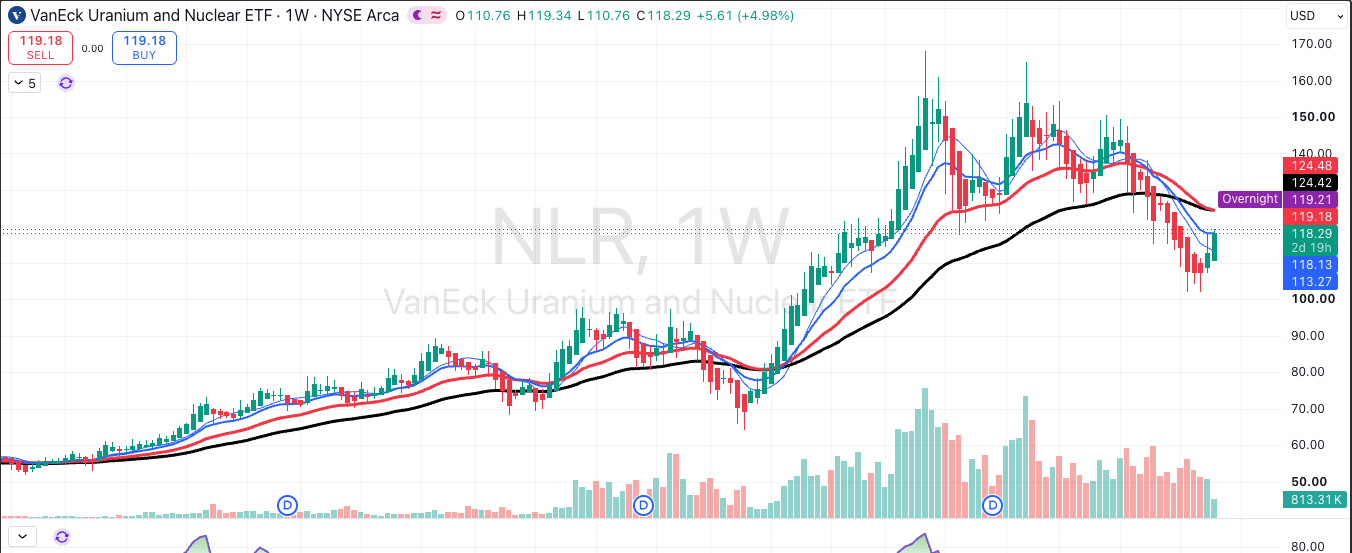
The gap between the two matters. Utilities are locking in long term uranium supply near $90 a pound, a 17 year high, while the equities are still pricing something closer to distress.
Outlook (URA & NLR): We want URA back above its 20 and 50 week averages before calling the bottom in. NLR's stronger bounce this week is the earlier tell to watch. That said, both URA and NLR appear to be in early stages of rebound.
Platinum Group Metals and Miners: One Deficit, One Surplus Risk
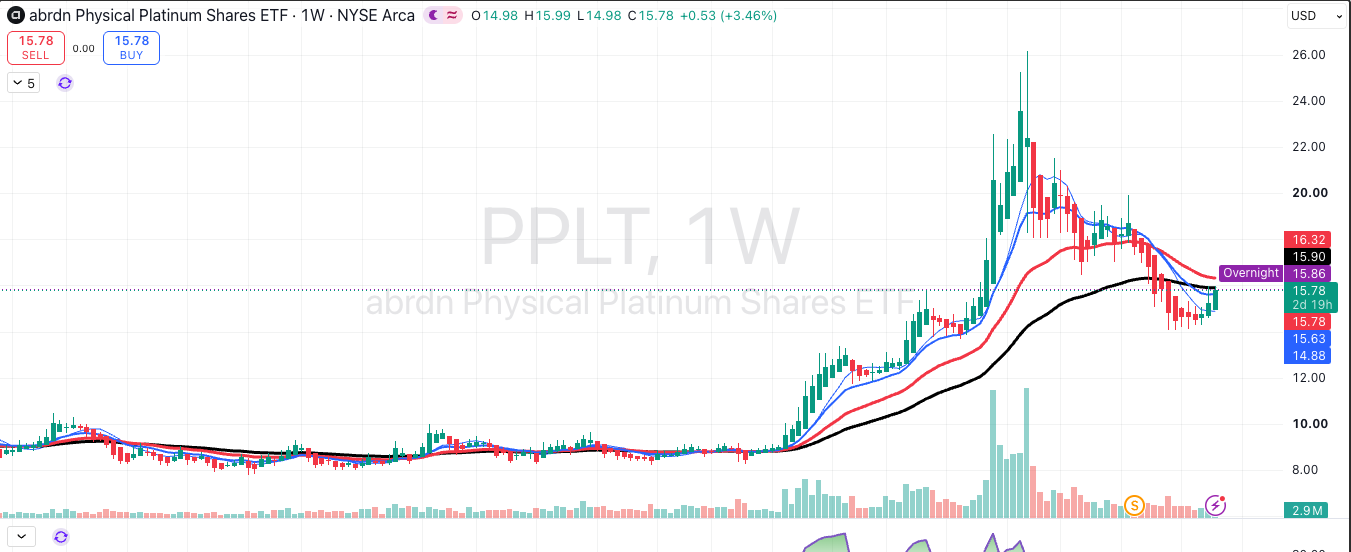
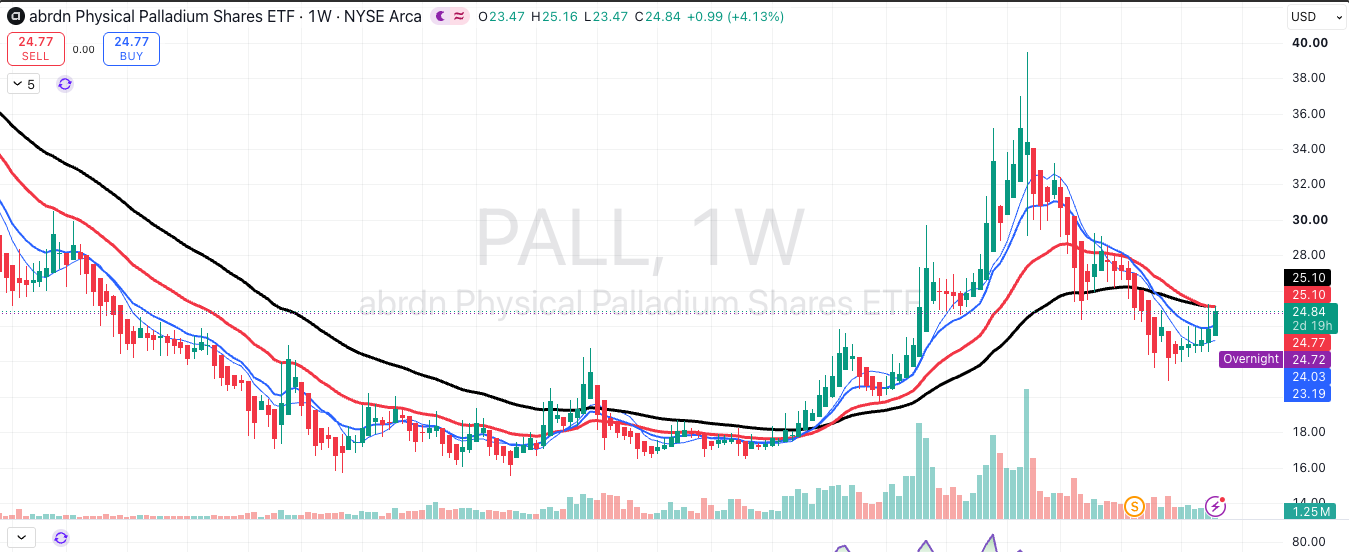
Platinum (PPLT) rose 3.5% this week and palladium (PALL) rose 4.1%, but the fundamental paths diverge from here. The World Platinum Investment Council's fourth consecutive annual deficit forecast is a platinum story. Palladium is the metal institutions are flagging as a surplus risk into 2027. Same chart pattern this week, different next chapter.
abrdn Physical Platinum Shares ETF (PPLT), weekly
abrdn Physical Palladium Shares ETF (PALL), weekly
Bank of America's Q4 platinum target of $3,000 and JPMorgan's more sober $1,800 to $1,950 bracket the debate, but even the conservative case implies upside from spot near $1,730.
Implication (PPLT & PALL): Prefer platinum over palladium within the PGM complex. The deficit argument only holds for one of the two, the same asymmetry we have flagged before between gold and silver.
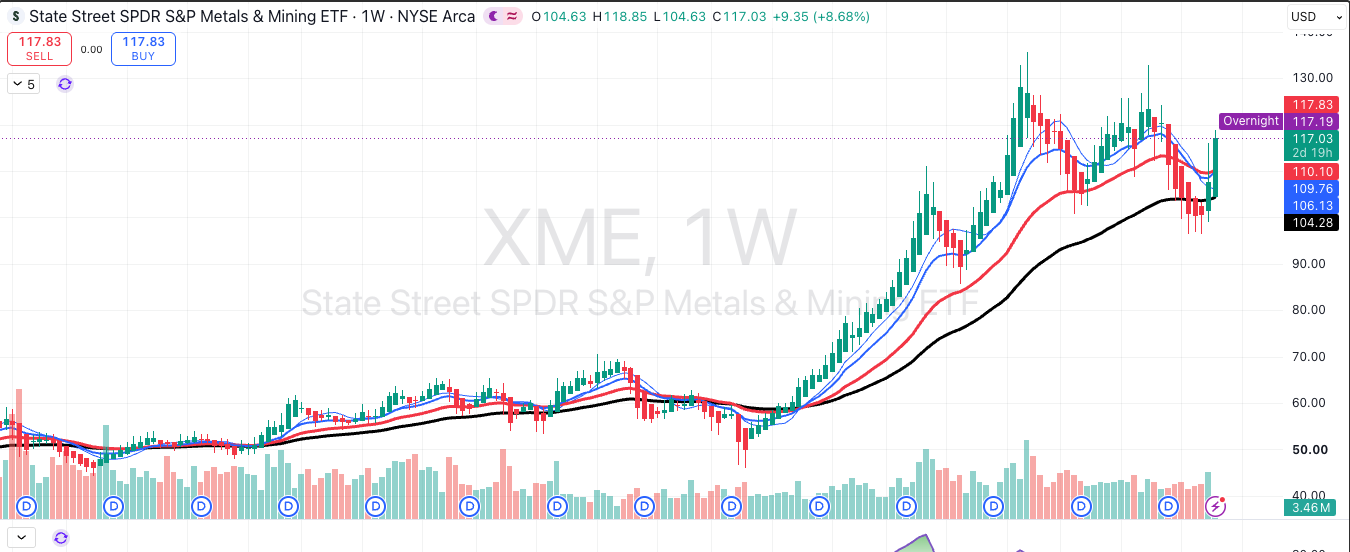
State Street's SPDR Metals and Mining ETF (XME) is the tell for the whole basket. It never broke its uptrend. The 200-week average is still rising, price never traded below it, and this week's 8.7% move is a pullback resolving inside a bull trend, not a bottoming process inside a bear one.
Implication (XME): That is what a real structural theme looks like when sentiment gets shaky. It dips. It does not break.
The Call
This is not an everything is cheap call. The broad market's Fear and Greed reading of 61 tells you sentiment has moved on to celebrating AI infrastructure and left the hard power and hard asset trades behind. That gap is the opportunity, and it argues for being selective rather than buying the basket blind.
- Own the theme through XME and the sector ETF complex over single names carrying contract specific risk, with KTOS as the one name we would own outright given the guide raise.
- Platinum over palladium. within platinum group metals. The structural deficit case is real for one metal and questionable for the other.
- Add on confirmation, not anticipation, in uranium and nuclear. We want URA back above its 20 and 50 week averages before adding exposure, and NLR's move this week is the leading indicator to watch.
- Metals and mining (XME) as the least controversial way to play the theme. It never broke trend, so it never needs to be repaired.
What Would Change Our Mind
A retreat from NATO's 5% commitment at the next review, a stall in uranium term contracting below $85, or a supply surprise out of South African or Russian PGM output that erases the deficit case would force a full revisit of this thesis. None of those have happened yet. Until they do, we are treating this drawdown as a regroup, not a retreat.


.png)