


Micron, SanDisk, Western Digital and SK Hynix spent the first half of 2026 delivering one of the great capital-goods stories of this cycle - triple-digit revenue growth, guidance raised into every print, and management teams openly saying the tightness in DRAM, NAND and high-bandwidth memory (HBM) persists into 2027 and beyond. The stocks did what stocks do when a structural story turns undeniable: they went vertical. Micron, SanDisk and Western Digital were each up well over 100% at the highs.
Then, starting in late June, the story didn't change, but the stocks did an about-face. A basket that was the market's best-performing trade of the year is now sitting in its own bear market, with semiconductor names collectively shedding a very large chunk of market value in a handful of trading sessions. No profit warning triggered it. No demand data turned. If anything, the fundamental prints since the selloff started have kept beating.
That is the dichotomy - the fundamental story hasn't gone anywhere. The price has.
The bias, upfront
We are not chasing the reversal, and we are not fighting it either. When a structurally sound growth story sells off this hard without a change in the facts, the mistake is usually trying to time the exact bottom with fresh capital. The better trade is to get paid while you wait for your price. And right now, the market is paying generously for that patience.
Sharp, fast drawdowns in stocks that were recently the market's biggest winners do one very reliable thing: they blow out implied volatility. Single-name option premiums across the memory complex have moved well beyond what the broad-market VIX would suggest. This is an idiosyncratic panic, not a macro one, and idiosyncratic panics are exactly where selling volatility earns its place. The opportunity isn't predicting where memory stocks bottom. It's getting paid, richly, to set the price at which you're happy to own more of a story you already believe in.
The story and the stock will fall back in love eventually, they usually do, once a crowded trade finishes clearing out. Until then, the honest position isn't to guess the exact day it happens. It's to sell the elevated fear, set the price you're happy to buy at, and let the market pay you for your conviction while you wait.
Beat-and-raise quarters across the memory complex, AI/HBM demand tight into 2027, and forward multiples that look more cyclical-trough than cyclical-peak.
The memory basket is down sharply from its June highs and, by some measures, in its own bear market - even as the underlying numbers kept improving.
CONFIRMATION SIGNALS - the story keeps winning
- SK Hynix's print and forward commentary reaffirm HBM/DRAM tightness rather than flag any early softening.
- HBM4 pricing holds as the standard ramps, rather than eroding as new capacity comes online.
- Hyper-scaler capex commentary continues to lean into AI memory demand rather than away from it.
- The Chinese DRAM entrant's listing lands without evidence of near-term pricing disruption.
- Implied vol normalises from spiked levels - the clearest sign the panic phase is behind the move.
DENIAL SIGNALS - worth reassessing
- Management teams at Micron, SanDisk or Western Digital walk back tightness commentary in a future print.
- HBM4 pricing cracks meaningfully as Samsung/SK Hynix capacity lands, rather than holding at current premium levels.
- Evidence emerges of actual channel destocking or order cancellations, not just sentiment.
- New supply (domestic or Chinese) starts showing up in pricing data, not just in competitor headlines.
What the story is actually saying
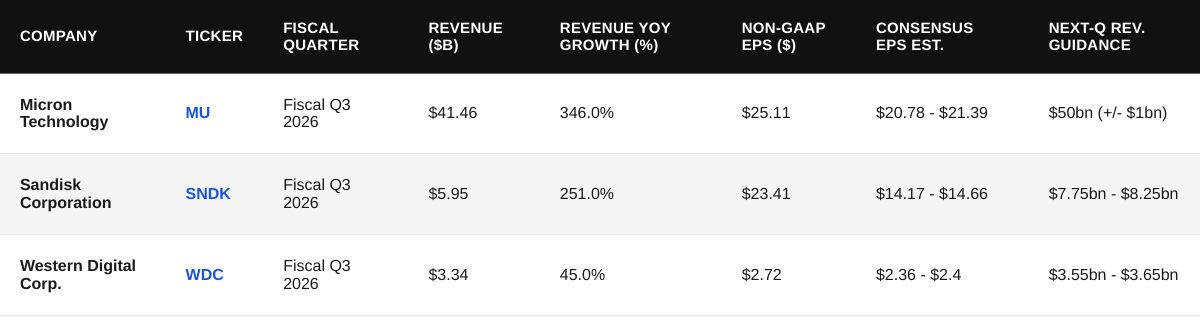
Strip out the price action and the memory complex has just posted some of the cleanest quarters in tech. Micron's most recent quarter grew revenue at a triple-digit clip year on year, beat consensus EPS comfortably, and guided the next quarter higher again, with management explicitly framing the current tightness in DRAM and NAND as a multi-year, not multi-quarter, phenomenon. SanDisk and Western Digital both reported similarly strong prints. None of the three has walked back guidance.
HBM is the sharpest version of this story. Micron has said its HBM output is essentially sold out into 2027, with roughly $100bn of locked-in future revenue against that backlog. SK Hynix, which reports this morning, has built a commanding share of the HBM market on the back of its early lead with Nvidia's accelerator platforms. If there is a genuine swing factor for the group, it isn't demand, it's HBM4 pricing, the next-generation standard now ramping, and whether the current premium economics hold as more supply comes online.
Valuation tells the same story from a different angle. Even after this year's run, Micron trades on a forward earnings multiple below the broad market - a stock growing revenue at triple-digit rates priced like a cyclical trough, not a cyclical peak. That gap between growth and multiple is unusual, and it is the clearest sign that this is a positioning and sentiment story, not a fundamental one.
Memory Complex – Latest Quarter Snapshot
Why the heart walked out anyway
A few things came together at once, and none of them individually explain the scale of the drawdown.
- Positioning unwind - after gains of this size in this short a window, some amount of profit-taking and risk-rebalancing was inevitable. The bigger the run, the harder the snapback when sentiment turns.
- A new competitive scare - a large Chinese DRAM entrant (CXMT) moving toward a multi-billion-dollar listing has revived the market's oldest memory-sector fear - oversupply - well before there's any evidence it changes near-term HBM or DRAM pricing power.
- A split sell-side view - Morningstar's director of research, Lorraine Tan, warned on Bloomberg TV that AI-linked names, memory chief among them, could give back 20-30% before becoming buyable again, pointing to fresh Samsung/SK Hynix supply and HBM4 pricing as the swing factor. Bank of America, in the same window, raised its SanDisk price target to $2,500 (Buy); and Morgan Stanley's Joseph Moore went further, calling the pullback a "compelling entry point" and arguing the selloff was driven by soft PC/smartphone demand signals bleeding into sentiment, not any break in AI/HBM demand. Same stocks, same week, opposite conclusions.
- Event risk clustering - SK Hynix's print and the next round of hyper-scaler capex commentary land in quick succession, and the market has chosen to de-risk ahead of the news rather than trade through it.
None of this is a demand story breaking. It's a crowded, high-multiple trade meeting a wall of nervous hands right as a handful of uncertain catalysts line up together. That combination produces exactly this kind of overshoot.
Micron Implied Vol

The trade: selling the fear, not fighting it
If the view is that the story is intact and the stocks have overcorrected, there are two ways to express it. Buying the dip outright says you know today is close to the bottom. Selling volatility says something more honest - you don't know exactly where the bottom is, but you're happy to own more at a lower price than today's - and you'd like to get paid while that price finds you.
What that looks like in practice
- Cash-secured or margin-backed put-selling at strikes meaningfully below current levels (or closer ATM for more aggressive, bullish views) - levels you'd genuinely want to add at, collecting premium that is currently rich precisely because implied vol has spiked.
- Put spreads for a defined-risk version of the same view, sacrificing some premium for a capped downside if the drawdown extends.
- For existing holders, covered calls or call spreads above the market to monetise the elevated premium on the way back up, without giving up the core position.
The common thread: every one of these structures uses the market's fear, expressed as elevated implied volatility, as the source of return, rather than treating it purely as a risk to be hedged away. The heart panicked. The head is selling it insurance.


.png)

.png)

.png)