


Structure, succession, and the capital decisions that define the generation after
Concentration built the wealth of Southeast Asia. One founder, one industry, one bet placed on a country's growth trajectory and held for decades. For the families who made that bet, the business was never just income — it was an identity. That era is ending.
Across Malaysia and the wider Southeast Asian region, second- and third-generation heirs are asking different questions about diversification, international exposure, and what it means to manage capital rather than run a company.
At Lighthouse Canton's latest IDEAS event in Kuala Lumpur — Family Wealth Excellence: Structure, Succession & Strategy — high net worth family principals and advisors came together to work through exactly that shift.
"Wealth creation and wealth transfer are two very different things," said Kei Ooi, Senior Director at Alvarez & Marsal's tax practice in Malaysia. "Building a successful business creates the wealth; transferring it across generations requires intentional stewardship, and that means planning on governance, structure, and taxes."
The moment that forces the conversation is usually a liquidity event — a business sale, a dividend extraction after years of accumulated profits, or a strategic investor arriving to recapitalise the core entity. Suddenly, what was wealth in theory becomes capital in practice, and the question of what to do with it falls squarely on the next generation.
"Families coming to us after a liquidity event are often sitting on concentrated, illiquid wealth for the first time in a form they can actually deploy," said Audrey Tang, Managing Director, Chief Operating Officer, at Lighthouse Canton. "The immediate instinct is to replicate what worked — to back sectors they know, to stay close to home. Our job is to help them see that the purpose of this capital is different now. Preservation and growth across cycles requires genuine diversification."
With traditional diversifiers under pressure, that diversification increasingly means going beyond the conventional. Alternative investments, offering uncorrelated return streams and downside resilience that public markets alone cannot provide, are playing a growing role in how serious family wealth management is constructed.
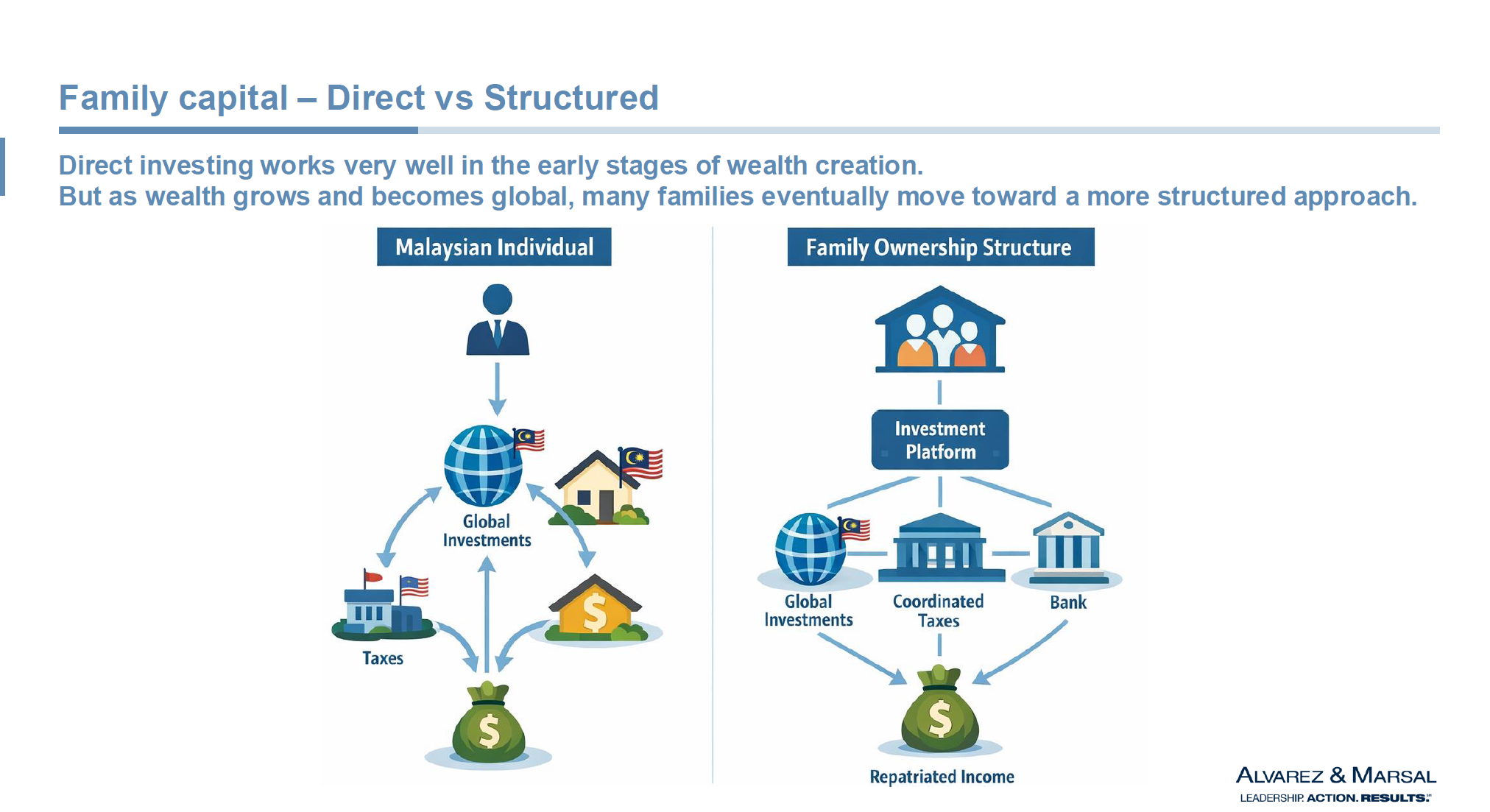
From direct investing to structured platforms
For most Southeast Asian family businesses, the early model was straightforward: a broker account, a handful of positions, decisions made fast and alone. It worked — until the portfolio grew large enough to outrun it.
Fragmented holdings across multiple banks and geographies, no succession continuity if the founder steps back, and no framework for the next generation to step in — these are the failure points Ooi and her colleagues at Alvarez & Marsal see repeatedly.
The answer is structure, though Ooi is careful to distinguish purpose from mechanics. Trusts remain the most common entry point in Malaysia's Commonwealth legal framework, allowing a trustee to hold and manage assets according to family-defined terms. Private foundations in the region are gaining traction among families who want to embed charitable or educational mandates and go further. And for the largest family balance sheets, a single family office framework — a dedicated entity that centralises capital allocation, coordinates across borders, and separates ownership from day-to-day investment management — is increasingly the structure of choice.
Louisa Yeo, Managing Director, Alvarez & Marsal Tax, from the firm's Singapore office, was present throughout the event to discuss family office structuring options in more detail. She walked attendees through two jurisdictions that have emerged as leading choices for centralising a family office.
A question that surfaced repeatedly from attendees was why a Malaysian family might look to Singapore for their structure, or vice versa. Yeo noted that the choice is rarely binary. For some families, the answer is both.
"The structures in each jurisdiction serve distinct purposes within a broader family office architecture," Yeo explained.
"The real value also comes from the governance framework that needs to be set up," Ooi said. "Many mature families introduce mechanisms such as a family council, which provides a forum for family members to communicate towards long-term goals, and an investment committee, which helps organise and oversee investment decisions."
Lighthouse Canton's Tang sees both sides of that equation.
"Governance and portfolio strategy have to be designed together," she said. "A family that has not decided who makes investment decisions or how those decisions get made is not ready to deploy capital into alternatives or illiquid structures, no matter how attractive the opportunity."
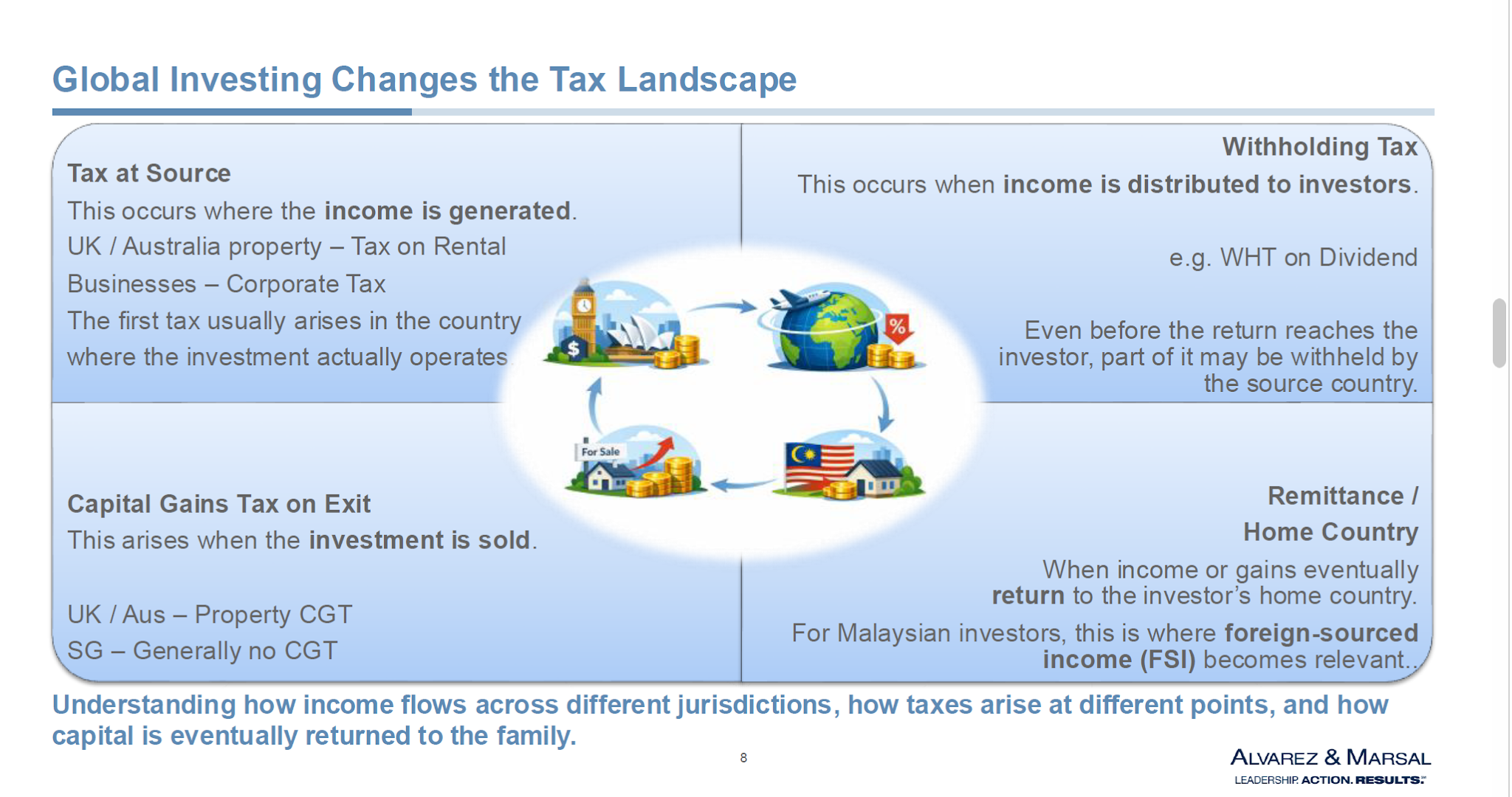
The cost of not planning
The Samsung case has become something of a reference point across the region, and for good reason. When Samsung chairman Lee Kun Hee passed away in 2020, his estate — worth approximately USD 23 billion — triggered the largest single inheritance tax bill in modern history, estimated at around USD 10 billion under South Korea's 50% top rate. To meet the obligation, the family sold luxury real estate, divested Samsung shares, and pledged holdings as collateral. Six years on, payments are still being made under a government instalment plan.
"What the situation illustrates is three simple lessons to note: succession can be a tax event, liquidity planning matters, and cross-border assets create additional complexity," Ooi said.
Malaysia has no inheritance tax, but stamp duty, capital gains tax, real property gains tax, and the newly introduced dividend surcharge above RM100,000 mean that poorly structured ownership and cross-border tax exposure can still generate serious, unexpected obligations.
The broader data is sobering. A study by the LIMS Group found that 60% of intergenerational wealth transfer failures stem from breakdowns in family communication and trust, 25% from inadequate preparation of the next generation, and only 15% from tax and legal complications.
"The issue is rarely financial," Ooi said. "It is relational. Family members have different expectations, different visions."
For Tang, helping families resolve that tension is where advisory work really begins, and where structure and strategy have to work together.
"The right structures create the conditions for good decisions," she said. "But they only hold if the family has done the harder work alongside — agreeing on purpose, on values, on what this wealth is actually for. Once there is clarity on both, the investment strategy follows naturally. Without it, even the most carefully designed structure can become a source of conflict rather than continuity."


.png)


%20(16).png)