Structure, succession, and the capital decisions that define the generation after
Concentration built the wealth of Southeast Asia. One founder, one industry, one bet placed on a country's growth trajectory and held for decades. For the families who made that bet, the business was never just income. It was an identity, but that era is ending.
Across Malaysia and the wider Southeast region, second- and third-generation heirs are asking different questions about diversification, international exposure, and what it means to manage capital rather than run a company.
At Lighthouse Canton's latest IDEAS event in Kuala Lumpur, Malaysia, Family Wealth Excellence: Structure, Succession & Strategy, high net worth family principals and advisors came together to work through exactly that shift.
"Wealth creation and wealth transfer are two very different things," said Kei Ooi, Senior Director at Alvarez & Marsal's Tax practice in Malaysia. "Building a successful business creates the wealth; transferring it across generations requires intentional stewardship, and that means planning on governance, structure, and taxes."
The moment that forces the conversation is usually a liquidity event, a business sale, a dividend extraction after years of accumulated profits, or a strategic investor arriving to recapitalise the core entity. Suddenly, what was wealth in theory becomes capital in practice. And the question of what to do with it falls squarely on the next generation.
Also read: Asia's wealth transition is structural, and that's where the real opportunity lies
"Families coming to us after a liquidity event are often sitting on concentrated, illiquid wealth for the first time in a form they can actually deploy," said Angela Saik, Managing Director at Lighthouse Canton.
"The immediate instinct is to replicate what worked and back the sectors they know, to stay close to home. Our job is to help them see that the purpose of this capital is different now. Preservation and growth across cycles requires genuine diversification."
With traditional diversifiers under pressure, that diversification increasingly means going beyond the conventional. Alternative investments, offering uncorrelated return streams and downside resilience that public markets alone cannot provide, are playing a growing role in how serious family wealth management is constructed.
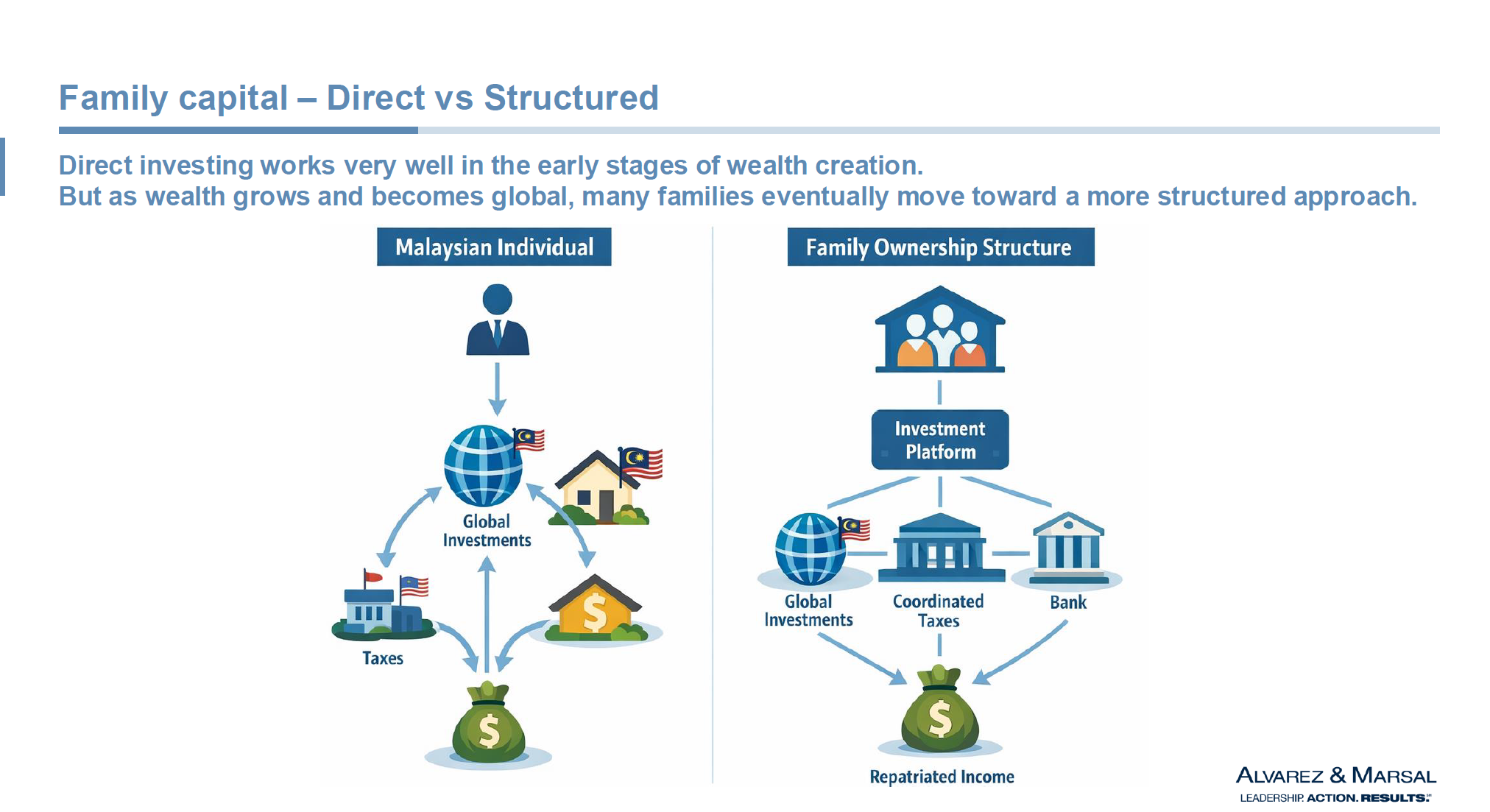
From direct investing to structured platforms
For many Southeast Asian family businesses, the early investment model is relatively simple.
The founder builds the business, accumulates surplus cash, opens a brokerage or private banking account, and personally makes the investment decisions. That approach works well while the portfolio is still relatively small.
As wealth grows, however, the limitations become more apparent.
Investments become scattered across multiple banks, brokers and jurisdictions. There is often no central oversight of the family's assets, succession planning becomes more complicated, and investment decisions remain heavily dependent on a single individual.
This is usually the point where families begin thinking about a more structured approach.
"The objective isn't simply to create another legal entity," Ooi explained. "It's to create a framework that supports how the family wants to own, manage and preserve its wealth over the long term."
Three structures commonly used by Malaysian families:
- Trusts — the most common structure, allowing assets to be held by a trustee and managed according to the family's wishes as set out in a trust deed.
- Labuan foundations — a legal entity that holds family assets, useful where families prefer a foundation model over a trust.
- Single family offices — for larger family balance sheets, centralising capital allocation, coordinating relationships with banks and investment managers, and separating ownership from day-to-day investment management.
Alvarez & Marsal’s Singapore office members were present throughout the event to discuss family office structuring options available to wealth holders in more detail.
Two jurisdictions have emerged as leading choices for family office structuring:
- Malaysia's Labuan International Business and Financial Centre (Labuan IBFC) — offers a legal and regulatory framework for international holding companies, trusts, foundations and fund structures. Depending on the structure used and the applicable tax regime, certain tax concessions may be available.
- Singapore's Variable Capital Company (VCC), introduced in 2020 — a flexible investment fund vehicle that allows multiple sub-funds to be housed within a single legal entity while maintaining ring-fencing between each sub-fund, making it attractive for investment managers and some family office structures managing diversified portfolios.
-
The appropriate structure will depend on the family's objectives, the location of its investments and where it wishes to establish its investment platform. Regardless of the jurisdiction, the objective remains the same — to centralise capital allocation, coordinate cross-border investments and separate ownership from day-to-day investment management.
"The real value comes from the governance framework that needs to be set up," Ooi said.
"Many mature families introduce mechanisms such as a family council, which provides a forum for family members to communicate towards long-term goals, and an investment committee, which helps organise and oversee investment decisions."
Lighthouse Canton’s Saik sees both sides of that equation.
"Governance and portfolio strategy have to be designed together," she said. "A family that has not decided who makes investment decisions or how those decisions get made is not ready to deploy capital into alternatives or illiquid structures, no matter how attractive the opportunity."
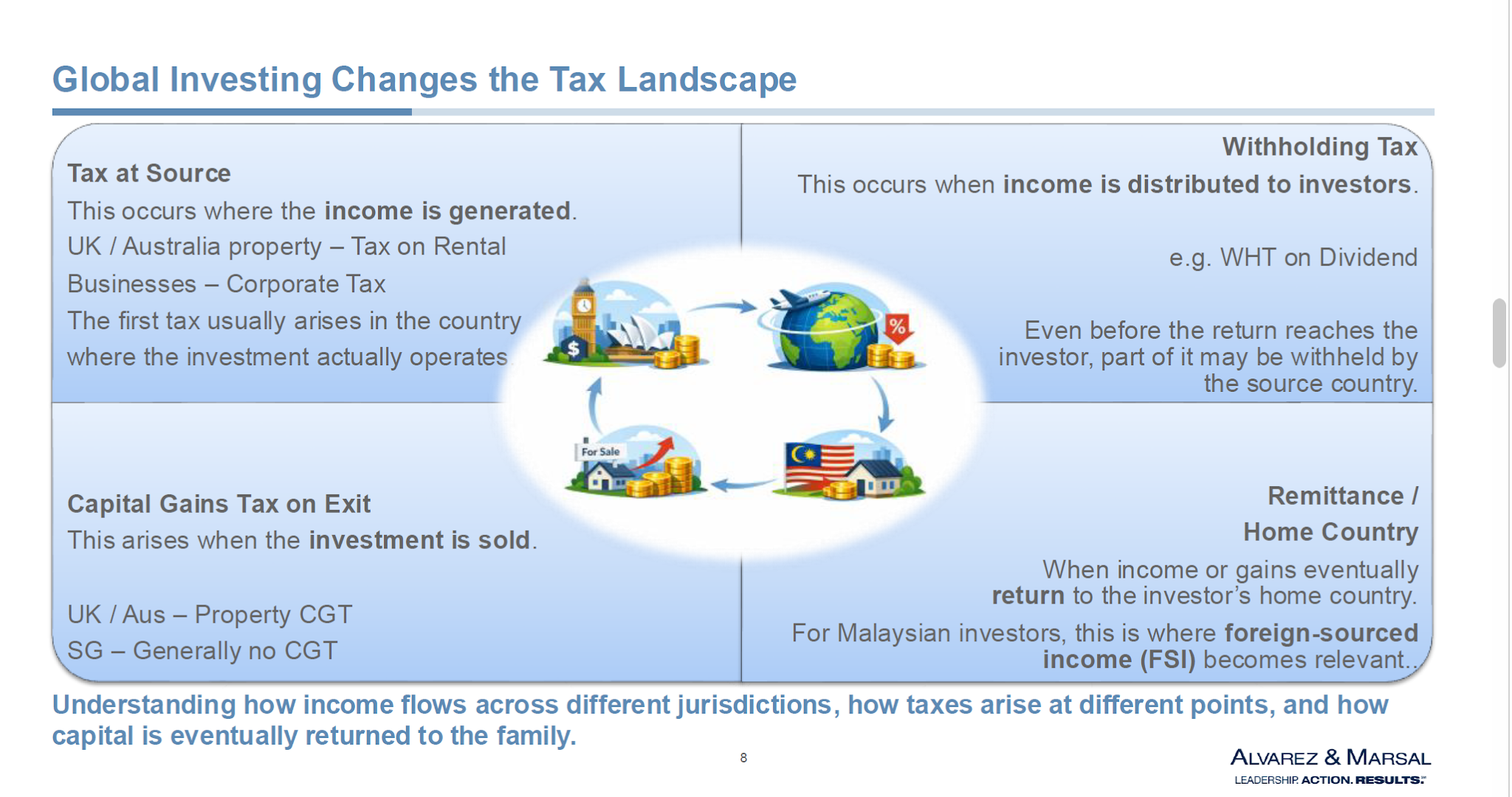
The cost of not planning
The Samsung case has become something of a reference point across the region and for good reason.
When Samsung chairman Lee Kun Hee passed away in 2020, his estate, worth approximately USD 23 billion, triggered the largest single inheritance tax bill in modern history, estimated at around USD 10 billion under South Korea's 50% top rate. To meet the obligation, the family sold luxury real estate, divested Samsung shares and pledged holdings as collateral. Six years on, payments are still being made under a government installment plan.
"What the situation illustrates is three simple lessons to note: succession can be a tax event, liquidity planning matters, and cross-border assets create additional complexity " Ooi said.
Malaysia has no inheritance tax but stamp duty, capital gains tax, real property gains tax, and the newly introduced dividend surcharge above RM100,000 mean that poorly structured ownership and cross-border tax exposure can still generate serious, unexpected obligations.
The broader data is sobering.
A study by the LIMS Group found that 60% of intergenerational wealth transfer failures stem from breakdowns in family communication and trust, 25% from inadequate preparation of the next generation, and only 15% from tax and legal complications.
"The issue is rarely financial," Ooi said. "It is relational. Family members have different expectations, different visions. “Wealth creation and wealth transfer are two very different challenges. Building a successful business creates wealth. But transferring that wealth across generations often requires intentional stewardship — advance planning around governance, structure, and tax. Because ultimately, the goal for many families is not just to create wealth, but to ensure it can be sustained across generations.”
For Saik, helping families resolve that tension is where advisory work really begins, and where structure and strategy have to work together.
"The right structures create the conditions for good decisions," she said. "But they only hold if the family has done the harder work alongside — agreeing on purpose, on values, on what this wealth is actually for. Once there is clarity on both, the investment strategy follows naturally. Without it, even the most carefully designed structure can become a source of conflict rather than continuity."
Kei Ooi is Senior Director, Tax, at Alvarez & Marsal Malaysia. Angela Saik is Managing Director at Lighthouse Canton.
Frequently Asked questions
FAQ: Family Wealth Structuring & Succession in Southeast Asia
Q!: What triggers the need for family wealth structuring?
Typically a liquidity event — a business sale, a large dividend extraction, or a strategic investor recapitalising the core business. This converts theoretical wealth into deployable capital, forcing decisions about diversification and governance that weren’t previously necessary.
Q2: What structures do Malaysian families commonly use to hold wealth?
The three most common are trusts (assets held by a trustee per a trust deed), Labuan foundations (a legal entity model preferred by some families over trusts), and single family offices (which centralise capital allocation and separate ownership from day-to-day investment management).
Q3: What is Labuan IBFC?
Labuan International Business and Financial Centre is Malaysia’s offshore financial hub, offering a legal and regulatory framework for international holding companies, trusts, foundations and fund structures, with potential tax concessions depending on the structure used.
Q4: What is a Singapore VCC?
A Variable Capital Company is a flexible investment fund vehicle introduced in Singapore in 2020. It allows multiple sub-funds to sit within a single legal entity while keeping each sub-fund ring-fenced, making it popular with investment managers and family offices running diversified portfolios.
Q5: Does Malaysia have an inheritance tax?
No. Malaysia has no inheritance tax, but stamp duty, capital gains tax, real property gains tax, and a dividend surcharge above RM100,000 mean poorly structured ownership can still trigger significant unexpected costs.


.png)