


Since mid-2022, wheat is down 38%, corn is down 23%, soybeans are roughly flat, while the DBA basket itself is up 34% - an unusual outcome for a war between the world's two largest wheat exporters (Russia and Ukraine). Wheat fell not because the war resolved supply risk, but because Russia's own harvests overwhelmed it. That offset is now breaking down at the same time the US has its smallest crop since 1970.
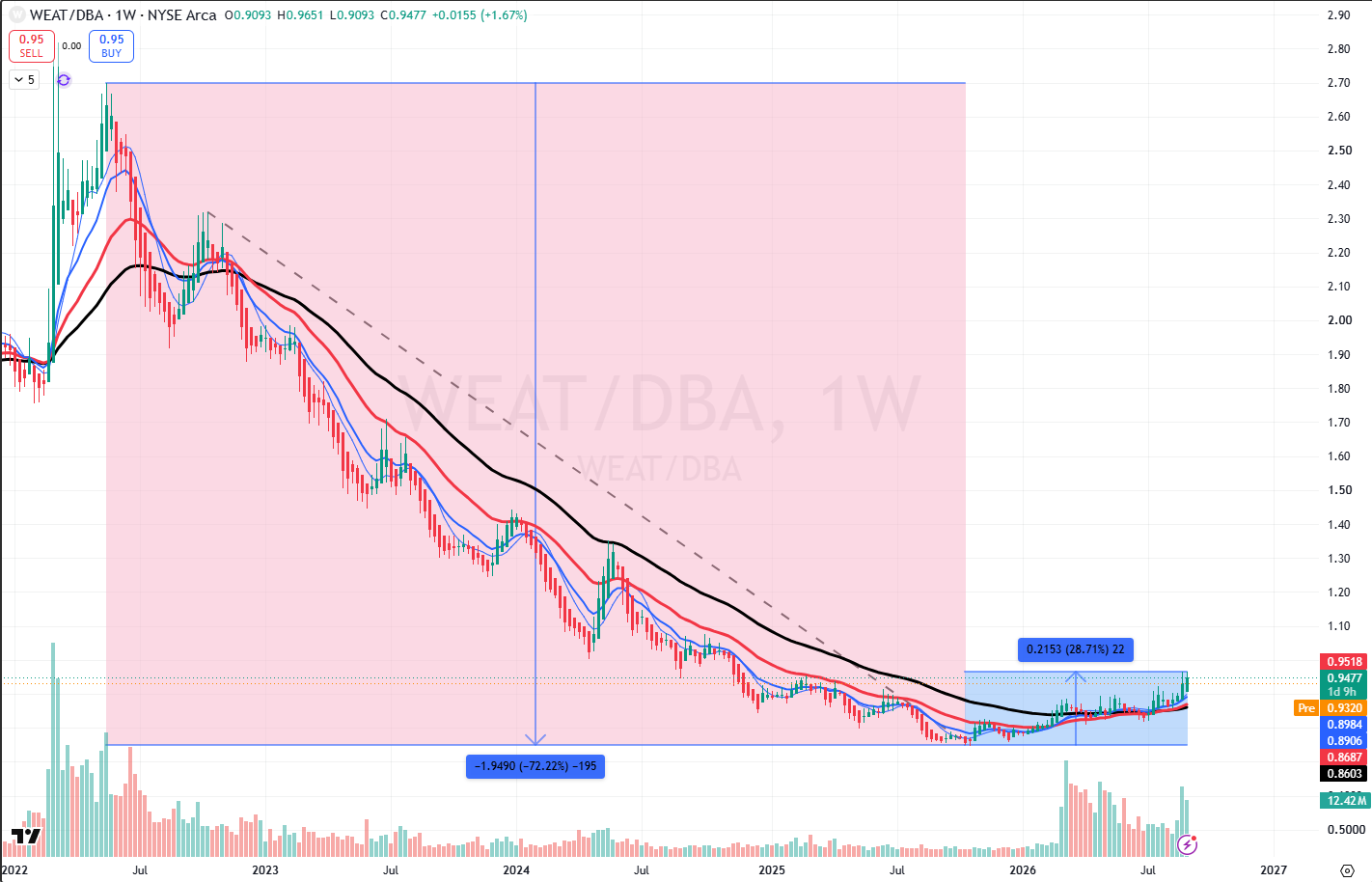
Wheat has risen c40% off its lows a year ago, outperforming DBA over that stretch by 28.7% points, on the WEAT/DBA ratio. In the context of 72% point peak-to-trough under-performance since 2022, that recovery is still small. Both DBA (broad agri-commodity exposure) and WEAT (the wheat ETF) look like attractive tactical opportunities, with more outperformance potential concentrated in WEAT specifically.
- Tactical / high-conviction: long wheat (futures, WEAT, or a wheat-corn spread). A re-pricing-of-risk trade with September 11 WASDE as the near-term catalyst.
- Strategic / portfolio-level: DBA as a diversified agri-commodity allocation. The return driver isn't "wheat will rally," it's "the basket has already proven it doesn't need wheat or corn to work, and now the two most beaten-down legs are showing early signs of turning.
The Rise (& fall) of Wheat
With two of the world's biggest wheat producers at war, the intuitive expectation was higher prices - and they did rise initially, roughly 68%, as the invasion began in February 2022. So why did prices then collapse?
- Russia's harvests, not the war, set the price. After the initial shock, Russia posted back-to-back record crops - production estimated at 91-93 million tonnes against a five-year average closer to 80 million, becoming the dominant low-cost supplier. Russian and Ukrainian wheat production is up 55% over the last decade, and by 2023/24 Russian exports were forecast at 50 million tonnes, the highest on record. Excess supply meant lower prices, war or no war..
- Both combatants needed hard currency more than they needed a high price. Reporting at the time described Russia and Ukraine effectively competing on price to keep dollars flowing rather than defending margins - both were believed to be selling wheat below the cost of production to fund the war effort.
- Ukraine routed around the blockade. Even after the Black Sea Grain Initiative lapsed in July 2023, Ukraine kept shipping via alternative routes, exporting over three million tonnes of grain and legumes in the opening weeks of the 2024/25 season, versus under two million tonnes a year earlier. The market had clearly over-priced the initial disruption.
- Wheat is a genuinely global, fungible, year-round crop. Unlike a single-hemisphere commodity, wheat is planted and harvested somewhere on the planet every month of the year, so a regional shock can be substituted around in a way oil or gas cannot. Combined with China holding nearly half of world ending stocks as a buffer (historically 44% average), the market never faced a true scarcity signal, only a redistribution of who was supplying it.
The market spent three years pricing geopolitical risk in wheat down to essentially zero. A risk premium that's been fully unwound, has far more room to reprice on the next shock than one the market is already braced for.
Why it's rallying now, and the outlook
The mechanism that suppressed prices for three years is the one now breaking:
- The offset has flipped. Russia's surplus used to cover everyone else's shortfalls. Now Black Sea port and vessel attacks have re-escalated (recent wheat prints near $7.65/bu, the highest since early 2023, with both Russian and Ukrainian export volumes down double digits year-over-year), and at the same time the US posted its smallest wheat crop since 1970/71. European yields fell in France, Poland, Hungary and the UK. Multiple exporters are impaired simultaneously, a condition that didn't exist in the early years of the conflict when Russian abundance plugged every gap.
- Cross-commodity support from feed substitution (tight corn pushing EU feed users toward wheat) is adding demand-side pull on top of the supply story.
Outlook: near-term bullish and volatile; medium-term balanced; long-term not yet a super-cycle. Global stocks, even ex-China, remain large enough that this reads as a sharp, reversible repricing of risk rather than a structural shortage, unless Black Sea disruption persists into the next planting cycle. The September 11 WASDE is the next hard data checkpoint.
The case for owning DBA
DBA, Invesco Agri Fund, holds corn, soybeans, soybean meal, soybean oil, wheat, KC wheat, sugar, cocoa, coffee, cotton, live cattle, feeder cattle, and lean hogs - a genuinely diversified real-asset sleeve, not a grain proxy. It generally weights its sub-sectors to keep a balanced exposure between grains (approx. 37-38%) , softs (approx. 25%), and livestock (approx. 20%).
The basket has been carried by non-grain commodities - DBA's +34% run since mid-2022 happened while its two largest calorie crops were falling 23–38%. The gains came from cocoa, coffee, sugar, and livestock. Coffee and cocoa both hit multi-year or record highs on West African and Brazilian weather disruption, and cattle has run to the smallest US herd since the 1950s, with feeder and slaughter steer prices setting all-time records through April and May 2026.
Why that matters for timing, not just diversification - these are now three separate commodity cycles at three different stages:
- Grains (wheat, corn): washed out, multi-year lows, just turning
- Livestock: 2026 is being flagged as the peak of the current cattle cycle, with prices expected to decline through 2031 as herds rebuild
- Softs (cocoa, coffee): already had their explosive re-rating
That's a genuine barbell - DBA gives you exposure to the grain leg re-rating higher from depressed levels, without needing the softs/livestock legs to keep running - they may well plateau or give back gains, a headwind, but a diversified one, not a single-crop bet.
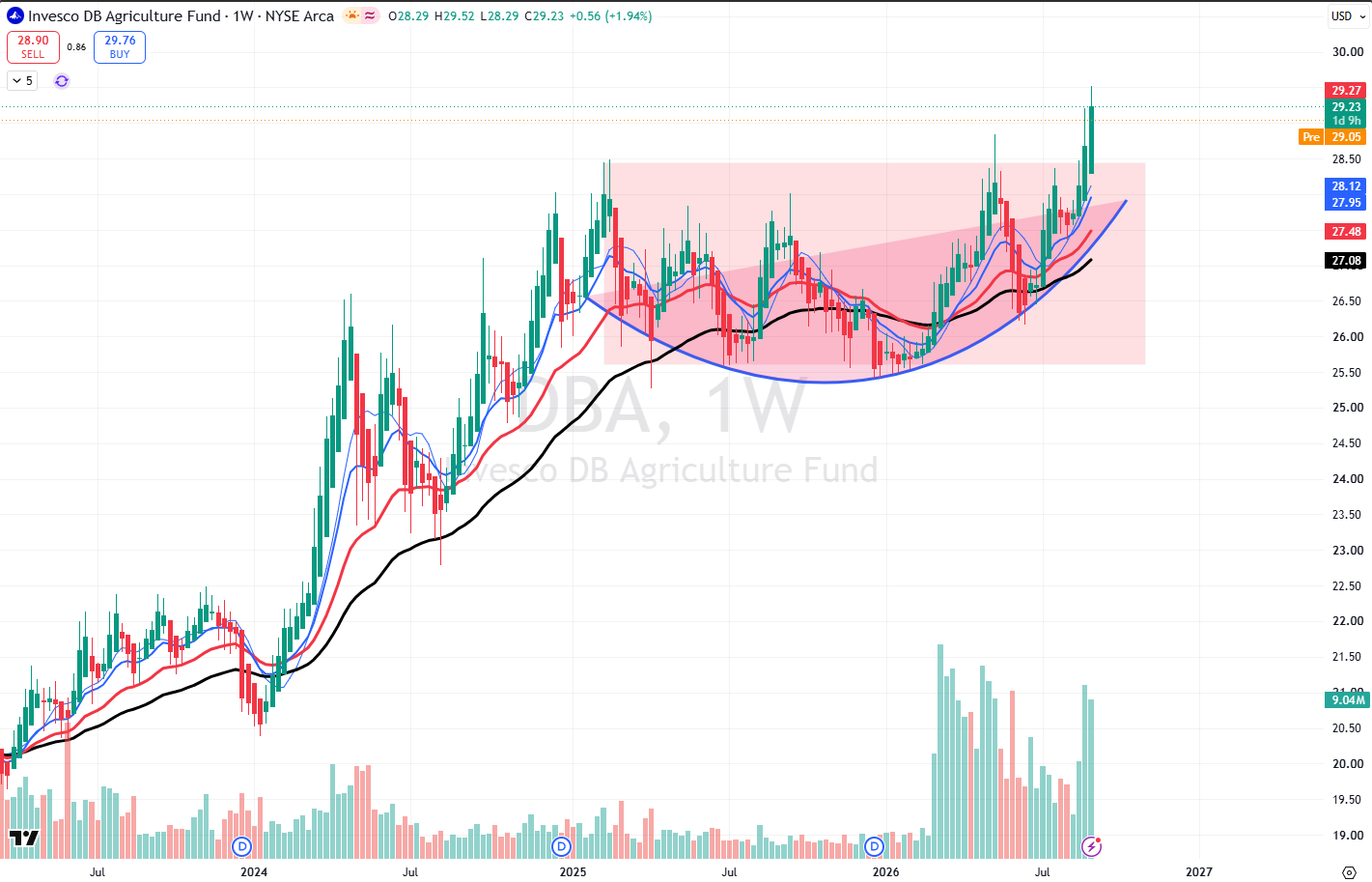
The technical setup adds confidence. DBA has broken out of a roughly six-month, c10% consolidation range to a fresh high, the first clean breakout in the pattern since the base began forming late in 2025. Combined with the fundamental barbell above, this is a reasonable point to add rather than chase.
A concentrated wheat position (or a wheat/corn spread) remains the more efficient way to express the grain view specifically. DBA is the way to express a portfolio-level view that agri commodities broadly remain a scarce, under-owned real-asset exposure after three years of being ignored.
Grains (particularly Wheat) Have Underperformed Agri-Commodities - Now Turning
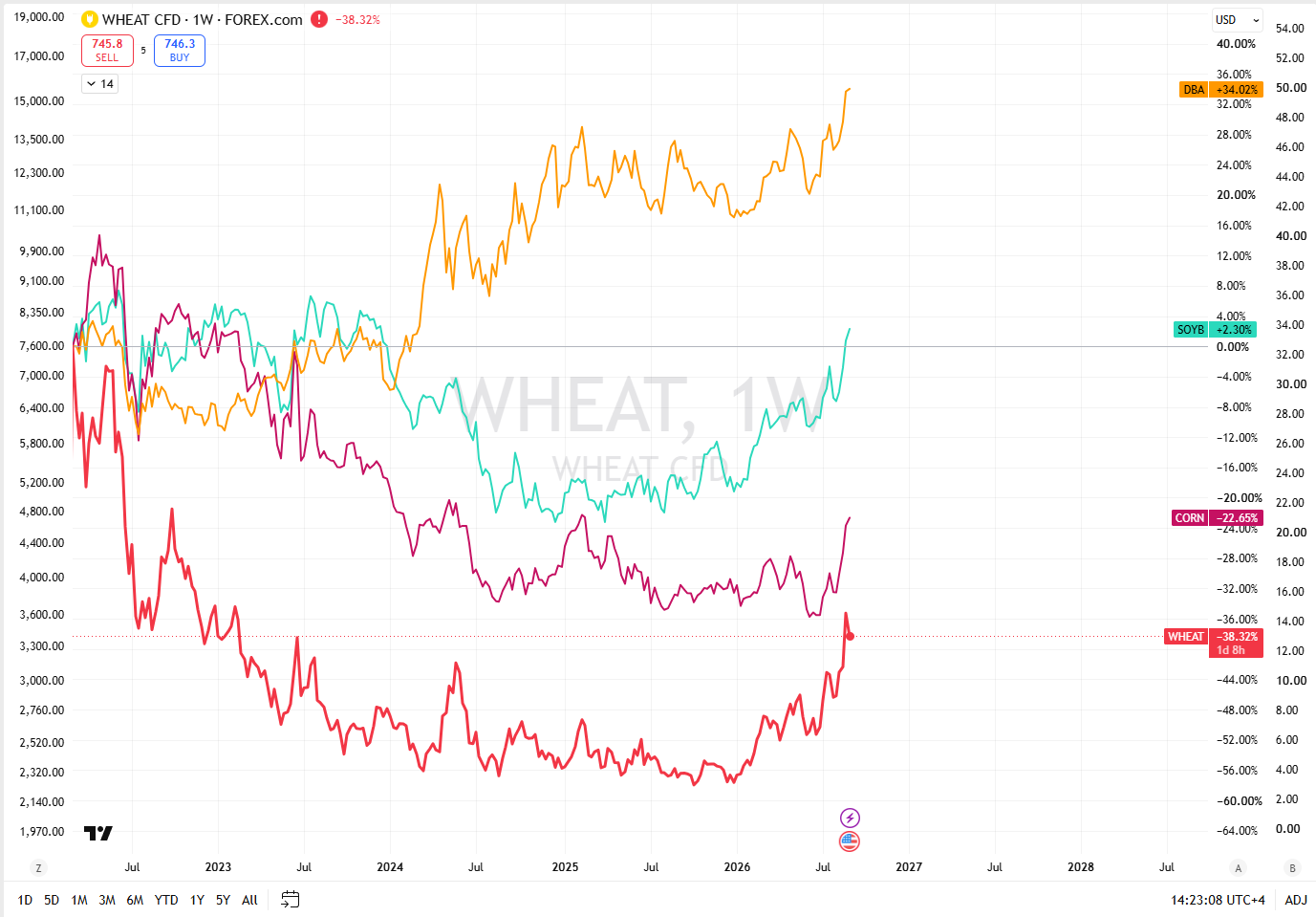
Wheat - Bracing for a Turnaround
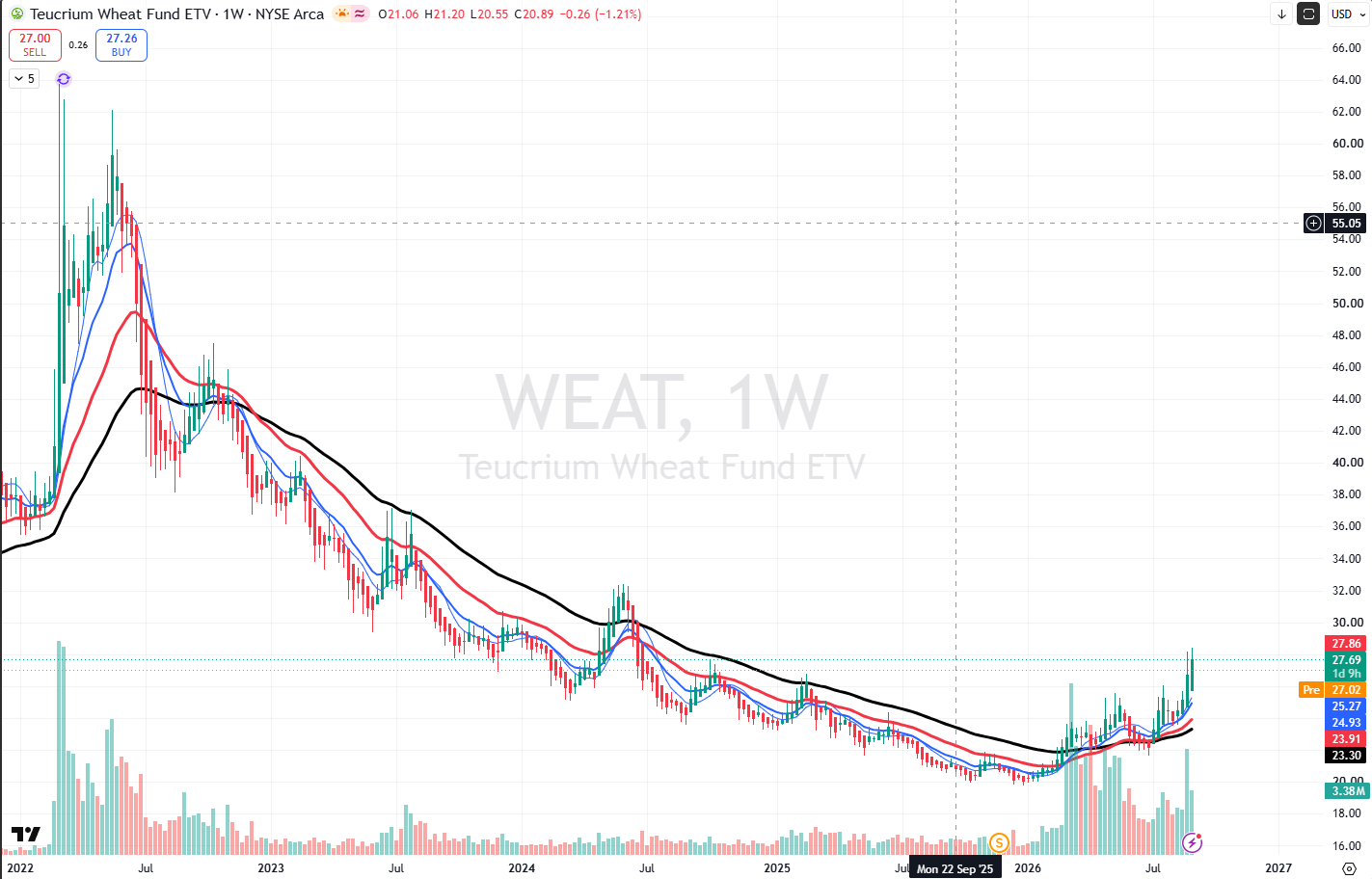
Wheat Has Underperformed DBA
DBA - Stellar Performer - Now Breaking Out Again





.png)